Photo Outfits
School Picture Day Outfits
One minute in front of the camera, decades on the wall — the solid colors, collar checks and morning-of habits that make the portrait a keeper.
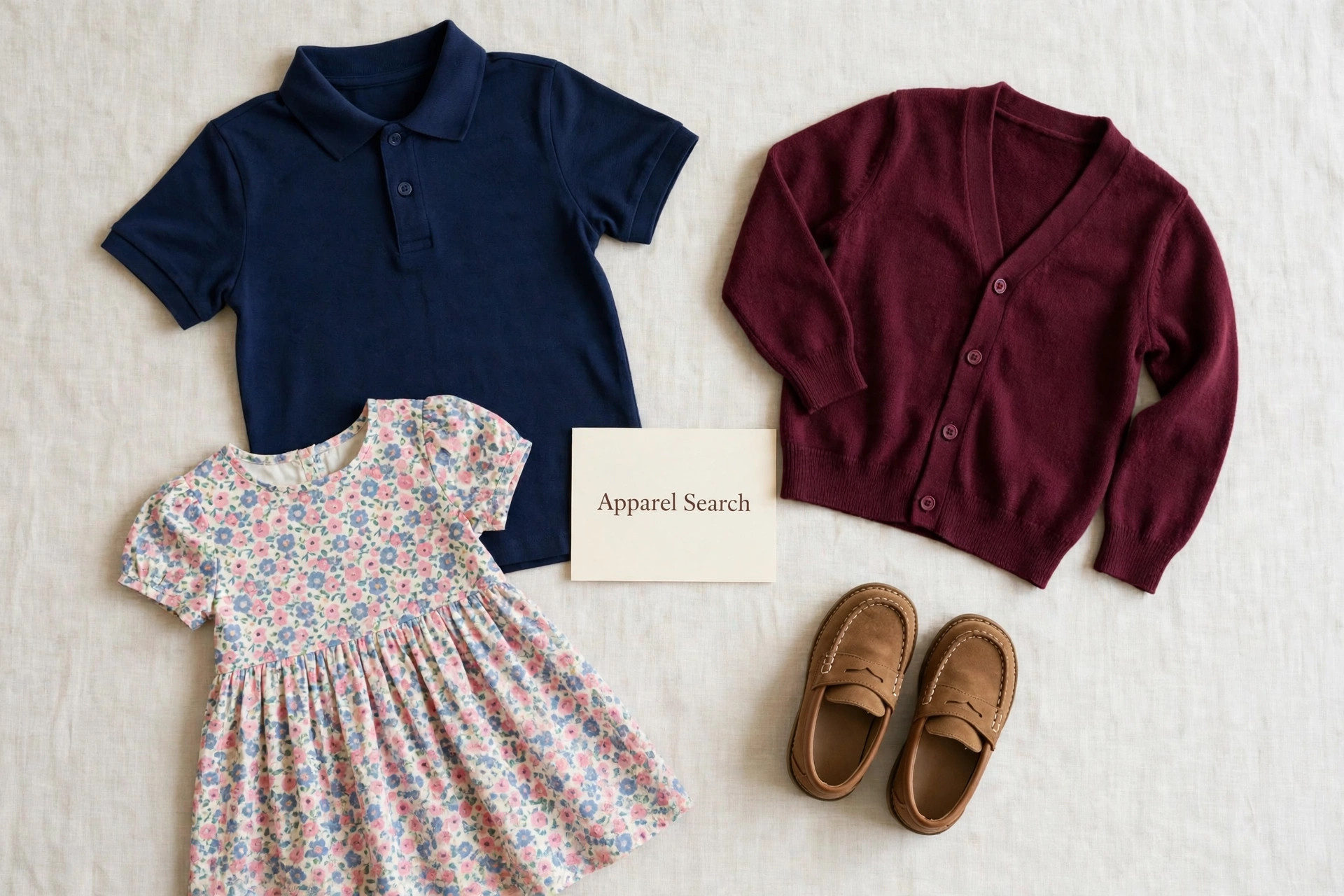
School picture day produces the most durable photograph of the school year: a head-and-shoulders portrait, taken in about a minute, against a plain backdrop, that ends up in the yearbook, on the family wall and in grandparents’ frames for decades. The clothing rules for it are not fashion rules at all — they are camera rules, and school photographers give out the same short list every year: solid colors, mid-tones, nothing that shimmers, stripes or shouts. This guide collects that standard advice in one place, adds the practical part (the outfit also has to survive a full school day), and covers the uniform-school version. It is the youngest stop on the portrait calendar; the older stops are our senior picture outfits guide and the family photo outfits guide, and the camera logic is the same at every age.
01 / Color
Colors That Photograph Well
A school portrait is a face with a frame of clothing beneath it, usually shot against a blue, grey or mottled studio backdrop. The colors that serve that picture best are solid mid-tones: navy, burgundy, deep teal, forest green, plum, dusty blue, warm rust. They hold their depth under flash, they flatter a wide range of skin tones, and they do not compete with the face for the eye’s attention. Rich jewel tones sit in the same reliable family and read slightly dressier in the finished print.
Three color cautions, all from photographers rather than stylists. Pure white close to the face can blow out under flash and reflect light upward, washing out a chin and neck; off-white and cream behave far better. Black right at the neckline can swallow the bottom of the portrait into a dark block, losing the line between clothing and backdrop on darker backdrops. Neon and fluorescent colors do something worse: they cast their color back onto skin, tinting a jawline green or pink in a way no retouch fully fixes. A neon accent that never reaches the crop — shoes, say — is harmless; neon at the collar is the one to swap.
02 / Pattern
Patterns, Logos and Words
Fine patterns are the classic picture-day trap. Very thin stripes, tiny checks and tight herringbones can produce a shimmering rainbow ripple on camera called a moiré pattern — the sensor reads the pattern at a frequency it cannot reproduce cleanly, and the garment seems to vibrate in the finished image. Photographers’ standard advice is simply to avoid fine, high-contrast pattern anywhere in the chest-up zone. Bold, widely spaced patterns — a broad plaid, a floral with real space in it — photograph without the effect, though they date a portrait faster than solids do.
Large logos and chest graphics fail differently: the portrait crops at mid-chest, so a big logo or slogan is sliced in half, leaving partial letters that read as a mistake rather than a statement. Small emblems at the chest edge usually crop out or read cleanly; center-chest artwork is the risk. The same crop is why picture day is a poor stage for anything the school dress code already frowns at — the portrait is the one outfit of the year the school itself archives, and a retake spent on a dress-code dispute is a retake wasted.
03 / Neckline
Necklines, Collars and Layers
In a head-and-shoulders crop, the neckline is half the garment. The necklines that photograph best are the ones that frame rather than fight: a polo or button-down collar lying flat and even, a crew or scoop neck that sits symmetrically, a cardigan or blazer over a plain top creating a clean V. Before the day, check the chosen collar the way a photographer will see it — both sides lying the same way, no curl, no twist, top button decided (fastened for formal, open for relaxed, but decided rather than accidental).
A layer earns its place for one practical reason as well: two looks in one. The cardigan goes on for the portrait and off for the playground, and a button-down over a plain tee lets a child choose the more formal or more casual version in the thirty seconds before the camera. Keep jewelry to one simple piece if any — a small pendant or studs read as polish; long necklaces leave the frame or swing sideways in a tight crop. The last neckline decision is hair: worn down, it usually falls over the collar and shoulders, which is fine and natural; just make the choice at home rather than leaving the collar half-buried by accident.
04 / Fit
Fit, Comfort and Surviving the Day
The portrait takes a minute; the school day around it takes six hours, and the outfit has to do both. Fit for the child who exists now, not the size bought to grow into — oversized shoulders slump in a portrait and read as borrowed clothing. Comfort is a photographic feature, not a concession: a child tugging at an itchy collar or stiff new shoes carries the expression that goes with it into the frame. If a new outfit is bought for the day, have it worn once beforehand, washed once, and confirmed tug-free.
Two working tricks from the photographer’s playbook. First, mid-tones forgive the school day: the same colors that photograph best also hide a lunch spot or art-class smudge far better than white or pastels, and a spare plain top in the backpack covers the genuine disaster. Second, some families send the portrait top in the bag to be changed into just before the photo and changed out of after — a fair strategy for the very young or the very stain-prone, and schools running class-by-class photo schedules usually allow it. And keep the stakes where they belong: nearly every school schedules a retake day, which converts picture day from a performance into a first attempt.
05 / Preparation
The Morning Of
Lay it out the night before
Top, layer, bottoms and shoes in one place, tried on once as a complete outfit. Night-before discovery of a missing button or a growth-spurt shortage is an errand; morning-of discovery is a crisis.
The collar check
Thirty seconds in the mirror: collar flat and even, neckline sitting straight, layer fastened the way it will be photographed. This is the single highest-value check on the list, because the crop makes the collar a headline.
Lint, hair and a quick press
A lint roller over shoulders and chest — pet hair photographs enthusiastically — and a pass with an iron or steamer if the fabric wrinkles. Mid-tone solids show lint more than patterns do, which is the trade for photographing better.
Pack the backup
A spare plain mid-tone top in the bag, against the juice box incident. It costs nothing and converts the day’s one real risk into a non-event.
Fed, unhurried, reminded once
Breakfast eaten, no rushing, and one sentence of instruction is plenty: sit up, look at the camera, smile like something is funny. Children photographed after a morning of fussing about the photograph tend to look it.
Uniform Schools
If Your School Wears Uniforms
Uniform picture day removes the choosing and replaces it with condition and fit — which is why photographers privately call it the easy day: the class portrait is coordinated by policy. The work that remains is small and specific. Send the best-kept version of the uniform — the polo without the fraying collar, the sweater without the snag — which is one reason our school uniform buying guide recommends owning one set kept a half-step nicer than daily rotation. Check that the fit is current; uniforms bought in August have a way of being outgrown by the October photo. Shoes and hair carry more of the individuality load than usual, so give them the attention the outfit would have had. And confirm the school’s rules for the one permitted variation — some allow the formal version (blazer or tie) for portraits, some require the standard daily uniform. The durability habits in our guide to making school uniforms last are what keep a portrait-worthy set available in the closet all year.
Keep Going
The Portrait Calendar

More to Explore
- Senior Picture Outfits — the yearbook portrait’s three looks
- Family Photo Outfits — coordinating a whole group for the camera
- Back to School Clothes Guide — the wardrobe picture day draws from
- School Uniform Buying Guide — pieces, fit and rotation
- Making School Uniforms Last — care that keeps uniforms portrait-ready
- Engagement Photo Outfits — the couple’s version of the same rules
- Professional Headshot Outfits — the workplace portrait
Questions
Common Questions
What is the single best color for school pictures?
A solid mid-tone — navy is the classic answer, with burgundy, deep teal, forest green and plum in the same family. Mid-tones hold their depth under flash, flatter the widest range of skin tones and do not compete with the face. The colors to avoid at the neckline are pure white, which can wash out under flash, black against dark backdrops, and neon, which can cast its color onto skin.
Can my child wear a favorite logo shirt for picture day?
They can, with one expectation set: the portrait crops at mid-chest, so a large center-chest logo or slogan will be sliced in half and can read as partial letters in the finished picture. A small emblem near the chest edge usually crops cleanly. If the favorite shirt matters, it is a good retake-day or backup-top candidate — send it in the bag and let the solid top take the yearbook portrait.
Should we buy a new outfit just for picture day?
Rarely necessary, and a brand-new outfit carries its own risks — unwashed stiffness, an untested collar, a fit surprise on the morning. A clean, current-fitting favorite in a solid mid-tone photographs better than a stiff new purchase. If you do buy for the day, have it worn and washed once beforehand, and check the collar lying flat in the mirror the night before.
What if the school requires uniforms for picture day?
Then the work is condition and fit rather than choosing: send the best-kept set of the uniform, confirm the fit is still current, and check whether the school allows the formal version — blazer or tie — for portraits or requires the standard daily uniform. Shoes and hair carry more of the individual look than on a free-dress day, so they deserve the few minutes the outfit choice would have taken.