Full Guide
How to Sew Fortuny Pleats — A Fold-by-Fold Guide
Fortuny pleats are the finest pleats in this guide: hundreds of narrow, slightly irregular folds set into silk so closely that the fabric becomes a shimmering column, clinging and releasing with every movement. They carry the name of the Delphos gown, one of the most celebrated garments of the twentieth century — and they come with an honest warning, given in full below, about which parts of the original craft can be reproduced at home and which cannot.
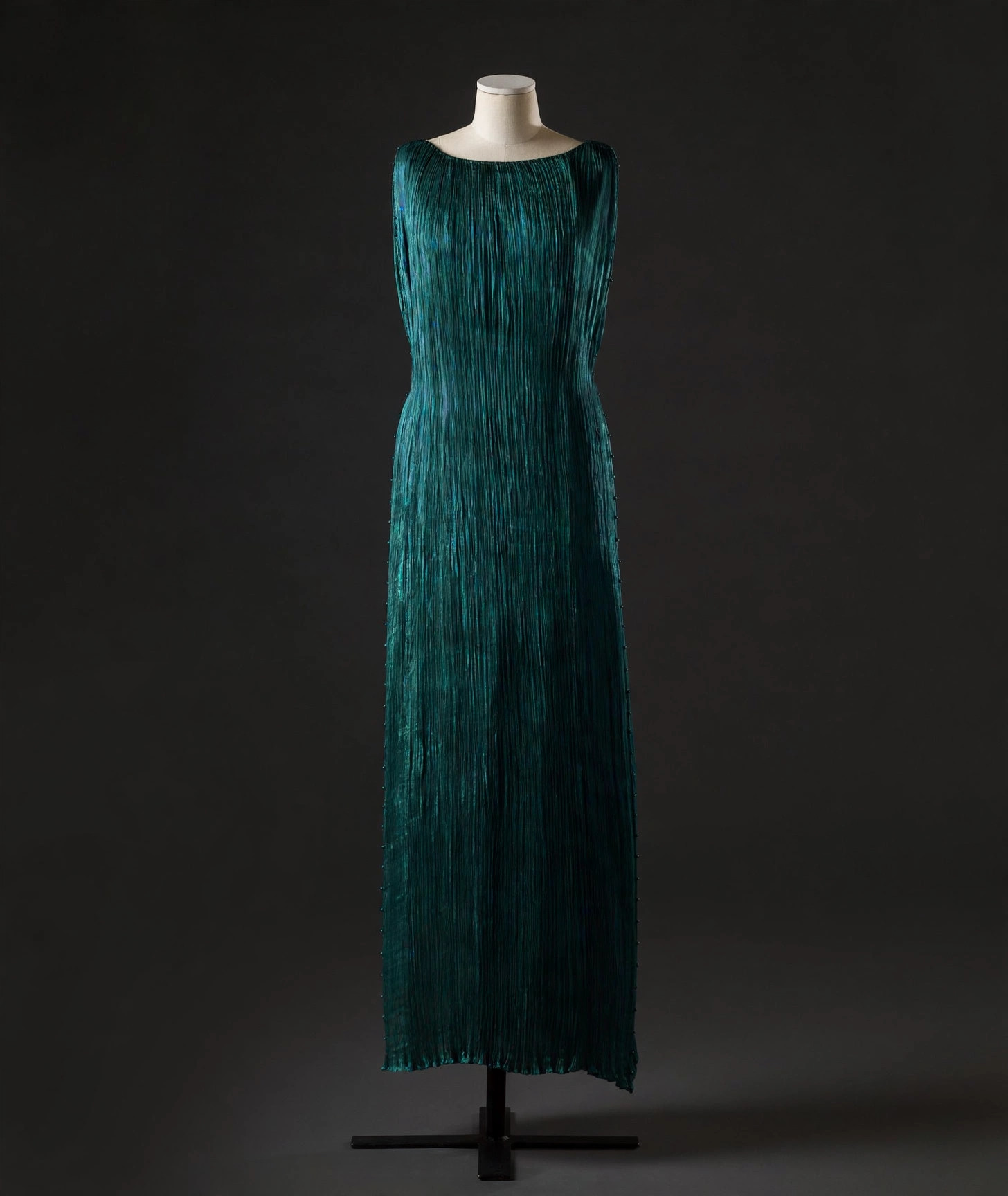
Fortuny pleats are very fine, closely spaced pleats with a deliberately soft irregularity, permanently set into silk so the whole garment becomes one continuous pleated surface. They are named for Mariano Fortuny, whose Delphos gown of 1909 clothed its wearer in nothing but pleated silk, weighted at the hem with small ceramic beads.
The Delphos gown, briefly
In 1909 Mariano Fortuny, working in Venice with Henriette Negrin — whose role in developing the pleating is now widely acknowledged — patented a gown inspired by the chiton of ancient Greek sculpture. The Delphos was radical in its simplicity: a tube of finely pleated silk that slipped over the head, needed no corset, no fastenings and almost no sewing, and fitted the body through the elasticity of its pleats. Small ceramic or glass beads at the hem weighted the feather-light silk so it fell in a straight column. The gowns were sold twisted into small boxes, worn for decades, and are now museum pieces — yet the pleats in surviving examples remain astonishingly alive more than a century later. Everything on this page honours that standard while being truthful about how it was reached.
Fortuny-style pleats, fold by fold
Cross-section of Fortuny pleats showing very fine closely spaced folds with a soft irregular rhythm Illustration by Apparel Search.
- Choose silk, and choose it fine. The method below works on lightweight silk — habotai, crepe de chine or a fine silk satin. The pleats are set into damp silk, so the fabric must tolerate water and heat; test a corner first. Polyester imitations of the pleat exist, but the true Fortuny surface is a silk surface, and silk is what these steps assume.
- Work in short lengths. Fine pleating is done a section at a time, across a width you can hold in both hands — about 30 to 45 cm (12 to 18 inches) of width per pass. Mark nothing; Fortuny pleats are not measured pleats. Instead, establish the scale by eye: each fold is only a few millimetres wide, far finer than accordion pleats.
- Pinch the first folds. With the silk slightly damp, pinch a tiny fold between finger and thumb and roll it a fraction as you lay it down, then pinch the next fold immediately beside it in the opposite direction. The slight roll is what gives Fortuny pleats their soft, wavy edge rather than a knife-sharp crease — compare the rounded cross-section in the diagram with the crisp zigzag of the accordion diagram.
- Build the field of pleats. Continue pinch by pinch across the section, keeping the folds close, roughly parallel and gently irregular. Small waves and variations are correct. If a fold goes badly astray, smooth it out while the silk is still damp and pinch it again; the fabric is forgiving at this stage and unforgiving later.
- Secure the section. Baste loosely along both edges of the pleated section with long stitches, or pin it to a padded board, so the folds cannot open while you pleat the next section. Match the fold scale at the join so the pleating reads as one continuous field.
- Set with heat and steam. Press the pleated section lightly — a cool-to-warm iron over a damp press cloth, with the iron rested on the folds rather than dragged across them. The aim is to dry and set the folds in place, not to flatten them. Allow the section to dry and cool completely before removing the basting.
- Assemble with almost no sewing. In the Delphos spirit, the pleated silk needs little construction: side openings left unstitched or closed with a few hand stitches, a soft cord or ribbon at the neckline if wanted, and the hem finished with its row of small beads, threaded on a cord or sewn individually, whose weight keeps the column hanging true.
Expect the first sections to look uneven and the later ones to settle as your fingers learn the scale. That learning curve is itself faithful to the original: this was hand work, done by skilled pleaters, and the hand is visible in every genuine example.
Fabrics & behaviour
Silk is not a preference here; it is the mechanism. Silk fibres accept the fine folds while damp, hold them when dried with gentle heat, and give the pleated surface its characteristic liquid shine, in which each tiny fold reflects light at a slightly different angle. The result is a fabric that seems to move even on a still wearer. No other common fibre reproduces that combination, which is why Fortuny-style pleating in cotton or synthetics reads as an homage rather than the thing itself. Within silks, plain weaves pleat most evenly; silk satin gives the most dramatic light-play but shows every handling mark, and silk velvet should not be attempted — its pile crushes under pleating.
A Fortuny-pleated garment behaves unlike any other pleated clothing. The pleats act as thousands of tiny springs, so the garment stretches gently around the body without darts, zips or elastic, and falls back to a narrow column when removed. It packs to almost nothing, weighs almost nothing, and wrinkles — in the ordinary sense — are meaningless on it, because the whole surface is already folds. Its weaknesses are the other side of the same nature: water spots silk, strong heat and crushing flatten the folds, and once the set is lost across an area, restoring it means re-pleating that area fold by fold.
Handle the finished garment as the steps suggest it was made: by hand, gently, and never through a washing machine. The care section below and the linked storage guide are part of the technique, not an afterthought.
Variations & uses — and an honest limit
Fortuny-style pleating can be used at any scale: a full Delphos-style gown, a pleated silk scarf or stole in Fortuny's manner, a pleated panel set into an evening dress, or a lampshade-style skirt of pleated silk over a plain lining. Modern designers return to fine irregular pleating whenever they want a surface that is both structure and decoration at once, and the pleated column dress in silk remains the clearest descendant of the Delphos.
What home sewers can and cannot reproduce
Honesty is owed here, because the Fortuny name invites overclaiming. The original setting process was a guarded workshop secret: Fortuny patented the gown and aspects of the method, but the full procedure was never published, and reconstructions by textile historians remain partly conjectural. What a home sewer can reproduce, following this page, is the visible craft: genuinely fine, closely spaced, softly irregular pleats in real silk, set with damp heat, finished with a bead-weighted hem, and cared for by twisting. A garment made this way looks right, moves right, and can last for years with gentle handling. What a home sewer cannot honestly promise is the original's permanence — pleats that shrug off a century of wear and museum storage. Home-set silk pleats soften over time and with any cleaning, and need re-pleating section by section to restore them. Treat any tutorial claiming to reveal the exact lost Fortuny process with polite scepticism, and your own results as what they are: a faithful, beautiful approximation of a masterpiece.
Care and the twisted storage
Store the garment twisted: gather it lengthwise along its pleats, twist it gently into a loose coil or soft knot, and keep it in a small box or soft bag where nothing heavy rests on it. Never iron the pleats flat, never hang the garment for months at a time, and keep it from water and perfume sprays. The full method, with washing guidance by fibre and instructions for re-pleating a softened section, is on the pleating care and storage page of this guide.
Related pleats
 Crystal & Mushroom PleatsFine machine-set pleats, sharp crystal or soft mushroom
 Heat-Set PleatsSynthetic pleats made permanent with controlled heat
 Machine-Set PleatsEven permanent pleats set by blade pleating machines
 Plissé PleatsThe fine soft folds closest in spirit to the Fortuny surface
Fortuny pleats stand at the hand-made end of the set-and-permanent family; the machine-set and heat-set sections show how the same ambition — pleats that stay — is achieved industrially.
Search Apparel Search
Frequently Asked Questions
Who invented Fortuny pleats?
They are named for Mariano Fortuny, the Spanish-born artist and designer working in Venice, who patented the Delphos gown in 1909. The pleating itself is widely credited as a collaboration with his wife, Henriette Negrin, and Fortuny's patent covered the gown and its pleating method. The exact setting process used in the Fortuny workshop was never fully disclosed and remains partly a matter of informed guesswork.
Why are Fortuny pleats irregular instead of perfectly even?
The irregularity is deliberate and is part of their beauty. The pleats are fine, narrow and slightly uneven, with tiny waves and variations along their length, so the silk catches light in a shifting, watery way that machine-even pleats cannot imitate. When you make Fortuny-style pleats at home, aim for fine and close rather than mechanically perfect — a little life in the folds is correct.
What are the beads on a Fortuny hem for?
The small ceramic or glass beads threaded at the hem of a Delphos gown are weights. Finely pleated silk is extremely light and the pleats have no stitching to hold the skirt down, so the beads give the hem just enough weight to hang in a straight column and keep the pleats in line. They are functional first and decorative second, though they quickly became part of the gown's recognisable look.
How should a Fortuny-pleated garment be stored?
Twisted. Delphos gowns were famously stored rolled and twisted into a loose knot or coil, often in a small round box, because twisting follows the direction of the pleats and keeps them compressed without crushing any single fold flat. Never hang a finely pleated silk garment for long periods, never fold it flat in a drawer, and never press the pleats out with an iron. The care and storage page in this guide gives the full method.
Keep Exploring
See the Fortuny pleat among the other set and permanent pleats, read how care and twisted storage keep fine pleats alive, and browse the full guide.