Full Guide
How to Sew Sunburst Pleats — A Fold-by-Fold Guide
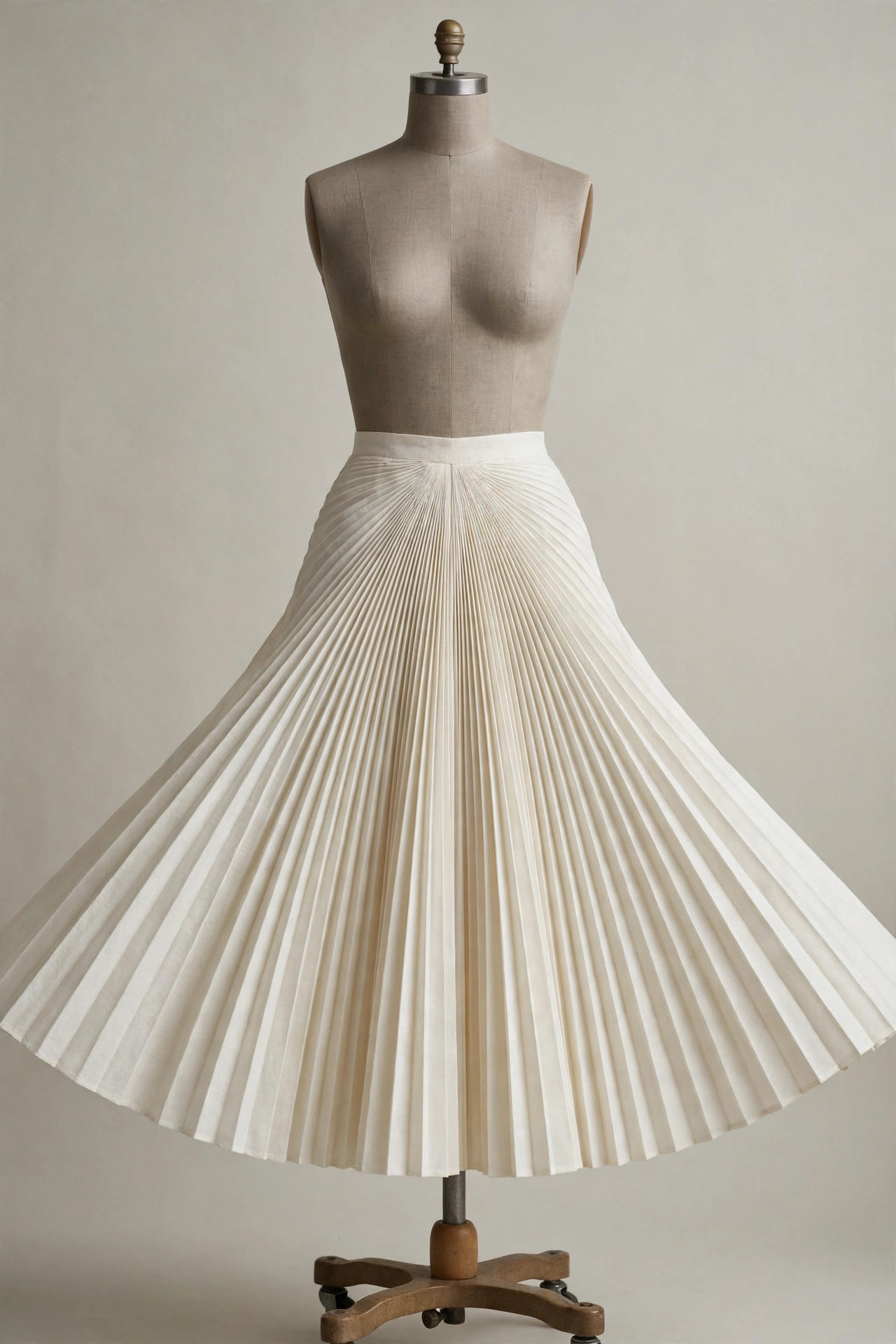
Sunburst pleats — also called sunray pleats — are accordion folds arranged as a fan: fine and close together at the waist, radiating outward and widening all the way to a sweeping hem. They make the most glamorous skirts in the pleating repertoire, the kind that stand in a perfect cone when you are still and flare into a full circle when you turn.
Sunburst pleats are a run of zigzag folds whose spacing increases steadily from one edge of the fabric to the other, because every fold points toward a common centre. Pleated at the waist of a skirt they lie narrow and flat; at the hem the same folds open wide, giving flare without gathers, seams or added panels.
There are two honest routes to this effect, and this guide teaches both. Professional pleaters fold a straight length of fabric whose folds are set along radiating lines — the radial grain trick explained below — so the top edge comes out far narrower than the bottom. Home sewers more often take the second route: cut the skirt as a circle or half-circle first, then fold ordinary even accordion pleats into it, letting the circle's own geometry widen the folds toward the hem. Both give true sunburst pleats. Choose by your fabric, your equipment and your confidence — and fold a sample by your chosen route before the real length is touched.
Sunburst pleats, fold by fold
Plan view of sunburst pleats radiating from a centre point with the folds narrow at the waist and wide at the hem Illustration by Apparel Search.
- Route one — mark the radial lines. For the straight-length route, lay the fabric flat and mark the fold lines as rays from a centre point positioned beyond the top edge of the cloth, as in the diagram. Each line is a fold; because the lines radiate, they are close together at the top edge and far apart at the hem edge. The grain of the fabric runs along the centre ray, which is why pleaters call this pleating on the radial grain — every fold sits at a slightly different angle to the weave, yet the fan hangs true.
- Route two — cut the circle first. For the circle route, cut the skirt as a full circle or half circle with the waist and hem already curved, and finish or stay-stitch the waist edge. Mark fold lines at even intervals around the waist curve; the same marks will naturally stand further apart at the hem curve, which is the whole secret of this route.
- Fold the first zigzag. Whichever route you chose, begin at one side and fold the fabric up into a mountain at the first line, then down into a valley at the second, exactly as for accordion pleats. On the radial route, fold along the ray, not across it; on the circle route, fold so the crease runs straight from the waist mark toward the hem.
- Continue around the fan. Alternate mountain and valley folds along every marked line, pinning the folds together at the waist edge as you go. Check from above that the folds radiate evenly, like the spokes in the diagram — a fold that leans toward its neighbour at the hem will show as a twisted ray in the finished skirt.
- Fit the waist. With all folds made, draw the pleated top edge in to the waist measurement and baste it firmly at its wearing width. On the radial route the top edge will already be close to size; on the circle route the pleats absorb the circle's extra waist width, so distribute them evenly before basting.
- Press and set the folds. Press each fold from waist to hem, working around the fan a few folds at a time and letting each section cool before releasing it. Follow the fold's own radiating direction with the iron rather than pressing straight down the grain. Heat-set synthetics at the hottest safe temperature; press natural fibres with steam and a press cloth.
- Hem last, and level it hanging. Hang the skirt for at least a day — radiating folds settle unevenly at first — then level the hem from the floor upward while it hangs, and finish with a narrow rolled or machine-stitched hem that adds no weight to pull the folds open.
The diagram is a plan view, drawn from above the fan, because sunburst pleats cannot be understood from a cross-section: their whole character is in the radiation. Keep it beside you while marking, whichever route you take.
Fabrics & behaviour
Sunburst pleats ask more of a fabric than any other pleat in this guide, because every fold sits at a different angle to the grain and part of each fold is always on the bias. Fabrics that drape without stretching out of shape succeed: polyester georgette, crepe and lightweight satin are the reliable modern choices, since they also heat-set permanently at home-iron temperatures. Silk is the traditional luxury choice and pleats beautifully, but its folds are pressed rather than set and will need professional attention over the garment's life. Avoid stiff fabrics — the cone of a sunburst skirt should pour, not stand — and avoid very slippery fabrics for a first attempt, because radiating folds in slippery cloth migrate while you pin them.
In wear, a sunburst skirt is fitted and smooth over the waist and hips — the folds lie almost flat there — and then releases into increasing movement toward the hem, so the flare feels weightless rather than bulky. The hem is where the pleats earn their name: turning opens the fan to its full circle, and light runs along the radiating folds in rays. Because the folds widen gradually, the skirt never has the abrupt gathered fullness of a dirndl; the silhouette is a continuous cone. That same geometry makes the style kind to many figures and explains its return in every decade since the 1950s, when pleated sunburst skirts became a signature of post-war dressing.
One behaviour to plan for: the bias portions of the folds stretch slightly under the skirt's own weight, so the hem drops unevenly in the first days after pleating. This is normal, expected, and the reason the steps insist on hanging before hemming.
Variations & uses
The full-circle sunburst is the classic, but the half-circle version gives a gentler flare with half the drama and half the fabric, and suits day dresses and shorter skirts. A sunburst panel can be set into one side of a plain skirt as a pleated insert, giving movement without a full pleated garment. The fan principle also works in miniature: sunburst-pleated sleeves, collars and peplums radiate from a small centre and flare over a few inches. Dresses pleated from shoulder to hem in a continuous sunburst — the folds radiating from the neckline — are the couture extreme of the same idea.
Colour transforms the effect. A plain fabric shows the rays as light and shadow. A fabric with a border print along one edge puts the border at the hem, interrupted by the folds. Ombré and dip-dyed fabrics deepen in colour as the folds widen, and a stripe woven across the fabric flashes in segments as the skirt moves. If you are choosing fabric specifically for sunburst pleats, hold a pleated handful of it up to the light before buying: the pleats, not the flat cloth, are what the world will see.
Common mistakes. Marking the folds evenly along a straight length without radiating them is the classic failure — the result is an accordion skirt that pulls at the waist, not a sunburst. Pressing straight down the grain instead of along each ray twists the folds. And hemming before the skirt has hung guarantees an uneven hem within a week; hang first, always.
Related pleats
 Accordion PleatsThe even zigzag that sunburst pleats open into a fan
 Plissé PleatsFine soft folds for a crinkled, fluid texture
 Rolled & Fluted PleatsRounded folds with a soft, shell-like rippleAccordion Pleats GuideThe full fold-by-fold guide to the basic zigzag
Master the even accordion zigzag first; sunburst pleating is that same fold given a centre to radiate from.
Search Apparel Search
Frequently Asked Questions
Why are sunburst pleats narrow at the top and wide at the hem?
Because the folds radiate from a centre point, like the rays in the name. Each fold is a wedge: the same fold that takes up a few millimetres at the waist spreads to several centimetres at the hem simply because it is further from the centre. Nothing extra is added — the widening is pure geometry, which is why a sunburst skirt fits smoothly at the waist and flares so dramatically at the bottom.
Can I pleat a sunburst skirt myself or must it go to a pleater?
You can pleat one yourself by either route in this guide, and home sewers do it successfully on polyester fabrics that heat-set at iron temperatures. What a professional pleater adds is speed and perfectly even setting over a long length. If the fabric is silk, the skirt is very long, or the event matters, sending the cut skirt to a pleater is money well spent; for a first attempt, choose the circle-skirt route in a forgiving synthetic.
How much fabric does a sunburst skirt take?
By the circle route, the skirt is cut as a full or half circle before pleating, so the fabric needed is the circle itself — often three to four metres of wide cloth for a full-circle long skirt. By the straight-length route, plan on about two and a half to three times the hem width you want in pleated fabric. Fold and measure a sample either way before committing the full length.
Do sunburst pleats have to be permanent?
No. On natural fibres they can be pressed in for an occasion and will soften with cleaning, exactly like accordion pleats. On polyester they can be heat-set and are effectively permanent. Many vintage sunburst skirts were sold with the understanding that the pleats would be re-pressed or professionally reset from time to time, and a well-made one can be re-pleated many times.
Keep Exploring
Place the sunburst among its fine-pleat relatives, revisit the basic zigzag, and then browse every pleat type in the gallery.