Exporting Documents When Shipping Apparel from the USA
Commercial invoices, packing lists, transport documents, origin certificates and the EEI filing — the paperwork behind a U.S. clothing export
This page is in regard to exporting apparel from the United States. What documents are needed for exporting clothing and fashion accessories? Requirements vary by destination and product. The information provided here by Apparel Search is for reference only and is NOT a specific solution for your exporting needs. We strongly suggest you consult with a professional customs broker regarding your specific project.
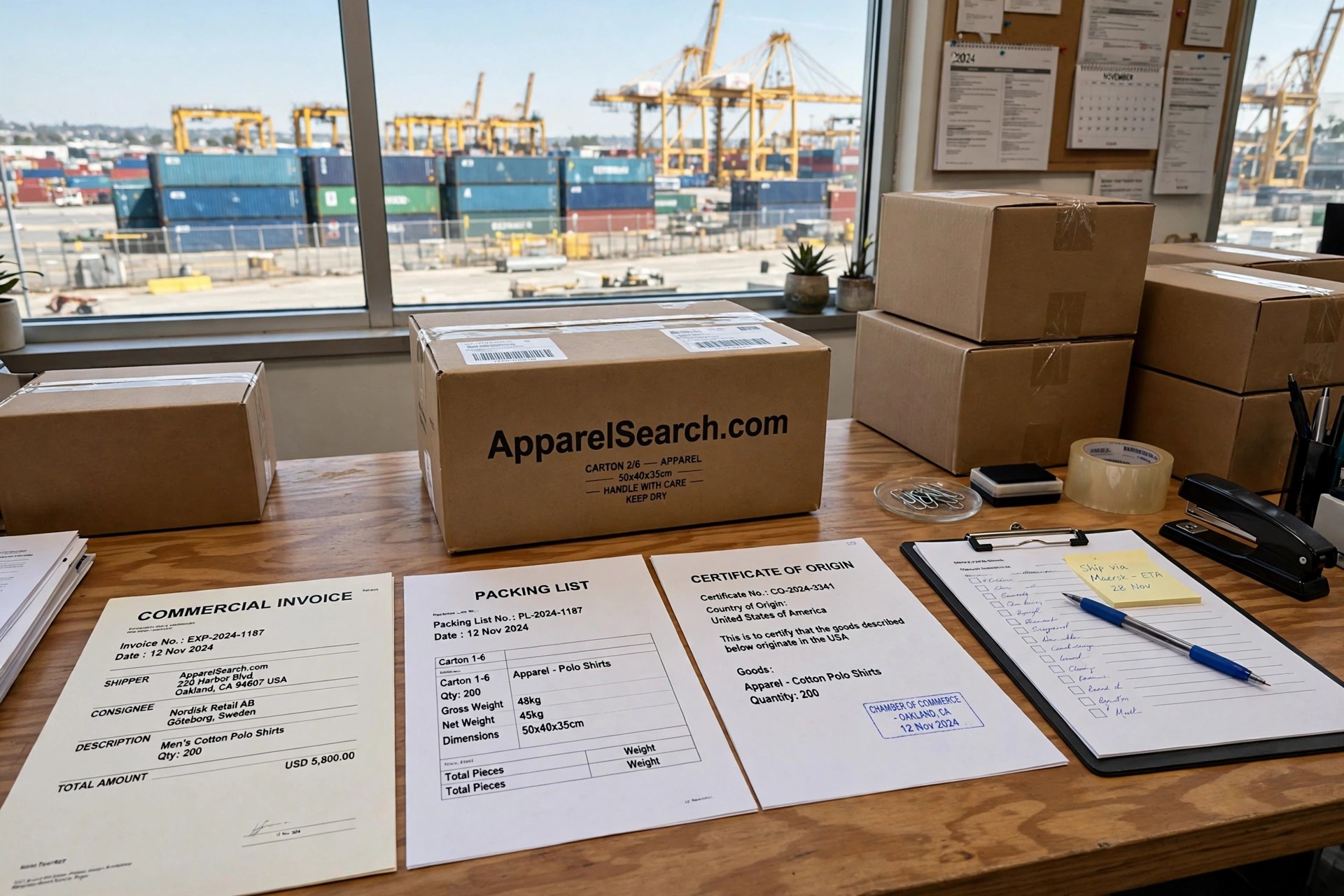
The documents below form the standard export file for a clothing shipment: the commercial invoice that prices it, the packing list that describes it physically, the transport document that moves it, the origin paperwork the destination may demand, and the U.S. government filing that records it. Each document feeds the others — the invoice values the packing list's cartons, and both feed the electronic filing — so accuracy compounds: a file built carefully once is checked quickly everywhere.
Commercial Invoice and Pro Forma Invoice
A commercial invoice is a bill for the goods from the seller to the buyer. These invoices are often used by governments to determine the true value of goods when assessing customs duties. Governments that use the commercial invoice to control imports will often specify its form, content, number of copies, language to be used, and other characteristics. For apparel, the invoice should identify each style and garment type clearly — descriptions like 'ladies' cotton knit tops' with quantities and unit values — because the destination customs authority will classify and value the shipment from this document first.
You may also need a pro forma invoice, which is an invoice prepared by the exporter before shipping the goods, informing the buyer of the goods to be sent, their value, and other key specifications. It also can be used as an offering of sale or price quotation. In an apparel order, the pro forma typically confirms the buyer's purchase order — styles, sizes, colors, quantities, price and terms — and gives the buyer and their bank the document they need to arrange payment or a letter of credit before the goods move.
Export Packing List
An export packing list is considerably more detailed and informative than a standard domestic packing list. It lists the seller, buyer, shipper, invoice number, date of shipment, mode of transport and carrier, and it itemizes quantity, description, the type of package — such as a box, crate, drum, or carton — the quantity of packages, total net and gross weight (in kilograms), package marks, and dimensions, if appropriate. Both commercial stationers and freight forwarders carry packing list forms.
A packing list may serve as conforming document. It is not a substitute for a commercial invoice. In addition, U.S. and foreign customs officials may use the export packing list to check the cargo: when a container is opened for examination, the cartons, marks and weights in front of the inspector are compared against this list, so carton-level accuracy — the right style and size run in the right marked carton — is what makes an examination a short delay instead of a shipment problem. The packing list also feeds the weight and volume figures behind the booking and the export filing.
Transport and Origin Documents
The transport document is the bill of lading for ocean freight or the air waybill for air cargo: it evidences the carrier's receipt of the goods and the contract to carry them to destination. It travels with the shipment's commercial life as well — buyers and banks routinely call for it by name — so the shipper, consignee and notify party details on it must match the invoice exactly.
A Certificate of Origin (CO) is required by some countries for all or only certain products. In many cases, a statement of origin printed on company letterhead will suffice. The exporter should verify whether a CO is required with the buyer and/or an experienced shipper or freight forwarder, or the Trade Information Center. Origin questions run deeper than the certificate itself — how a garment's country of origin is determined is covered in the country of origin guide. Note: when shipping to Canada you may need a Canadian Customs Invoice. For more detail on the compliance side of the file, see the export compliance documents material published through Export.gov.
EEI and Export Compliance
The EEI (Electronic Export Information; formerly called a Shipper's Export Declaration) is the U.S. government's electronic record of the shipment, filed through the Automated Export System when the shipment's value or nature requires it. It belongs in the same file as the invoice and packing list, and it is built from their data.
The U.S. Customs and Border Protection (CBP) is responsible for ensuring that all goods entering and exiting the United States do so in accordance with all applicable U.S. laws and regulations. Although CBP enforces these export regulations for various other government agencies, specific questions pertaining to commodity licensing requirements should be directed to that lead agency. Agency information, telephone numbers, and the basic commodities which may require export licenses can be obtained from the U.S. Department of Commerce Bureau of Industry and Security, the Department of State Directorate of Defense Trade Controls, the Bureau of Alcohol, Tobacco, Firearms and Explosives, the Drug Enforcement Administration, the Nuclear Regulatory Commission, the Office of Foreign Assets Control, or the Bureau of the Census. Further guidance regarding export licenses should be directed to the CBP port of export location used to export your goods.
Helpful Resources for Exporting Clothing
Export.gov helps U.S. companies export: 95% of the world's consumers live in other countries and the benefits of exporting are enormous. Its Export Basics section explains how to export, and registration gives access to market research and trade leads. Trade specialists are also available in your area to help plan your international business — call 1-800-USA-TRADE (1-800-872-8723) to find a trade specialist and get answers to your export questions.
For the apparel trade specifically, the Office of Textiles and Apparel (OTEXA) at the U.S. Department of Commerce is the industry's own government office, covering textile and apparel trade policy and export promotion; its contact details are listed in the references below. And when a shipment's facts go beyond the standard file — an unfamiliar destination rule, a licensing question, a certificate a buyer insists on — a professional customs broker or a specialist customs attorney is the right check before the goods move, not after they are held. Check for the most current information regarding documentation for exporting apparel from the U.S. Customs and Border Protection website, and check the government websites for the most current rules and regulations.
More Shipping & Freight Guides
Common Questions
What documents are needed to export clothing from the USA?
The core set is a commercial invoice, an export packing list, a transport document (bill of lading or air waybill), and — where the value or the goods require it — an Electronic Export Information filing. Some destinations also require a certificate of origin, and shipments to Canada may need a Canadian Customs Invoice. Requirements vary by destination and product.
What is the difference between a commercial invoice and a pro forma invoice?
A commercial invoice is the bill for the goods from seller to buyer, used by governments to determine the true value of the goods when assessing customs duties. A pro forma invoice is prepared by the exporter before shipping: it informs the buyer of the goods to be sent, their value and other key specifications, and can serve as an offering of sale or price quotation.
Is an export packing list the same as a commercial invoice?
No. An export packing list is considerably more detailed about the physical shipment — packages, marks, net and gross weights and dimensions — and may serve as a conforming document, but it is not a substitute for a commercial invoice. Customs officials may use the packing list to check the cargo against the invoice.
References & Further Reading
- Export Compliance Documents — Export.gov
- U.S. Department of Commerce, Bureau of Industry and Security
- Export.gov — Helping U.S. Companies Export
- U.S. Customs and Border Protection
- CBP Ports of Entry — U.S. Customs and Border Protection
- Office of Textiles and Apparel (OTEXA), U.S. Department of Commerce, Washington, DC 20230 — Phone: (202) 482-5078 | Fax: (202) 482-2331 | OTEXA@trade.gov