Electronic Export Information (EEI) for Apparel Exports
The U.S. export data filing (the old Shipper's Export Declaration) — when apparel shipments must file it, what goes in it, and how AES filing works
Electronic Export Information (EEI) filing is generally required by the U.S. Census Bureau for U.S. exports that contain a single commodity's value exceeding US$2,500.00. All EEI information is provided to the U.S. Census Bureau and is used for export compliance and governmental reporting. This page is in regard to exporting apparel from the United States — the garments, footwear and accessories that leave U.S. ports and airports for stores and distributors abroad.
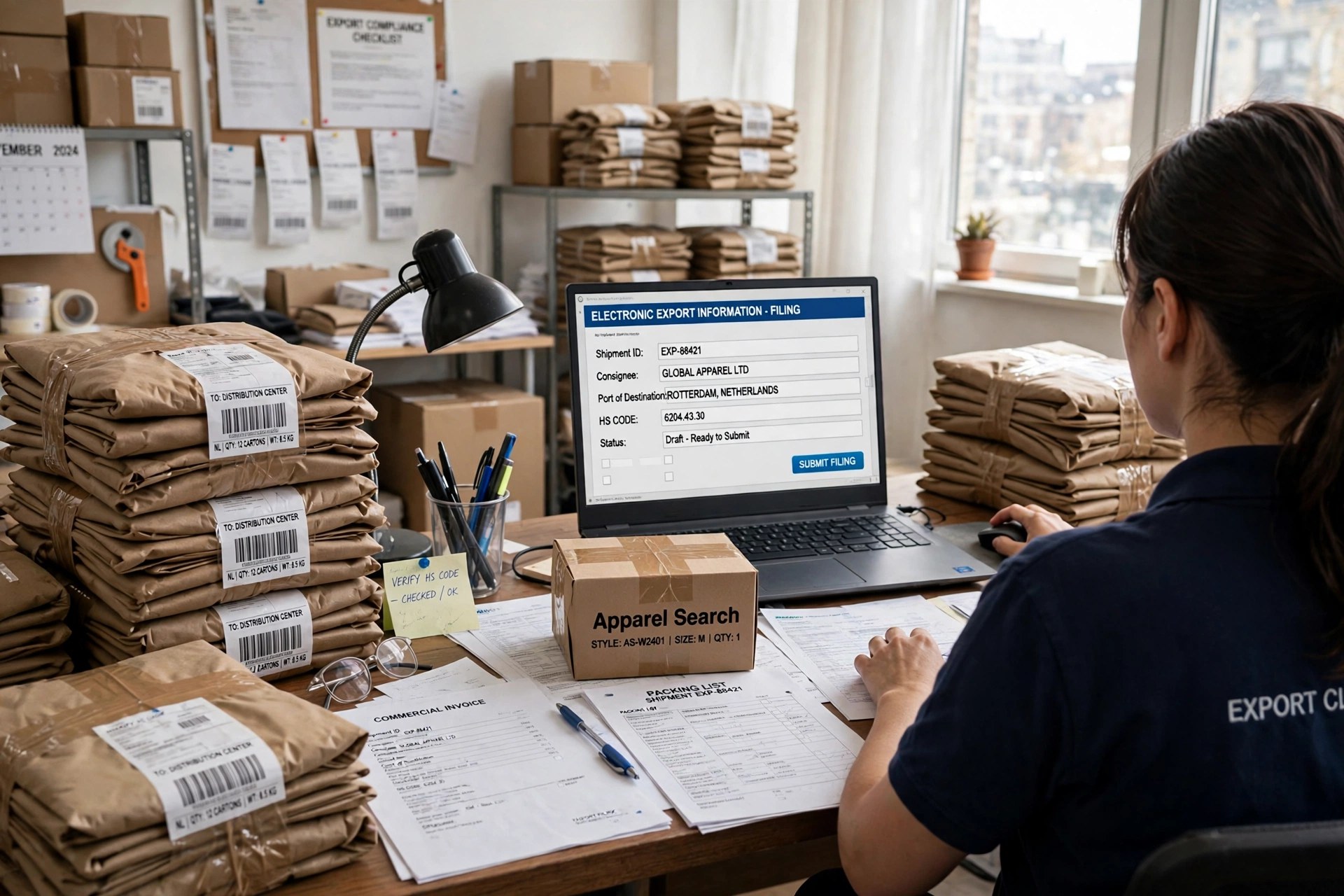
Formerly known as the Shipper's Export Declaration (SED), the EEI is filed electronically with the U.S. Census Bureau's Automated Export System (AES). There is no paper form to staple to the bill of lading: the filing is a data transmission, made by the exporter or by an authorized agent such as a freight forwarder, and the carrier will not load an export shipment that requires a filing until the filing has been accepted and the shipment carries its AES proof of filing citation.
When an EEI Filing Is Required
The headline rule is the value threshold: when the goods in a shipment that fall under one commodity classification (one Schedule B number) are worth more than US$2,500, an EEI filing is generally required. The test is per classification, not per shipment — a container holding $2,000 of men's woven shirts and $2,000 of women's knit tops may fall below the threshold for each line, while a single line of $6,000 of dresses clearly crosses it. Apparel exporters who ship mixed assortments should run the test line by line, exactly as the goods appear on the commercial invoice.
Value is not the only trigger. Some shipments must be filed whatever they are worth — notably goods moving under an export license, and certain special categories the Foreign Trade Regulations name. There are also exemptions: many shipments to Canada, for example, are exempt from filing unless a license or another special rule applies, and low-value shipments below the threshold are the everyday exemption most small apparel exporters rely on. Exemptions do not erase the paperwork — an exempt shipment is normally annotated on the transport document with the applicable exemption citation instead of a filing confirmation. Because thresholds, exemption lists and license rules are revised over time, treat the $2,500 figure as the starting point and confirm the current rule for your destination and product before the goods leave.
What Information Goes Into the Filing
An EEI filing describes who is exporting, who is receiving, and exactly what is moving. It identifies the U.S. principal party in interest (the exporter), the foreign consignee, the carrier and the port and date of export. For the goods themselves it asks for the Schedule B commodity code, a description of the merchandise, the quantity and shipping weight, and the value at the port of export. Shipments controlled for export-license reasons also carry the license or authorization information the responsible agency requires.
For apparel, the discipline behind the filing is classification. Men's and women's garments, knit and woven constructions, and different fiber contents sit under different Schedule B numbers, and the value test, the filing data and any license review all run off those numbers. The practical source documents are the same ones the rest of the export file depends on — the commercial invoice and the export packing list covered in the apparel export documents guide. If the invoice groups unlike garments into one vague line ('assorted clothing, $8,000'), neither the filing nor the value test can be done properly; itemized lines by style and classification make the EEI straightforward.
How and When to File in AES
Filings are transmitted to the Automated Export System, most commonly through AESDirect, the Census Bureau's free online filing portal, or through the exporter's freight forwarder or customs software filing on the exporter's behalf under a written authorization. Once AES accepts the filing, the shipment receives its proof of filing — an Internal Transaction Number (ITN) or the pre-departure filing citation — which is quoted on the transport document so the carrier and CBP can see the shipment was filed.
Timing is mode-specific and unforgiving. Export rules set filing deadlines ahead of departure — earlier for vessel shipments, where the filing is due well before the container is loaded, and closer to departure for air cargo. A late filing can hold a container at the terminal while the sailing leaves without it, which is why apparel exporters build the EEI into the booking checklist alongside the container planning tools on this site: the weight calculators, the guide to how many cartons fit in a container, and the container dimensions chart. If AES is unavailable, the regulations provide a downtime procedure, but it is an exception route, not a routine fallback.
EEI, Compliance and the Wider Export File
The Census Bureau owns the data, but the filing sits inside a wider compliance system. U.S. Customs and Border Protection enforces the export rules at the port, and other agencies — the Bureau of Industry and Security for most commercial licensing questions among them — control whether particular goods need permission to leave at all. An accepted EEI is not an export license and does not clear a shipment that a licensing rule stops; it is the statistical and compliance record of the shipment, and errors in it are the exporter's errors even when an agent pressed the transmit button.
Keep the filing evidence with the rest of the shipment file. The ITN or citation, the invoice and packing list it was built from, and the transport document belong together, because post-departure questions — a Census or CBP inquiry, a buyer's bank checking documents, a correction filing — are answered from that file. Corrections matter too: when a material fact in a filed shipment turns out to be wrong, the regulations expect the filing to be corrected, not left standing. Exporters who treat the EEI as the last step of good documentation, rather than a formality after it, rarely meet it as a problem at the port.
More Shipping & Freight Guides
Common Questions
What is Electronic Export Information (EEI)?
Electronic Export Information is the export shipment data the U.S. Census Bureau collects through the Automated Export System (AES). It replaced the paper Shipper's Export Declaration (SED): the exporter or their agent files the shipment's parties, commodity classification, value and weight electronically, and the data is used for export compliance and governmental reporting.
When does an apparel shipment need an EEI filing?
A filing is generally required when the value of the goods under a single commodity classification exceeds US$2,500, and some shipments must be filed regardless of value — for example goods that need an export license. Thresholds and exemptions are set by the Foreign Trade Regulations and change over time, so check the current CBP and Census Bureau guidance for your shipment.
Who files the EEI if I use a freight forwarder?
Many exporters authorize a freight forwarder or other agent to file in AES on their behalf. The exporter remains responsible for the accuracy of the data supplied, so the commercial invoice and packing list behind the filing should be complete and correct before the forwarder transmits it.