Apparel Search · Fabric Construction Guide
Woven vs Knit Fabrics: How to Choose
One fabric is interlaced, the other interlooped — and that single structural difference explains stretch, drape, wrinkling, fraying and nearly every other way the two families behave in a garment.
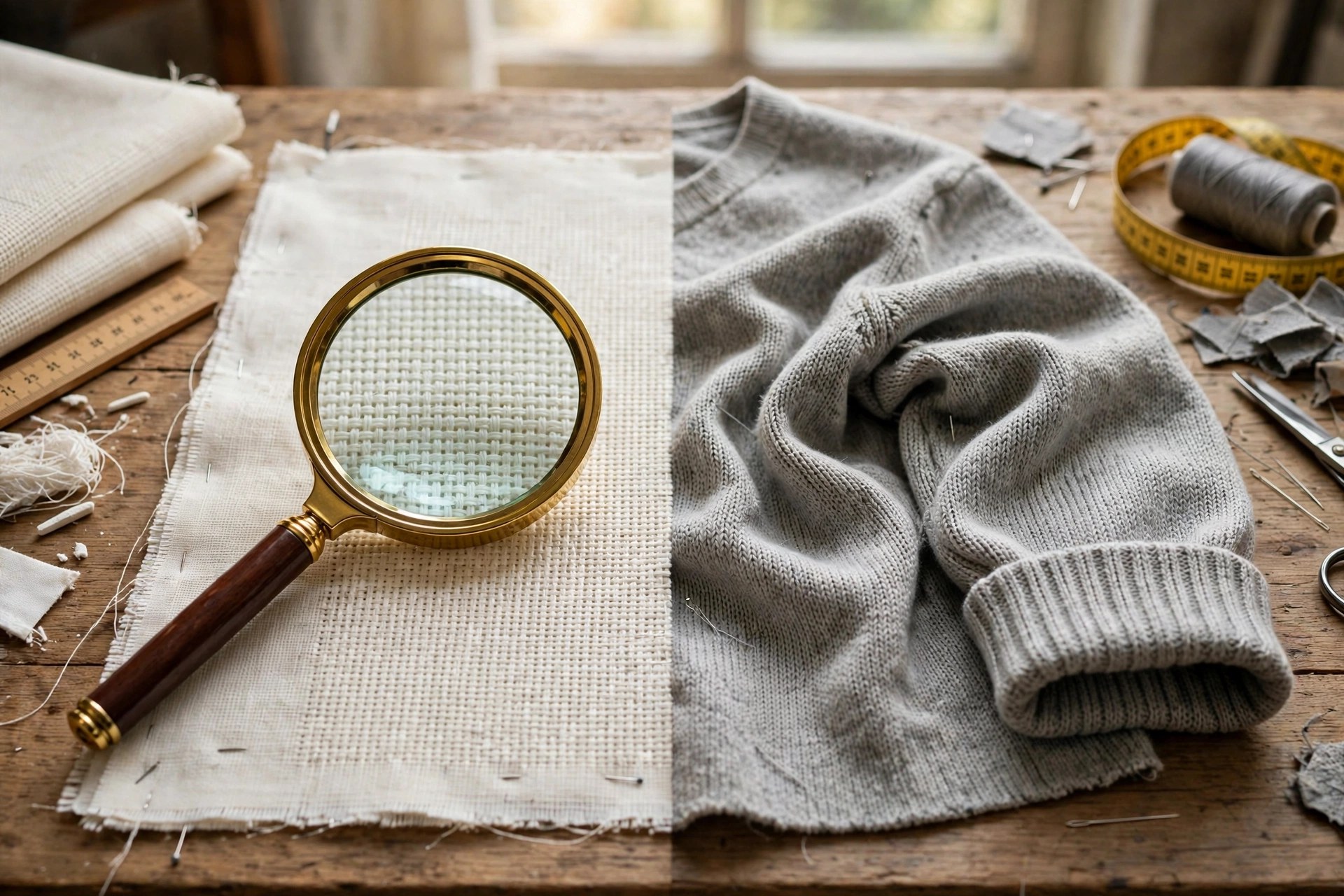
Every apparel fabric is built one of two ways. Woven fabric interlaces two yarn systems at right angles — the subject of this Weaving & Woven Fabric Construction guide. Knit fabric interloops a yarn (or several) into rows of connected loops, the construction covered by the companion Knitwear Construction Guide. Neither is better; they are different engineering answers, and choosing between them is one of the first real decisions in designing or buying a garment. This spoke compares the two families property by property — if you read one page in both clusters, make it this one and its mirror in the knitwear cluster.
The Structural Difference
A woven cloth is a grid: warp yarns run lengthwise, weft yarns cross them, and stability comes from the friction of thousands of interlacings. Cut it and the grid holds its shape but frays at the edges, because severed yarns can slide out of the crossings. A knit is a chain of loops: each loop is drawn through the loop below it, so the fabric is really one continuous yarn architecture. Stretch a knit and the loops change shape; snag and break one loop and its neighbors can unravel down the column — the ladder or run familiar from tights. Knits are built as weft knits (one yarn looping across, like hand knitting and jersey) or warp knits (yarns looping lengthwise, like tricot and raschel); the knitwear cluster's weft vs warp knitting spoke draws that distinction in full.
| Property | Woven fabrics | Knit fabrics |
|---|---|---|
| Construction | Two yarn sets interlaced at right angles (warp and weft) | Yarns interlooped in rows and columns of stitches |
| Stretch | Minimal on the straight grain; gives on the bias; stretch only with elastane | Natural stretch and recovery from loop geometry, even without elastane |
| Drape and hand | Crisp to fluid depending on structure; holds pressed shape | Soft, fluid, conforms to the body |
| Wrinkle behavior | Creases readily; holds a sharp pressed crease | Sheds wrinkles well; resists holding a crease |
| Edge behavior | Cut edges fray; seams need finishing | Cut edges do not fray; weft knits may curl, and can ladder if a loop breaks |
| Shape retention | Excellent dimensional stability | Can grow or bag with wear unless yarn and structure are chosen for recovery |
| Typical garments | Shirts, tailored suits, trousers, denim, dresses with structure | T-shirts, sweaters, activewear, underwear, leggings, fluid dresses |
Choosing by Garment
Tailoring belongs to wovens. A suit jacket needs a cloth that holds a pressed crease, keeps its shoulders where the tailor put them, and accepts canvassing and padding — only a stable woven grid does that, which is why suiting, shirting, trousers and denim are woven almost without exception. Comfort that moves belongs to knits: T-shirts, sweaters, underwear, activewear and anything worn against the skin through a full range of motion exploits loop stretch and softness. Dresses split the difference by intent — a structured sheath is woven, a body-skimming drape is knit, and the jersey fabric guide shows the knit most often chosen. Hybrids blur the line deliberately: stretch wovens add a few percent of elastane to a woven grid for trousers and jackets that move, while ponte and scuba knits are engineered dense and stable enough to cut like wovens.
Working With Each Family
The differences follow the fabric into the sewing room and the laundry. Wovens are cut on the grain, stay where they are pinned, and demand finished seams against fraying; knits are cut with the stretch direction planned, sewn with stitches that can extend, and need no seam finishing but punish careless handling by stretching out along seams. In wear, woven garments are pressed back to shape with an iron, while knits are folded rather than hung — a sweater on a hanger is slowly pulled out of shape by its own looped weight. The care spoke of the Garment Care Guide covers both families' laundry rules in practical depth.
Production and Waste
The families differ behind the factory door as well. Weaving produces wide, continuous yardage at high speed, but garments are then cut from that yardage and the cutting floor generates offcut waste between pattern pieces. Knitting can work closer to the final shape: full-fashioned knitwear is knitted as shaped panels that need only linking at the seams, and seamless knitting produces near-complete garments, so a larger share of the yarn ends up in the product. Neither advantage is absolute — woven greige fabric is cheap, fast and endlessly versatile, while shaped knitting is slower per garment — but it explains why sustainability discussions so often treat the two constructions differently, and why knit and woven lines are usually sourced from different factories with different machinery.
The Hand Test
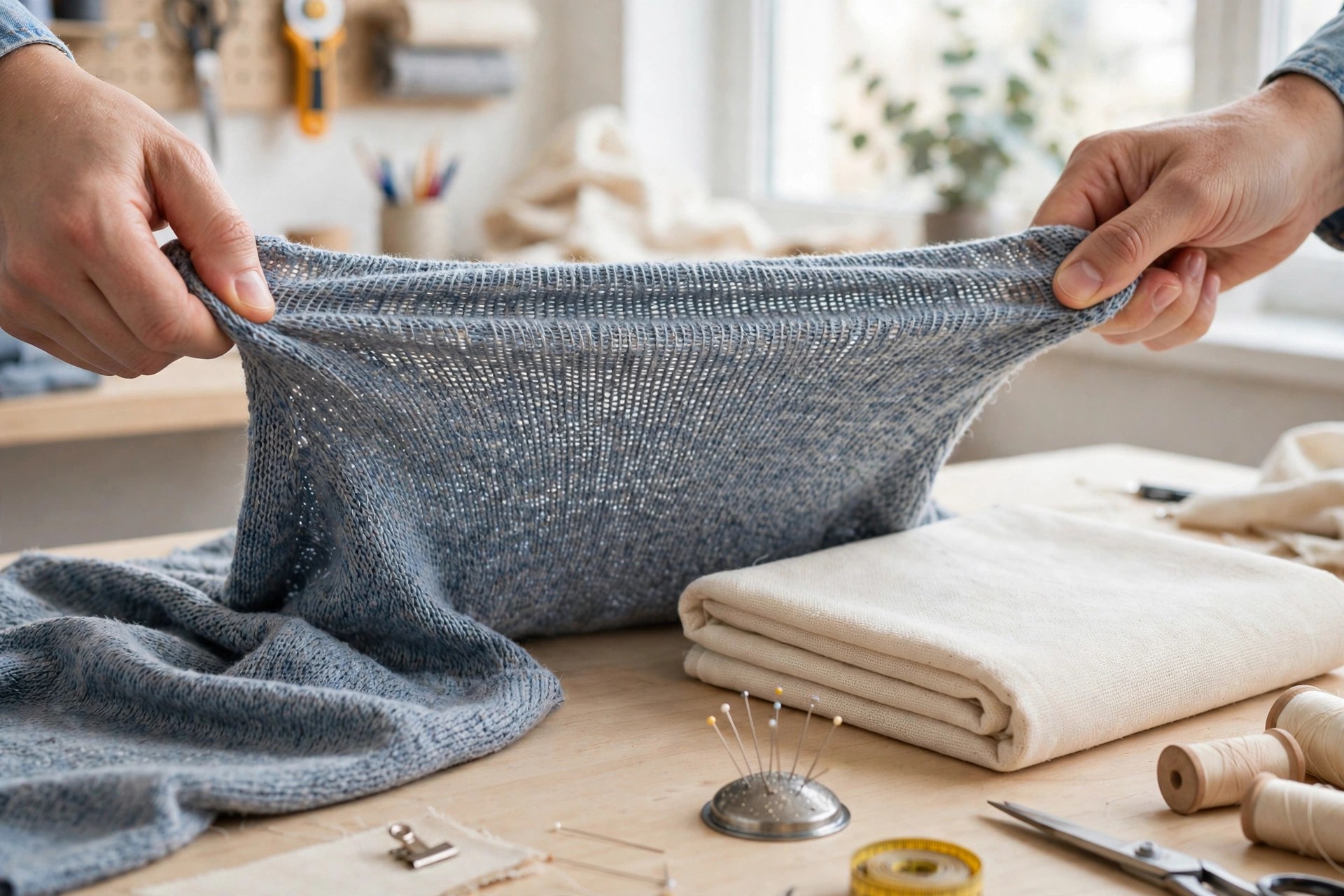
To identify an unknown fabric, stretch it gently across its width and then diagonally. Noticeable give across the width with quick recovery means knit; almost no give except a slight ease on the diagonal (the bias) means woven. Then check a cut edge: threads that can be teased out one by one are woven interlacings; a column of little V-shaped loops is a knit stitch.
Common Questions
Which is better, woven or knit fabric?
Neither — they solve different problems. Wovens are stable, crisp and shape-holding, which suits tailoring, shirts, trousers and denim. Knits are stretchy, soft and wrinkle-resistant, which suits T-shirts, sweaters, activewear and underwear. Most wardrobes need both, and many garments blend the families, such as stretch woven trousers or structured ponte knits.
Why do knit fabrics stretch but woven fabrics do not?
A knit's loops can change shape — straightening under pull and springing back — so the fabric extends even when the yarn itself does not stretch. A woven's yarns are locked at every interlacing point, so on the straight grain there is nothing to give; woven stretch comes from diagonal bias movement or from elastane yarns woven into the grid.
Do knit fabrics fray?
Knits do not fray the way wovens do, because there are no loose crosswise yarn ends to slide out. Instead, weft knits tend to curl at cut edges, and if a loop is cut or broken the stitches above it can unravel in a run or ladder. Woven cut edges fray but never ladder.
What is a stretch woven?
A stretch woven is a true woven fabric — warp and weft interlaced on a loom — with a small percentage of elastane, usually in the weft, sometimes in both directions. It keeps the stability, crease and tailored look of a woven while adding comfort stretch, and it is the standard construction for modern trousers, jeans and fitted jackets.
Back to the Weaving & Woven Fabrics Guide
The Weaving & Woven Fabrics hub maps the whole woven story — the loom cycle, loom types, structures and fabric types — and links onward to the knitwear cluster for the other half.