Non-Woven Fabric
Fabric Definitions — fabric and textile definitions from Apparel Search
Search Apparel Search
At a Glance
Definition: Non-woven fabric is a sheet made directly from fibers — neither woven nor knitted — laid into a web and bonded by adhesive, heat, water jets or needles, as felt has always been made.
Category: Fabric Definitions
Non-woven textiles are those which are neither woven nor knit — felt is the example the definition gives. Non-wovens are typically not strong unless reinforced by a backing, and they do not stretch, but they are cheap to manufacture. A non-woven fabric is made by putting small fibers together in the form of a sheet and binding them either with an adhesive or by interlocking them with serrated needles, so that inter-fiber friction produces the fabric. Modern non-wovens are mainly produced from man-made fibers, with polypropylene and polyester the dominant polymers.
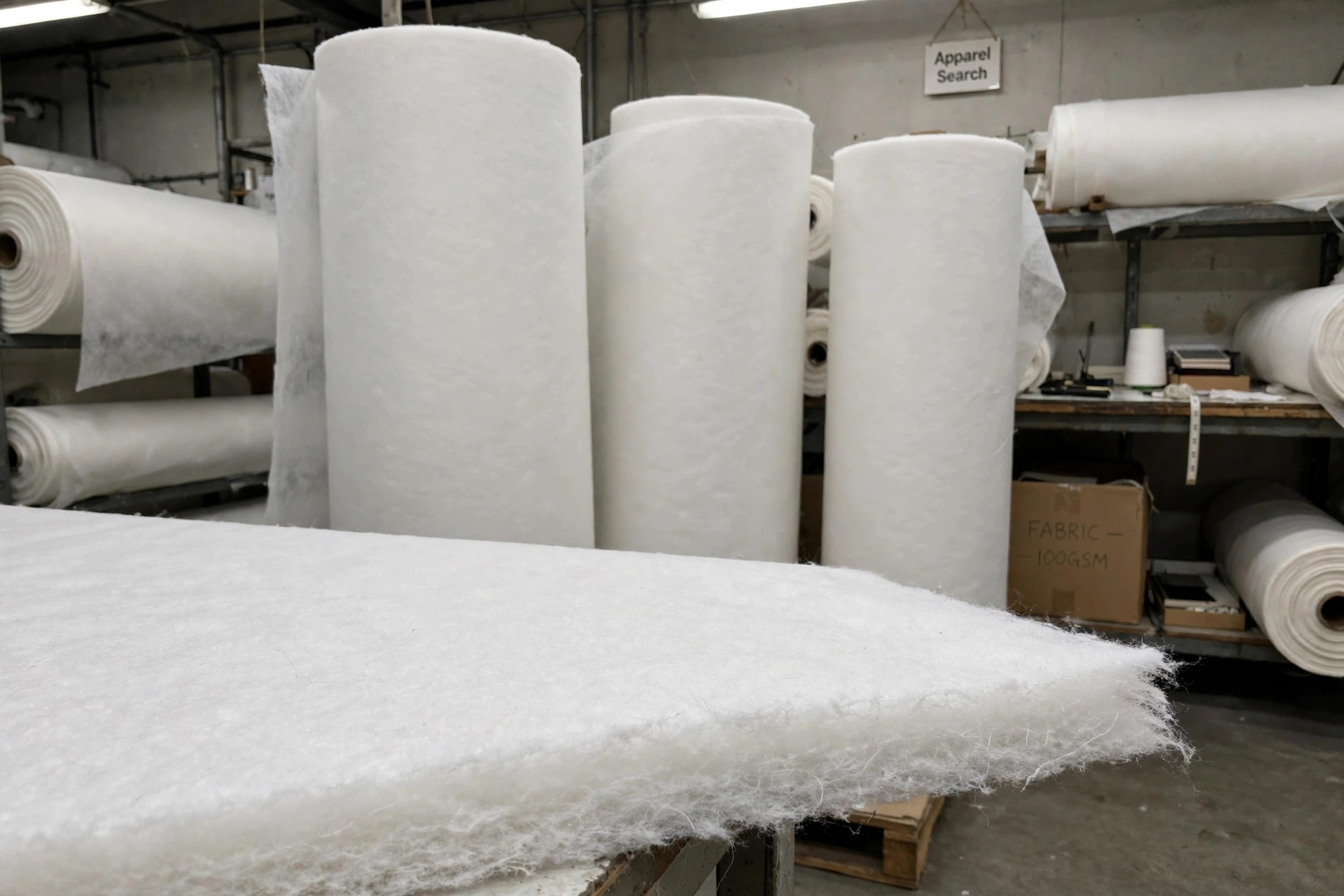
A Third Route to a Sheet of Fiber
Textile history has two classic ways to turn fiber into a sheet: interlacing yarns (weaving) and interlooping yarns (knitting). Non-wovens skip yarn entirely. Fibers — short staple or continuous filaments — are laid directly into a web and then bonded, so the sheet is fiber-scale rather than yarn-scale in structure. Every property difference follows. Without yarn geometry there is no grain, no bias stretch and no woven stability; the web is uniform in all directions or deliberately oriented, typically not strong and not stretchy unless reinforced or bonded heavily, exactly as the definition states.
What the route buys is speed and price: a spunlaid line converts polymer to finished fabric in one continuous pass, at volumes and costs weaving cannot approach, which is why non-wovens own the disposable and hidden-layer markets — interfacings, wipes, medical drapes, tea bags, filter media, geotextiles under roads, carpet backing — where a fabric is needed by the square kilometre and judged on engineered function rather than hand or drape.
Raw Materials and Applications
Non-woven materials are nowadays mainly produced from man-made fibers. Two synthetic polymers dominate the market: polypropylene and polyesters, mainly PET. The applications follow from the economics — enormous, consistent quantities of an engineered sheet, disposable by design where the use demands it. The definition's list runs: hygiene products (baby diapers, feminine hygiene, adult incontinence products), wipes, and domestic uses; and technical uses including filters, geotextiles, carpet backing and composites.
Making the Web: Staple and Spunlaid
Staple non-wovens are made in two steps. The fibers are first spun, cut to a few centimetres in length and put into bales; the bales are then dispersed on a conveyor belt, and the fibers are spread in a uniform web by a wetlaid process or by carding. Spunlaid non-wovens are made in one continuous process: the fibers are spun and directly dispersed into a web by deflectors. That technique leads to faster belt speeds and cheaper costs; several variants of the concept are available, but the leading technology is the Reicofil machinery manufactured by Reifenhauser in Germany.
Bonding: The Step That Makes the Fabric
Both staple and spunlaid webs would have no mechanical resistance in themselves without the bonding step, and several methods can be used. Thermal bonding calenders the web through heated rollers — called spunbond when combined with the spunlaid process. Hydro-entanglement intertwines the fibers mechanically with water jets. Needlefelt intertwines them with serrated needles — the needlefelting of the definition — and adhesive binding glues the web together. The bonding method decides the finished fabric's strength, softness and cost.
Felt: The Non-Woven Before the Word
Felt is named as the example because it proves the category is older than its industry: wool fibers, wetted, soaped and worked, mat together by their surface scales into a sheet with no weaving, knitting or adhesive — bonding by fiber interlocking alone, the same principle needlefelting mechanises with serrated needles. Modern synthetic non-wovens generalised that principle with polymer fibers and the bonding families above, each producing a distinct fabric character, from silky spunlace wipes to stiff needlefelt geotextiles.
For apparel readers, the most familiar non-woven is the fusible interfacing inside collars and waistbands, a web bonded to disappear inside a garment; for industry readers, the category is a materials platform specified by weight, bonding and polymer. Either way, the definition test is structural: if the sheet was neither woven nor knitted, it is non-woven, whatever it is called commercially.
Not to Be Confused With
A non-woven is not simply felt. Felt is the classic non-woven — wool fibers matted together by their own surface scales, with no weaving, knitting or adhesive — but “non-woven” names the whole class of fabrics made by laying fibers into a web and bonding them, by heat, water jets, needles or adhesive. Every felt is a non-woven; most modern non-wovens, made from polypropylene or polyester, are not felt.
Common Questions
How is a non-woven fabric held together?
The fiber web has no mechanical resistance on its own, so a bonding step creates the fabric: thermal bonding by calendering through heated rollers, hydro-entanglement by intertwining fibers with water jets, needlefelting by intertwining with serrated needles, or adhesive binding. The bonding method decides the fabric's strength, softness and cost.
What is the difference between staple and spunlaid non-wovens?
Staple non-wovens are made in two steps: fibers are spun, cut to a few centimetres, baled, then spread into a uniform web by wetlaid processing or carding. Spunlaid non-wovens are made in one continuous process — fibers are spun and directly dispersed into a web by deflectors — which gives faster belt speeds and cheaper costs, and combined with thermal bonding is called spunbond.
Why are non-wovens used for diapers and wipes?
Because they are cheap to manufacture in enormous, consistent quantities, can be engineered soft, absorbent or repellent as the layer requires, and are disposable by design. The definition's application list runs from baby diapers, feminine hygiene and adult incontinence products to wipes — hygiene is the largest non-woven market, alongside domestic, filter, geotextile and carpet-backing uses.