Felt
Fabric Definitions — fabric and textile definitions from Apparel Search
Search Apparel Search
At a Glance
Definition: Felt is a cloth made without weaving — a non-woven produced by matting, condensing and pressing fibres together into a single sheet.
Category: Fabric Definitions
Felt is a cloth made without weaving. It is a non-woven material, produced by matting, condensing and pressing fibres together until they hold as one sheet. One of its best-known apparel forms is loden, a type of felt originally worn in the Alpine regions that has gained worldwide acceptance as a textile for fine and durable clothing.
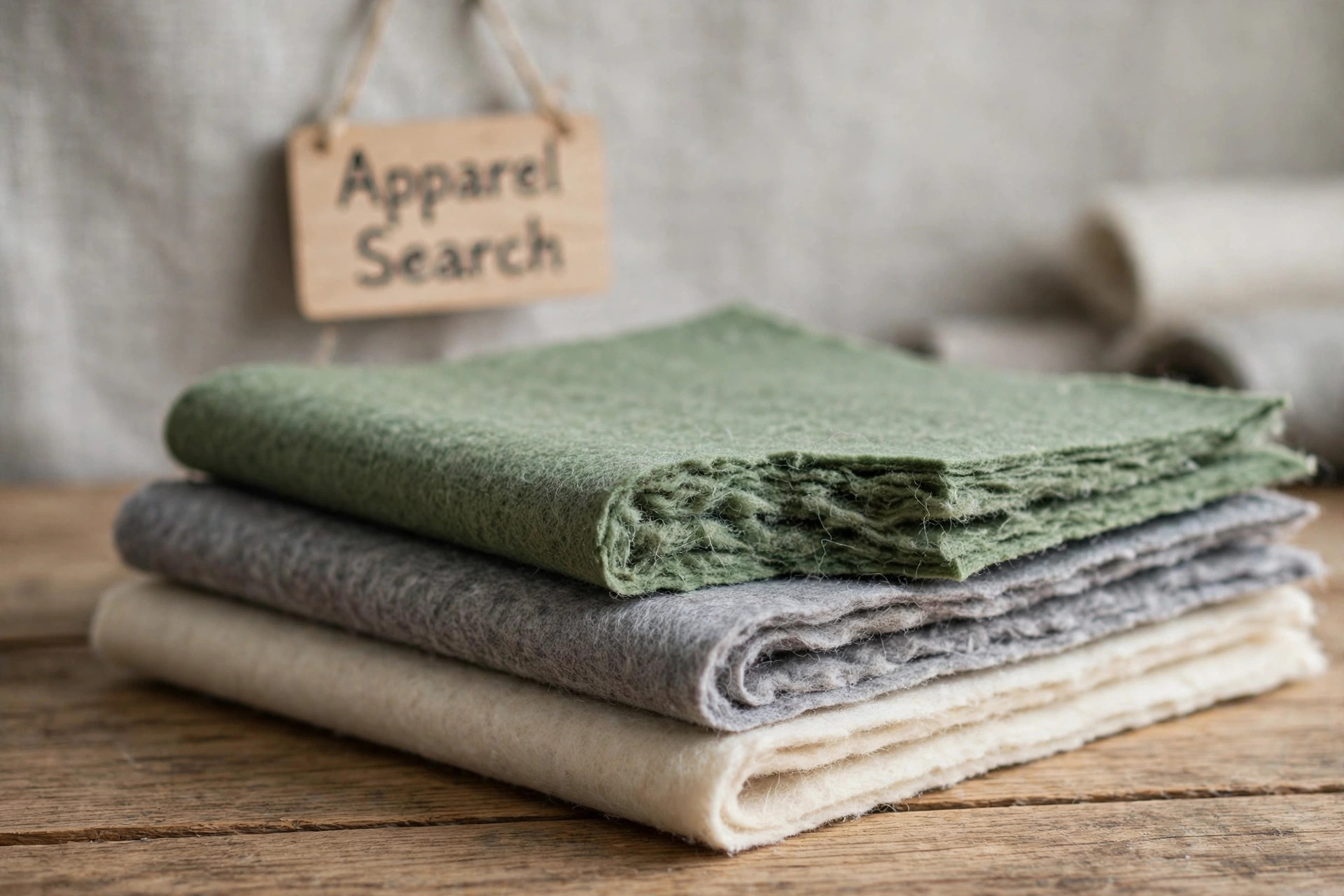
The Oldest Cloth Structure
Felt needs no loom, no spinning and, strictly, no yarn: loose fibre, water, heat and pressure are enough, which is why felting is plausibly the oldest textile technology, older than weaving in the regions where woolly sheep provided the raw material. Wool fibres are covered in microscopic scales pointing toward the fibre tip; under heat, moisture and pressure the fibres migrate in one direction and the scales interlock, tangling the mass into a single sheet that cannot be pulled apart fibre by fibre. That one-way ratchet is the felting mechanism, and smooth fibres such as most synthetics felt poorly or not at all without blending or mechanical needling.
The process scales in both directions. At the domestic end, a maker lays out batts of carded wool, wets them, and rolls or rubs them until the sheet consolidates — the shrinkage is the felt forming, as the fibres pull the mass tighter while they lock. At the industrial end, needle-punching and steam pressing produce felt in engineered grades: soft felt for hat bodies and craft sheets, and hard pressed felt for gaskets, seals, polishing wheels and piano hammers, where the same fibre-locking that makes a yurt wall makes a precision component. One mechanism, tuned by fibre choice and pressure, covers the whole range.
Wet Felting and Needle Felting
Wet felting mats loose fibres into sheet felt using water, heat and pressure or rolling — the traditional route to cloth. Needle felting works dry: barbed needles push the fibres into one another mechanically, entangling them without water. It is the method used for sculpted felt figures, and, at industrial scale, banks of barbed needles entangle a whole fibre web into needle-punched felt sheet.
What Felt Does That Woven Cloth Cannot
Felt's non-woven structure gives it properties no weave matches. It has no grain, so it cuts in any direction and the cut edge does not fray — there are no threads to unravel — which makes it the default material for appliqué shapes, insoles, craft work and gaskets. It is uniformly dense, so it insulates, deadens sound and cushions impact evenly across the sheet, and it absorbs vibration in machinery mountings.
Its limits are the same structure's other face: felt has lower tensile strength than a woven cloth of the same fibre, it stretches and distorts under sustained load, and once felted it cannot be un-felted or adjusted. Apparel felt therefore lives where those trade-offs win — hats shaped from a single felt hood, loden coats, slippers and linings — while woven and knitted cloth carry the loads that need strength in a direction. Felt is not a failed weave but a different answer: fibres locked directly, with nothing in between.
Loden
Loden is a felted wool cloth originally worn in the Alpine regions — dense, fulled and weather-resistant, traditionally in dark green — which has gained worldwide acceptance as a textile for fine and durable clothing such as coats, jackets and hats. It shows felt construction carried to apparel quality: the same matted, pressed structure as craft felt, finished to a standard a tailored garment can use.
Not to Be Confused With
Felt is often confused with non-woven fabric generally, but the words work at different levels. Non-woven is the broad class of fabrics made by bonding or entangling fibres rather than weaving or knitting them — a class that includes chemically bonded and needle-punched materials of many kinds. Felt is the specific, older member of that class: fibres matted, condensed and pressed together, traditionally wool fibres locked by their own scales. Every felt is a non-woven; not every non-woven is felt.
Common Questions
How does felt hold together without weaving?
Wool fibres are covered in microscopic scales pointing toward the fibre tip. Under heat, moisture and pressure the fibres migrate in one direction and the scales interlock, tangling the mass into a single sheet that cannot be pulled apart fibre by fibre. That one-way ratchet is the felting mechanism; smooth fibres such as most synthetics felt poorly or not at all without blending or mechanical needling.
What is the difference between wet felting and needle felting?
Wet felting mats loose fibres into sheet felt using water, heat and pressure or rolling. Needle felting uses barbed needles to push fibres into one another mechanically, dry — the method for sculpted felt figures and for industrial needle-punched felts, where banks of barbed needles entangle a fibre web into a sheet.
What is loden?
A type of felted wool cloth originally worn in the Alpine regions — dense, fulled and weather-resistant, traditionally in dark green — which gained worldwide acceptance as a textile for fine and durable clothing such as coats, jackets and hats. Loden shows felt construction carried to apparel quality.