Jeans
Clothing Definitions — definitions of garments and clothing terms from Apparel Search
Search Apparel Search
At a Glance
Definition: Jeans are trousers made from denim, originally sturdy work trousers, defined by their five-pocket cut, riveted stress points and indigo-dyed cotton twill.
Also known as: Blue jeans (the classic indigo form)
Category: Clothing Definitions
Word Origin
Both of the garment's names are place names worn smooth. Jeans comes from the French Gênes, the name of Genoa, the Italian port whose sailors wore the cloth; denim comes from serge de Nîmes — the serge of Nîmes, the French town the fabric came from. See the Denim Definition.
Jeans are trousers made from denim. Originally work clothes, they became popular among teenagers starting in the 1950s and are now the most widely worn trouser style in the world; the best-known makers include Levi's and Wrangler, and the category is surveyed in our fashion products section's page on jeans. The garment's two names preserve its double origin: a hard-wearing cloth associated with Genoa, Italy, and a fabric from Nîmes, France. This page explains those origins, the American rivet patent that created the modern jean, how jeans are constructed and fitted, and how a work trouser became a universal garment.
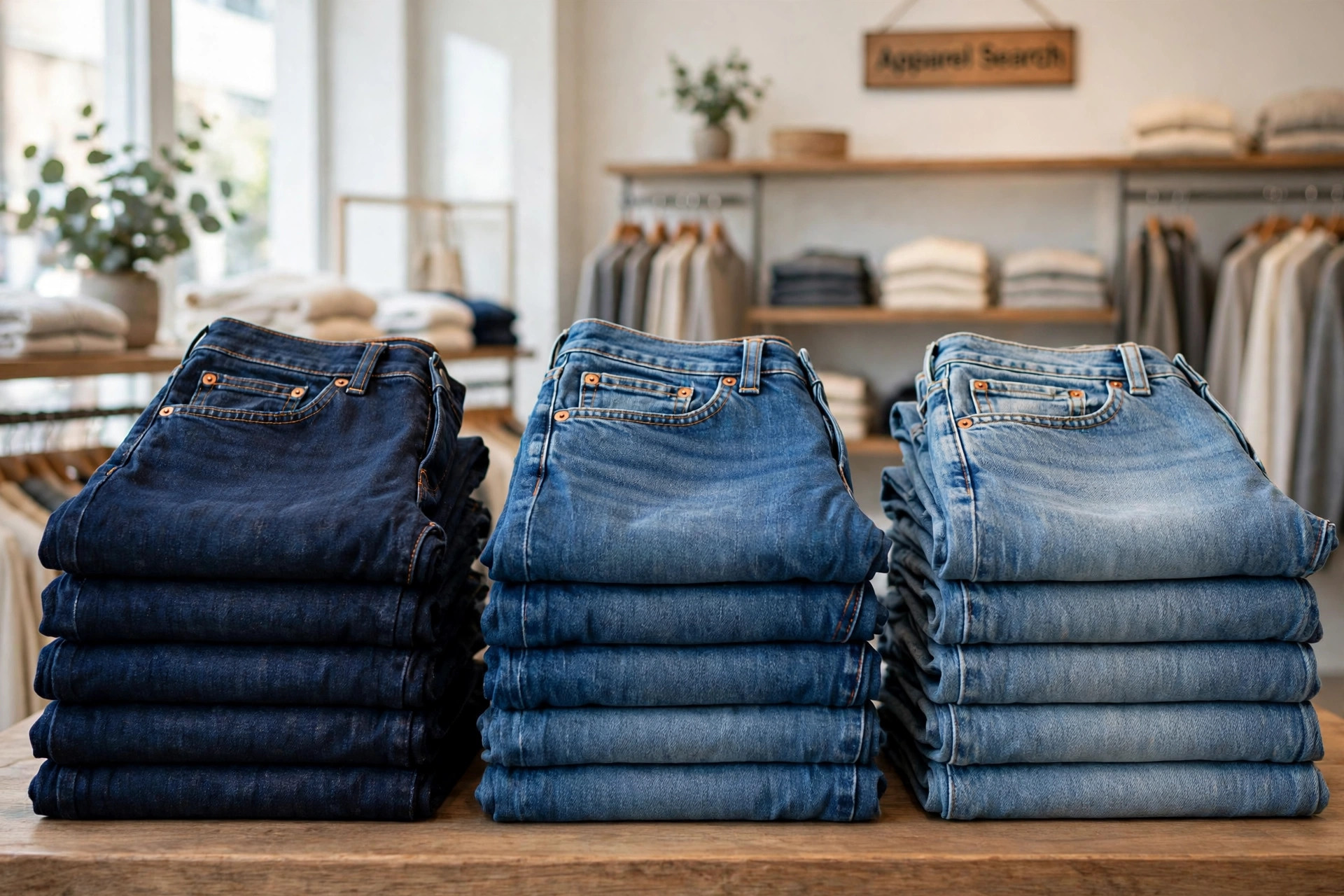
What Jeans Are: Construction
A pair of jeans is defined by its cloth and its construction together. The cloth is denim, a sturdy cotton twill traditionally dyed with indigo so that the warp threads are blue and the weft threads white — the source of the classic blue jean's colour and of the way it fades with wear. The construction is the five-pocket Western pattern: two front pockets, two back pockets and a small watch pocket, a button or zip fly, belt loops, and seams stitched in contrasting thread. Heavier denim weights make work jeans; lighter weights and stretch blends make fashion jeans, but the pattern persists through both.
The feature that turned a denim trouser into the jean is the rivet. Copper rivets reinforce the points of strain — the pocket corners and the base of the fly — where stitched trousers tore apart under work loads. Rivets, the five-pocket pattern and indigo denim are the three elements that have survived every change of fashion since, and a garment with all three is recognisably a jean whatever its fit or finish.
Origins: Genoa, Nîmes and an American Patent
Jeans were first made in Genoa, when that city was an independent republic and a naval power, for the Genoese navy, which required an all-purpose trouser for its sailors that could be worn wet or dry and rolled up for swabbing decks. The first denim came from Nîmes, France — hence the fabric's name — and the French word for the Genoese trousers was close to their word for Genoa itself, which is where the term jeans comes from. Durable cotton trousers of this family were workwear on both sides of the Atlantic long before they were a fashion.
The modern jean was created in America. In 1853 Levi Strauss came to San Francisco to open a West Coast branch of his brothers' New York dry-goods business. One of his customers was Jacob Davis, a tailor who bought cloth from the Strauss wholesale house. After a customer's wife kept asking for stronger trousers for her husband, Davis had the idea of using copper rivets to reinforce the points of strain — the pocket corners and the base of the button fly. Davis lacked the money for a patent, so he wrote to Strauss proposing they go into business together. Strauss accepted, and on May 20, 1873, the two men received United States patent 139,121 for riveted work trousers. The blue jean was born.
Workwear: Miners, Farmers and Cowboys
Riveted jeans were work equipment first, and the workwear market was led by three names — Levi's, Wrangler and Lee — whose riveted and reinforced models set the pattern other makers followed. Miners, farmers, railroad workers and cowboys wore them because the riveted construction survived loads and abrasion that destroyed ordinary trousers, and the heavy denim protected the legs in the saddle and at the rock face. Wrangler jeans, traditionally cut for western wear and made in denim up to 15 ounces — heavier than most rivals — became the cowboy's standard, in regular or slim fits with straight or boot-cut legs shaped to go over boots. In this period jeans were bought by occupation, not by style, and were expected to be worn until they wore out.
The workwear era also established the shrink-to-fit tradition. Early jeans were sold unshrunk, in few sizes, and the wearer shrank them to a personal fit by wearing them into water and letting them dry on the body. That practice survives as a deliberate choice: jeans are still sold both pre-washed, softened and stabilised before sale, and shrink-to-fit, stiff and dark, for wearers who want the fit and the fade to be their own work.
From Protest Symbol to Wardrobe Staple
In the United States during the 1950s, blue jeans worn by teenagers and young adults came to symbolise mild protest against conformity — strongly enough that some movie theatres refused to admit patrons wearing them. During the 1960s the wearing of blue jeans became more acceptable, and by the 1970s they had become general fashion for informal wear. Outside the United States, and particularly in Soviet-era Russia, blue jeans symbolised American culture and the good life precisely because they were imported American products.
The 1970s and 1980s added the designer jean: brands such as Jordache, Seven for All Mankind and True Religion sold the work trouser as a premium fashion garment — the story told in our Designer Jeans guide — alongside the established workwear names and newer labels such as Diesel. Jeans are now made and worn for every market segment, in dedicated guides for women's jeans, men's jeans and children's jeans, and compared in our Best Jeans survey.
Fits, Finishes and Care
Modern jeans are specified by fit, leg, rise and finish. Fits run from skinny through slim and straight to relaxed and loose; legs are straight, tapered, boot-cut or flared; the rise — the distance from waistband to crotch seam, the subject of the rise terminology — decides where the waistband sits, and named styles such as mom jeans fix a whole combination of high rise, relaxed thigh and tapered leg. Cropped lengths shade into capri pants, and cut-off jeans into Daisy Dukes and shorts. Finishes do the rest: stone-washing, whiskering and distressing reproduce in the factory the wear that work once produced naturally.
Care follows from the cloth. Indigo sits on the surface of the yarn rather than through it, so jeans fade where they crease and rub — the quality wearers prize and the reason jeans are washed inside out, in cool water, and as seldom as appearance allows. Denim also softens and shapes itself to the wearer over time, which is the modern form of the old shrink-to-fit idea: a pair of jeans is one of the few garments that is genuinely finished by being worn. As a pants style, the jean has outlasted every fashion that adopted it, because its definition — denim, five pockets, rivets — is a construction, not a look.
Not to Be Confused With
Jeans are a garment; denim is the fabric they are made from. Denim is a cotton twill, traditionally indigo-dyed, and it is used for many garments besides jeans — jackets, skirts, shirts and overalls among them. Jeans are the specific trouser: five pockets, rivets at the strain points, a fly and belt loops. A denim jacket is denim but is not jeans; a pair of jeans in a non-denim fabric is, strictly, a five-pocket trouser in the jeans pattern rather than true jeans. Garment versus fabric is the whole distinction.
Common Questions
What are jeans?
Jeans are trousers made from denim, a sturdy indigo-dyed cotton twill. They are defined by their five-pocket cut and by copper rivets reinforcing the points of strain, and were originally work clothes.
Where do the words jeans and denim come from?
Jeans comes from the French name for Genoa, Italy, whose sailors wore the cloth. Denim comes from serge de Nîmes, the serge of Nîmes, France, where the fabric was made.
Who invented modern jeans, and when?
Levi Strauss and tailor Jacob Davis received United States patent 139,121 on May 20, 1873, for trousers reinforced with copper rivets at the pocket corners and the base of the fly — the construction that created the modern blue jean.