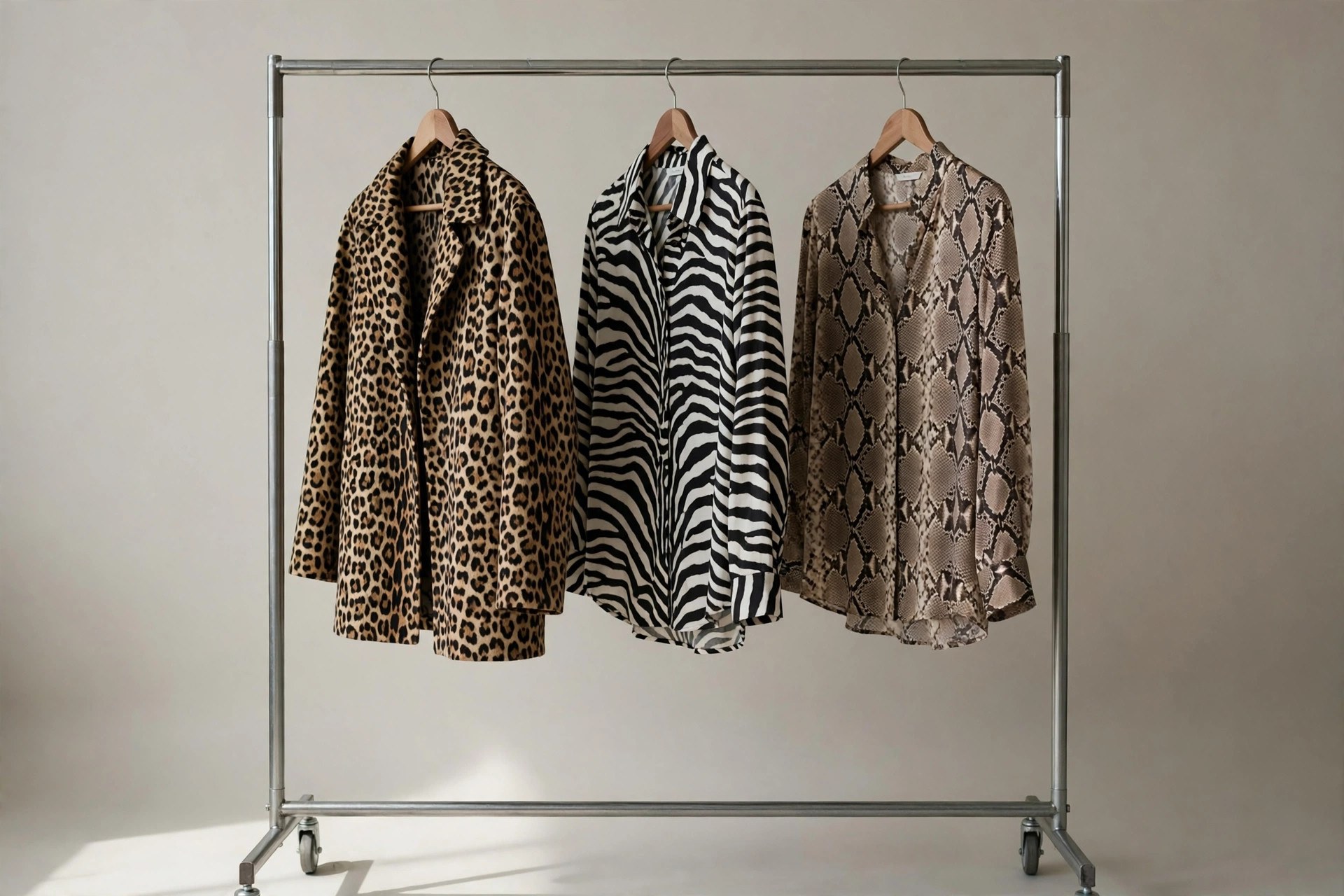
Animal prints are patterns and textures copied from animal coats and skins — spots, stripes, scales and markings reproduced on fabric, leather and faux leather. They occupy a special place in fashion because they behave both as pattern and as neutral: a leopard coat or a snake-print bag can anchor an outfit the way a plain color does, while still carrying unmistakable character. This overview shows how to tell the main prints apart, which ones read classic and which read playful, and the simple rules that make any of them work.
Telling the Prints Apart
Leopard is the benchmark: irregular rosettes — broken rings of black around a darker golden center — scattered over a tan ground, at a medium scale with moderate contrast. Zebra is the opposite geometry, bold black-and-white stripes of varying width that flow around the body. Snake print is made of interlocking scale shapes, usually in low-contrast greys and browns, so it reads almost as texture.
Crocodile barely counts as a print at all: it is an embossed texture of large rectangular tiles, usually in one solid color, carried by bags, belts and boots. Giraffe print uses large, irregular chestnut patches separated by cream lines, like a mosaic, at the biggest scale of any common animal print.
Classic Prints and Playful Prints
The prints split into two temperaments. Leopard, snake and crocodile read classic: their palettes come straight from nature — tan, grey, brown, black — their scales are moderate, and they have been in continuous use for so long that a leopard coat or a croc-embossed bag reads as a wardrobe staple rather than a novelty.
Dalmatian, cow, giraffe and tiger read playful. Their scales are larger, their contrasts stronger or their shapes more cartoon-like, and they carry a sense of humor that suits casual clothes, festival and holiday dressing, and single fun accessories.
The Styling Rules That Always Work
Three rules cover most situations. First, one print per outfit: let a single animal-print piece lead, and build the rest from plain colors drawn from the print itself, which is why these patterns pair so reliably with black, white, denim, camel and khaki.
From here, go deeper on the prints in this series: the Snake Print guide covers scale patterns and embossed accessories, the Dalmatian Print guide shows how to keep black-and-white spots chic, and the Crocodile Print guide explains mock croc quality and care. For the two classics not covered in this series, see our Leopard Print Dress Guide and the Zebra Prints Clothing Guide, which cover those patterns in the same practical detail.
Common Questions
- How many animal prints are there in fashion?
- Eight appear constantly: leopard, zebra, snake, dalmatian, crocodile, tiger, giraffe and cow print, with cheetah often grouped alongside leopard. Each copies a real animal's coat or skin and can be identified by three things — the shape of the marking, the scale of the pattern and the contrast between its colors. Leopard's rosettes, zebra's flowing stripes, snake's interlocking scales and crocodile's embossed tiles are all unmistakable once you know what to look for, and the rest of this guide gives the full comparisons.
- Which animal print is the most classic?
- Leopard is generally considered the most classic, followed closely by snake print and croc embossing. Their natural tan, grey and brown palettes, moderate scales and long history in wardrobes mean they read as neutrals rather than novelties: a leopard coat, a snake-print bag or a croc-embossed belt works in settings where brighter prints would not. Dalmatian, cow, giraffe and tiger prints sit at the playful end of the family, with bigger scales and stronger contrasts that set a fun mood.
- Can you wear two animal prints together?
- It is the hardest move in this family and usually best avoided. Two animal prints compete because both are organic, attention-drawing patterns, and the result normally looks accidental rather than styled. If you want to try it, make one print much smaller in scale than the other and keep both in the same color family, so one clearly leads. An easier mix is one animal print with a simple geometric pattern, such as a plain stripe or check, in a color taken from the animal print itself.
- How do you wear animal print without overdoing it?
- Use the one-print rule: choose a single animal-print piece — a dress, a coat, a pair of boots or a bag — and keep everything else plain, picking colors from inside the print such as black, white, tan or denim. Accessories are the gentlest entry point, since a leopard shoe or a croc-embossed belt adds the effect in a small dose. Fit and fabric quality do the rest: animal print on a well-cut garment in a natural palette looks intentional, while loud colors and poor fabric are what make it look overdone.
Animal Print Guides
Four pattern families, four very different moods. These guides cover snake, dalmatian and crocodile prints in detail, plus an overview that shows how to tell all the major animal prints apart and wear each one well.