Apparel Search · Fabric Construction Guide
Basic Weave Structures: Plain, Twill and Satin
Three interlacing patterns — one-over-one-under, the stepping diagonal, and the long float — generate nearly every woven fabric in production, including the basket, rib and herringbone variations built from them.
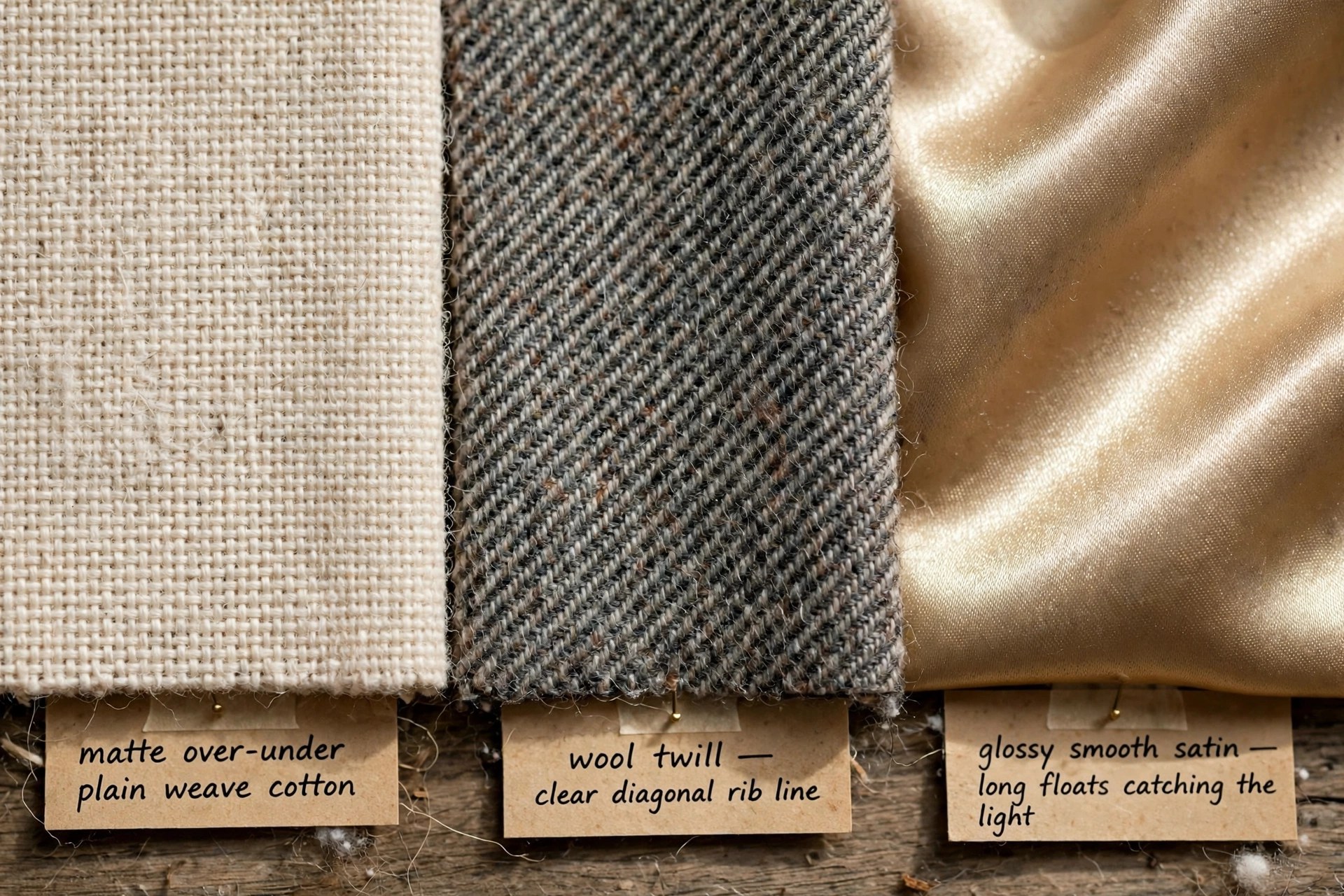
A weave structure is nothing more than the rule that decides, for every pick, which warp threads rise and which stay down. Three rules — plain weave, twill and satin — between them account for the overwhelming majority of woven cloth, and most other structures are variations, combinations or elaborations of these three. Learn to recognize them and you can identify the construction of almost any fabric on a store rack. This spoke of the Weaving & Woven Fabric Construction guide takes each structure in turn; the Apparel Search definition of plain weave gives the glossary-level version of the first.
Plain Weave: One Over, One Under
In plain weave each weft yarn passes over one warp end and under the next, and the following pick reverses the pattern, so every yarn is bound at every crossing. It is the simplest structure to weave — two harness frames suffice — and the most interlaced, which makes plain-weave cloth firm, stable and resistant to yarn slippage, with the same appearance on both faces when warp and weft are balanced. More fabric is woven plain than in any other structure: muslin, lawn, cambric, voile, organdy, percale sheeting, canvas and taffeta are all plain weaves, differing in fiber, yarn size and density rather than structure. The poplin fabric guide shows what happens when a plain weave is engineered with a much finer, denser warp than weft — a fine crosswise rib appears, and a shirt fabric is born.
Twill: The Stepping Diagonal
Twill interlaces each weft over two (or more) warp ends and under one (or more), then steps the pattern sideways by one end on the next pick. The steps accumulate into the diagonal lines — the wale — that make twill instantly recognizable. Notation such as 2/1 or 2/2 describes how many ends the weft passes over and under in one repeat; a 2/2 twill is balanced and shows equally on both faces, while a 3/1 warp-faced twill hides the weft almost completely. Twills drape better than plain weaves of the same weight, resist showing soil along their diagonals, and pack more yarn into a given area, which is why they dominate workwear and bottoms: denim, gabardine, chino, drill and most flannels are twills. Twill for denim specifically — right-hand, left-hand and broken twills — is covered in the types of denim weave spoke of the Denim Fabric Guide.
Satin and Sateen: The Long Float
Satin weave binds the weft down at widely spaced, deliberately scattered points and lets it — or, classically, the warp — float over four or more threads between bindings. Few interlacings mean little light scatter at the surface, so the floats present an unbroken, lustrous face: that is the whole secret of satin's shine. True satin is warp-faced, traditionally woven with filament silk or polyester warp. Its mirror image, sateen, is weft-faced and usually spun cotton, giving a softer, lower luster. The price of the floats is durability: long floats snag and abrade, and satin-faced fabrics show wear sooner than plain weaves of equal yarn. Satin weave also anchors the patterned structures — damask draws its designs purely by contrasting satin-faced and sateen-faced areas of the same cloth.
| Structure | Interlacing rule | Surface character | Typical fabrics |
|---|---|---|---|
| Plain weave | 1 over / 1 under, alternating every pick | Matte, even, same on both faces | Muslin, lawn, voile, percale, canvas, taffeta, poplin |
| Twill | Over 2+ / under 1+, stepping one end per pick | Visible diagonal wale; good drape | Denim, gabardine, chino, drill, flannel |
| Satin | Floats over 4+ threads, bindings scattered | Smooth, lustrous warp face | Bridal and lining satins, charmeuse |
| Sateen | Weft-faced version of satin | Soft sheen, smooth hand | Cotton sateen shirting and sheeting |
| Basket weave | Plain weave with 2+ yarns bundled as one | Bold checkerboard texture | Oxford cloth, monk's cloth |
| Rib weave | Plain weave with a strongly uneven warp/weft balance | Fine ribs across or along the cloth | Poplin, grosgrain, bengaline |
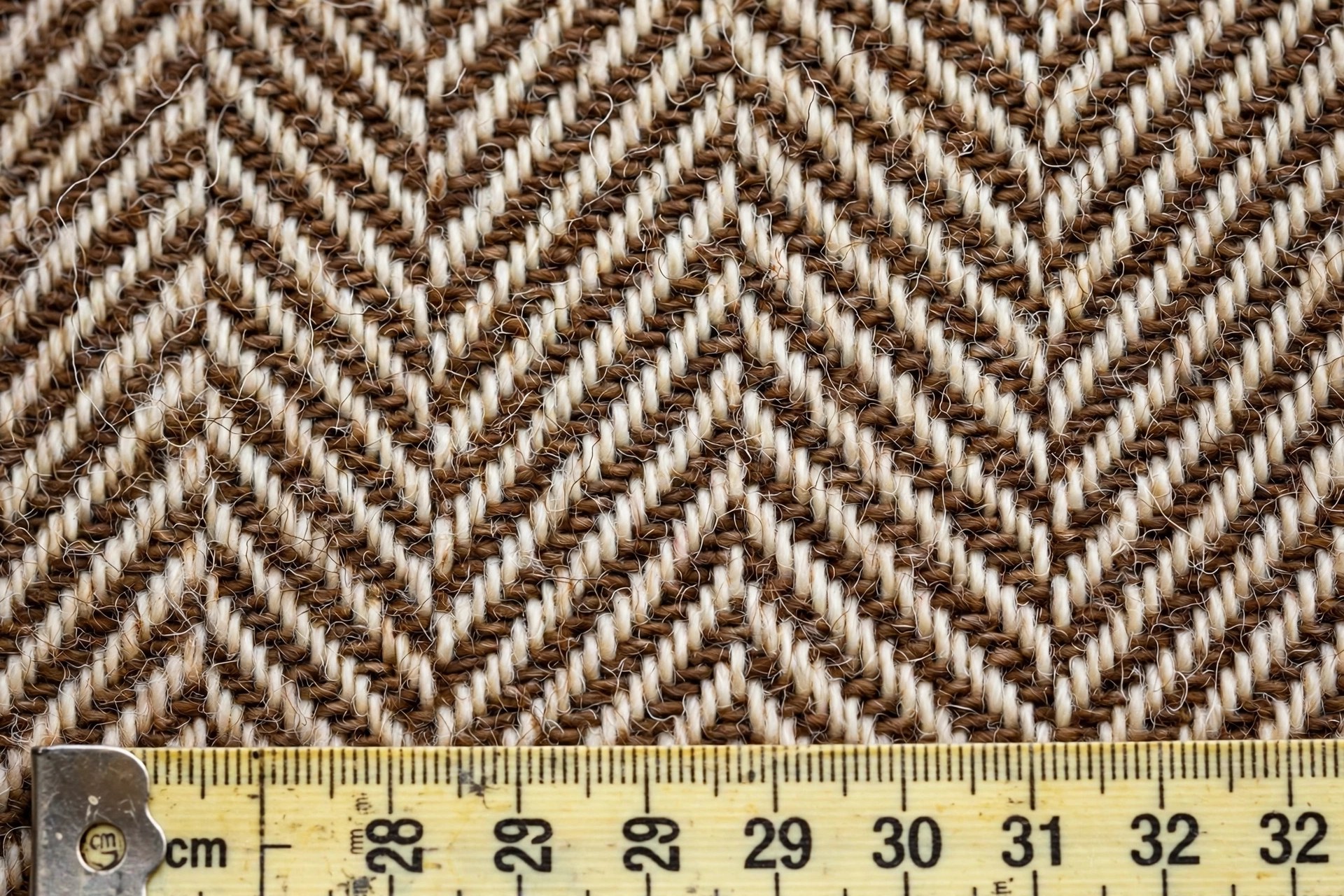
| Herringbone | Twill whose direction reverses at intervals | Broken zigzag diagonals | Suiting and coating tweeds |
Derivatives: Basket, Rib and Herringbone
Basket weave runs plain weave with two or more yarns grouped and treated as a single unit in warp, weft or both, magnifying the checkerboard into a chunky, breathable texture — Oxford shirting is a fine basket weave. Rib weaves keep plain interlacing but unbalance the yarn sizes or counts sharply: a heavy weft under a fine, dense warp raises crosswise ribs (poplin, grosgrain), while the reverse arrangement ribs lengthwise. Herringbone is a twill that periodically reverses its diagonal direction, breaking the wale into the zigzag chevron columns of classic suitings — proof that a derivative needs no new interlacing logic, only a new stepping pattern.
How Structure Drives Fabric Behavior
Interlacing frequency is destiny. Plain weave's maximum interlacing makes it the firmest and most stable structure but limits how much yarn can be packed in; twill's fewer crossings allow heavier, more pliable cloth; satin's sparse bindings maximize smoothness and luster at the cost of snagging. When a fabric disappoints — a lining that shreds, a shirting that skews — the structure is usually where the explanation starts, and the Textile Testing & Quality Standards guide shows how the resulting properties are measured. Structures also combine: a single cloth may stripe plain weave against twill or satin, which leads directly to the patterned-weaving machinery of the dobby and jacquard spoke.
Common Questions
What are the three fundamental weave structures?
Plain weave, twill and satin. Plain weave interlaces one over and one under in strict alternation. Twill passes the weft over two or more warp ends and under one or more, stepping sideways each pick to form diagonals. Satin floats yarns over four or more threads between scattered binding points, creating a smooth lustrous face. Most other structures are derivatives or combinations of these three.
What does 2/1 twill mean?
The numbers describe one repeat of the interlacing: the weft passes over 2 warp ends, then under 1, and the pattern steps one end sideways on each successive pick. A 3/1 twill floats over three and under one and is strongly warp-faced, which is why it is the classic denim construction — the indigo warp dominates the surface.
What is the difference between satin and sateen?
Both use the satin interlacing rule of long floats with scattered bindings, but satin is warp-faced — the warp floats on the surface, classically filament silk or polyester — while sateen is weft-faced and usually made from spun cotton yarns. Sateen has a softer, more muted sheen and a warmer hand.
Why is plain weave the most common structure?
It needs only two harness frames, interlaces at every crossing for maximum stability, looks the same on both faces, accepts printing and finishing well, and works across the widest range of yarns and densities. Muslin, lawn, percale, canvas, voile and taffeta are all plain weaves distinguished by fiber and yarn, not structure.
Back to the Weaving & Woven Fabrics Guide
The Weaving & Woven Fabrics hub maps the whole construction story — the loom cycle, loom types, patterned weaving and the named fabrics each structure produces.