Children's Jeans Guide
Children's jeans are denim trousers built for the hardest-wearing job in a child's wardrobe: school days, playgrounds, bikes, floors sat on cross-legged, and knees used as brakes. Denim's twill weave is what makes the garment work - the diagonal rib that gives jeans their toughness, their fade pattern and their ability to look better after a term of wear than most trousers look after a week. This page's links lead onward to the apparel category of jeans as a whole. This guide stays on the children's garment: the fits that translate to growing legs, the waist systems that make ready-sized jeans fit real waists, and the construction details that decide whether a pair lasts until it is outgrown.
Shop Children's Jeans Now
Shop Children's Jeans on Amazon Shop Children's Jeans on eBayThe Amazon and eBay links on this page are affiliate links. If you make a purchase through them, Apparel Search may earn a commission.
Children's jeans are denim trousers built for the hardest-wearing job in a child's wardrobe: school days, playgrounds, bikes, floors sat on cross-legged, and knees used as brakes. Denim's twill weave is what makes the garment work - the diagonal rib that gives jeans their toughness, their fade pattern and their ability to look better after a term of wear than most trousers look after a week. This page's links lead onward to the apparel category of jeans as a whole. This guide stays on the children's garment: the fits that translate to growing legs, the waist systems that make ready-sized jeans fit real waists, and the construction details that decide whether a pair lasts until it is outgrown.
Whatever type of pant kids are wearing is in fashion today - and jeans are the clearest proof of it. Straight, relaxed, skinny, bootcut and wide-leg children's jeans all sell at the same time, because fit in children's jeans is mostly about comfort and activity rather than a single fashion silhouette. Choose the fit by how the child moves - climbing, cycling, sitting on the floor - and let the current style be a tiebreaker between two pairs that both fit and move well.
Styles and Fits
Straight-leg jeans run the same width from knee to hem and suit the widest range of children and shoes. Relaxed fits add room through the seat and thigh, which active children and children who dislike any tightness usually prefer, while slim and skinny fits follow the leg closely in stretch denim and suit children who dislike loose fabric around the ankle. Bootcut legs widen slightly below the knee to sit over boots and chunky trainers. Shorts and cropped cuts in the same denims appear in summer ranges, and jeans with a pull-on, elasticated waist and a decorative fly serve younger children who are managing dressing and school toilets independently and need no button or zip at all.
Denim itself varies more than the color suggests. Classic jeans are 100 percent cotton denim - the toughest and the slowest to soften, breaking in over the first several wears and washes. Most children's jeans now blend a small amount of elastane into the cotton, which transforms comfort at the knee and waist without giving up much durability, and lighter-weight denims make summer pairs while heavier denims make the longest-wearing school pairs. Finishes are the surface story: dark, even washes dress up more easily and fade gradually, stonewashed and distressed finishes start soft and faded, and any pre-made holes or heavy distressing at the knee is a head start toward the pair wearing through exactly there.
Fit and Waist Systems
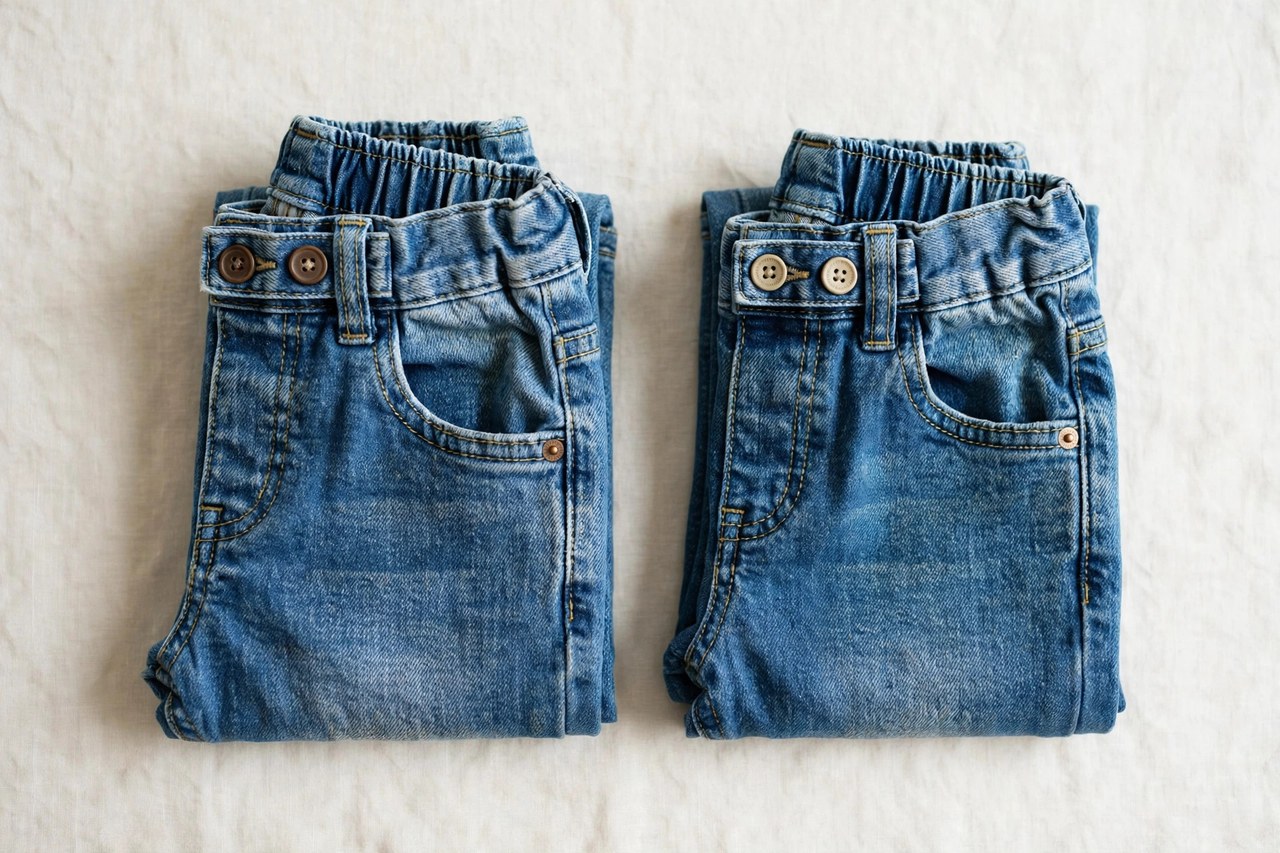
The adjustable waistband is the single most useful invention in children's jeans: an elastic strip inside the waistband on each side, pulled through to buttonholes to take the waist in - sometimes by several centimetres - and let out again as the child grows. It solves the classic mismatch of a waist size that fits the hips and length but gaps at the back, and it extends a pair's useful life across a growth spurt. For younger children, a fully elastic or part-elastic back waist does the same job with no adjustment needed. Check that the adjustment buttons sit flat and that spare buttonholes run far enough to matter - two settings is a gesture, six is a system.
Fit the rest of the jean in motion, as with everything in this letter. The waist should stay up through sitting, bending and a jump without a belt doing structural work. The inseam should break just at the shoe for straight and relaxed fits: an inch of extra length for growing room can be turned up, while several inches pooled at the ankle trips, frays and soaks up wet pavements. Rise - the distance from waist to crotch seam - decides sitting comfort, and a rise that is too low will be hitched up all day. If a child is between sizes, the adjustable waist usually makes the larger length the better buy, because the waist can be taken in while the leg length cannot be added.
Durability and Care
Where jeans fail is predictable: knees first, then inner thighs, then the seat. Look for the construction that delays it - double-stitched inseams and outseams, reinforced or double-layer knees on school ranges, bar-tack stitching at the pocket corners where hands pull, and a fly zip with a proper button rather than a snap that pops under a full stomach after lunch. Denim weight matters too: a noticeably heavier denim in the hand will generally outlast a thin, soft pair, which is why many families keep the heavier pair for school and the softer pair for weekends.
Wash jeans inside out in cool water to slow fading and protect any stretch fibre, which heat degrades - elastane blends should avoid hot washes and hot tumble drying if they are to keep their recovery. Jeans do not need washing after every wear; airing them and spot-cleaning playground marks keeps the denim stronger and the color darker for longer, and every wash shortens any pair's life a little. Name-label the inside waistband, because school changing rooms produce identical blue jeans in industrial quantities. Bought with an adjustable waist, a fit checked in motion and knees built for the floor, a good pair of children's jeans is usually outgrown before it is worn out - which is exactly the order those two events should happen in.
Common Questions
What is an adjustable waistband in children's jeans?
An elastic strip hidden inside each side of the waistband that pulls through a row of buttonholes, so the waist can be taken in - often by several centimetres - and let out again as the child grows. It fixes the common gap-at-the-back fit problem and lets one pair fit across a growth spurt. Look for plenty of buttonholes; more settings means more useful adjustment.
Are stretch jeans as durable as 100 percent cotton jeans?
Nearly, and far more comfortable. A small elastane blend - typically one or two percent - adds give at the knee and waist with only a small durability cost, while pure cotton denim is the toughest and longest-wearing but stiffer at first. Heat is the stretch fibre's enemy: wash cool and avoid hot tumble drying to keep the stretch working.
How long should children's jeans be?
The hem should just reach the shoe in straight and relaxed fits. Up to about an inch of extra length is reasonable growing room and can be turned up as a cuff. Several inches pooled at the ankle is too much - it trips the child, frays at the back hem, and soaks up water from wet ground, wearing the pair out from the bottom up.
More in Children's Clothes Guide J
The J letter hub and the guide closest to this one:
Looking for Children's Clothing Stores?
This guide helps you choose children's jeans. To browse where to buy, visit our children's clothing store directory, where you can find retailers that carry them.