Men's Cashmere V-Neck Sweaters Guide
Men's cashmere V-neck sweaters are pullovers whose neckline opens in a V at the front - the sweater designed to be worn over a collared shirt, with or without a tie, and cashmere's most office-worthy knit. The V is a frame: it displays the shirt's collar and knot, keeps the sweater's line formal enough for business, and in cashmere's fine gauges it slides under a suit jacket as a complete cold-weather system.
Shop Men's Cashmere V-Neck Sweaters Now
Shop Men's Cashmere V-Neck Sweaters on Amazon Shop Men's Cashmere V-Neck Sweaters on eBayThe Amazon and eBay links on this page are affiliate links. If you make a purchase through them, Apparel Search may earn a commission.
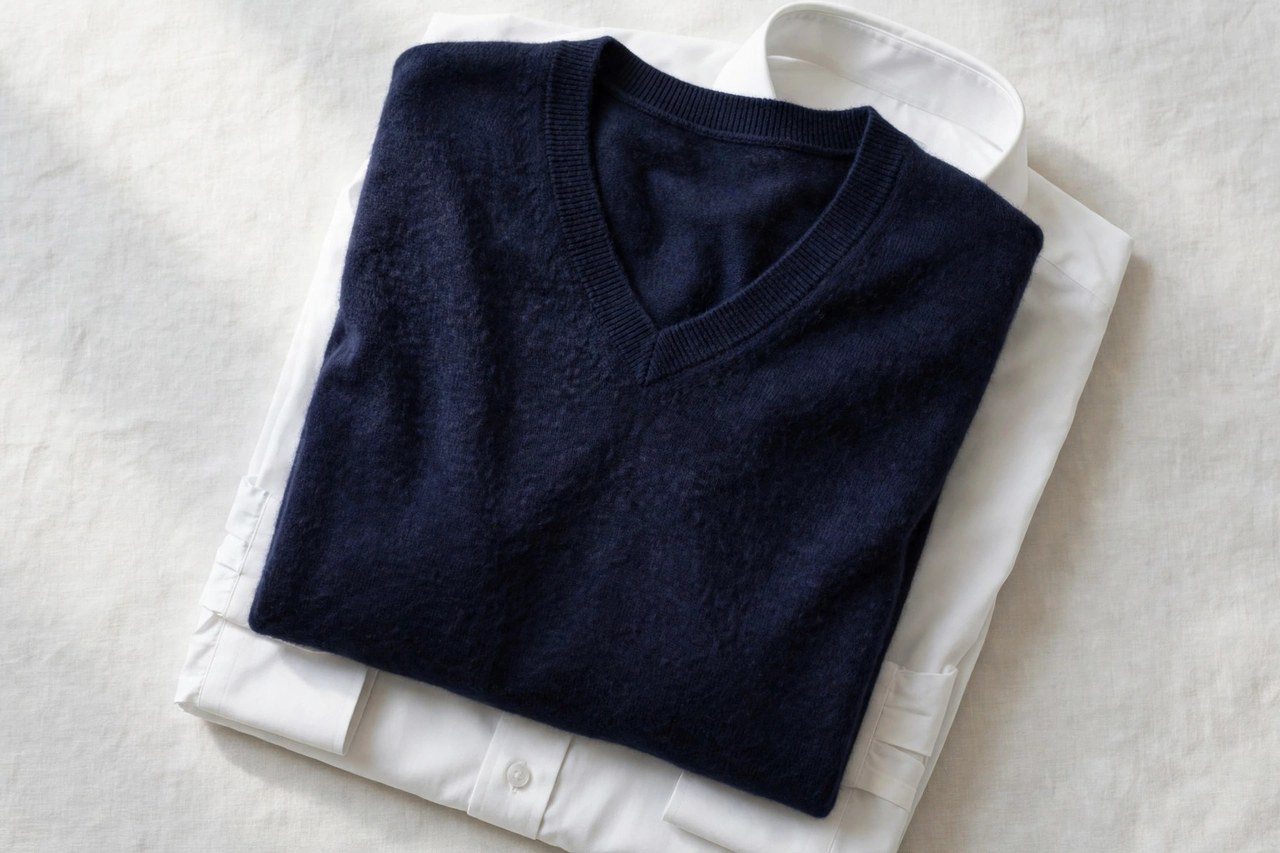
Men's cashmere V-neck sweaters are pullovers whose neckline opens in a V at the front - the sweater designed to be worn over a collared shirt, with or without a tie, and cashmere's most office-worthy knit. The V is a frame: it displays the shirt's collar and knot, keeps the sweater's line formal enough for business, and in cashmere's fine gauges it slides under a suit jacket as a complete cold-weather system. This guide covers the styles worth knowing, the fit points that decide comfort, the fabrics and construction that separate a good buy from a regret, and the simple care that makes the garment last.
Styles and Construction
Depth is the design variable: a classic V lands a few inches below the collarbone, deep enough to frame a tie knot with margin, shallow enough to wear over a tee without swallowing it; fashion V's plunge further and demand a shirt beneath. Fine gauges (single and two-ply) are the office builds, their smoothness letting a jacket glide over them; the neckline's ribbed band must be firmly finished because it carries the garment's visual signature - a wavy, relaxed V band makes the whole sweater look tired before its time. Fully-fashioned shaping matters here doubly, since the V's geometry exposes asymmetric knitting at a glance.
Judge knitwear by gauge, ply and finishing rather than by softness in the shop, because every knit feels kind on day one. Gauge counts stitches per inch - finer gauges drape and layer, coarser gauges insulate and read casual. Ply counts the strands twisted into the yarn: more plies mean more warmth, roundness and price. Fully-fashioned shaping, knitted in rather than cut and sewn, marks better garments, and linked seams at the shoulders and neck lie flatter and last longer than overlocked ones.
Fit and Sizing
Fit a V-neck over the shirt it will actually cover, with the band sitting symmetrically and the V's point centered - a V that pulls to one side is a size or a make problem. Body ease follows the crewneck rule (skim, over the base layer), and under a jacket the finer gauges should add no visible bulk at the shoulder. With a tie, check the knot's room in a mirror while seated; the V that frames a knot standing may crowd it sitting.
Fit knitwear by the body, not the shoulders alone: a sweater should skim rather than cling, with ease for a shirt beneath at the chest, sleeves ending at the wrist bone, and body length covering the waistband without pooling. Knits relax with wear - a slightly firm new fit is often the right long-term fit - but ribbed cuffs and hems should recover when stretched, and a neckline should sit flat against the base of the neck, neither gaping nor strangling.
Wearing and Care
Care follows the family covenant, with the V band as the inspection point: wash gently, dry flat with the V arranged symmetrically and the band straight, and store folded so the neckline bears no hanger's point. Button the shirt beneath before judging the sweater's fit after washing - a re-blocked V over the right shirt is the garment's whole purpose, restored in one dressing.
Knitwear care is gentle by default: wash cool by hand or on a wool cycle with knitwear detergent, never wring, roll in a towel to lift water, and dry flat on a mesh or towel, reshaped to its measurements. Fold for storage - hangers stretch shoulders into points - with cedar or lavender against moths, and rest a sweater a day between wears so its fibers recover their loft. Depill with a comb or electric shaver; pilling is loose fiber migrating, not the garment failing.
Common Questions
How deep should a V-neck sweater's V be?
For the classic shirt-and-tie role, the point lands roughly at mid-chest, framing the knot and an inch or two of tie. Shallower V's suit tee-shirts and open collars; deeper fashion V's require a shirt beneath and read as occasion wear. When in doubt, the classic depth is the one that never argues with anything you own.
Can you wear a V-neck cashmere sweater without a shirt?
Over a tee, yes - a standard casual combination, with the tee's crew band sitting inside the V. Against bare skin the shallow V works for many men, but the look is deliberate fashion rather than classic dress, and the sweater then needs washing as often as a shirt. The V was designed as a frame; what it frames is your choice.
Crewneck or V-neck cashmere - which first?
Follow your shirt life: men who wear collared shirts most days get more from the V, which completes them; men who live in tees and open collars get more from the crew. If the sweater must layer under suits specifically, the V's clean frame wins; for the broadest solo wear, the crew's simplicity does. The family pages here give each its full case.
More in Men's Clothes Guide C
Looking for Men's Clothing Stores?
This guide explains men's cashmere v-neck sweaters. To browse where to buy, visit our men's clothing store directory, where you can find retailers that carry them.