Men's Knit Sweaters Guide
Men's knit sweaters are knitted garments intended to cover the torso and arms - a sweater, as our original guide defined it, is either a pullover or a cardigan, distinguished in that cardigans open at the front while pullovers do not. The term sweater is a catch-all for a variety of knit garments, and within either group there is a great variety of design: the V-neck, turtleneck and crew neck are the most popular necklines, and the waistline is typically at hip height or slightly longer, just overlapping the waist of one's pants.
Shop Men's Knit Sweaters Now
Shop Men's Knit Sweaters on Amazon Shop Men's Knit Sweaters on eBayThe Amazon and eBay links on this page are affiliate links. If you make a purchase through them, Apparel Search may earn a commission.
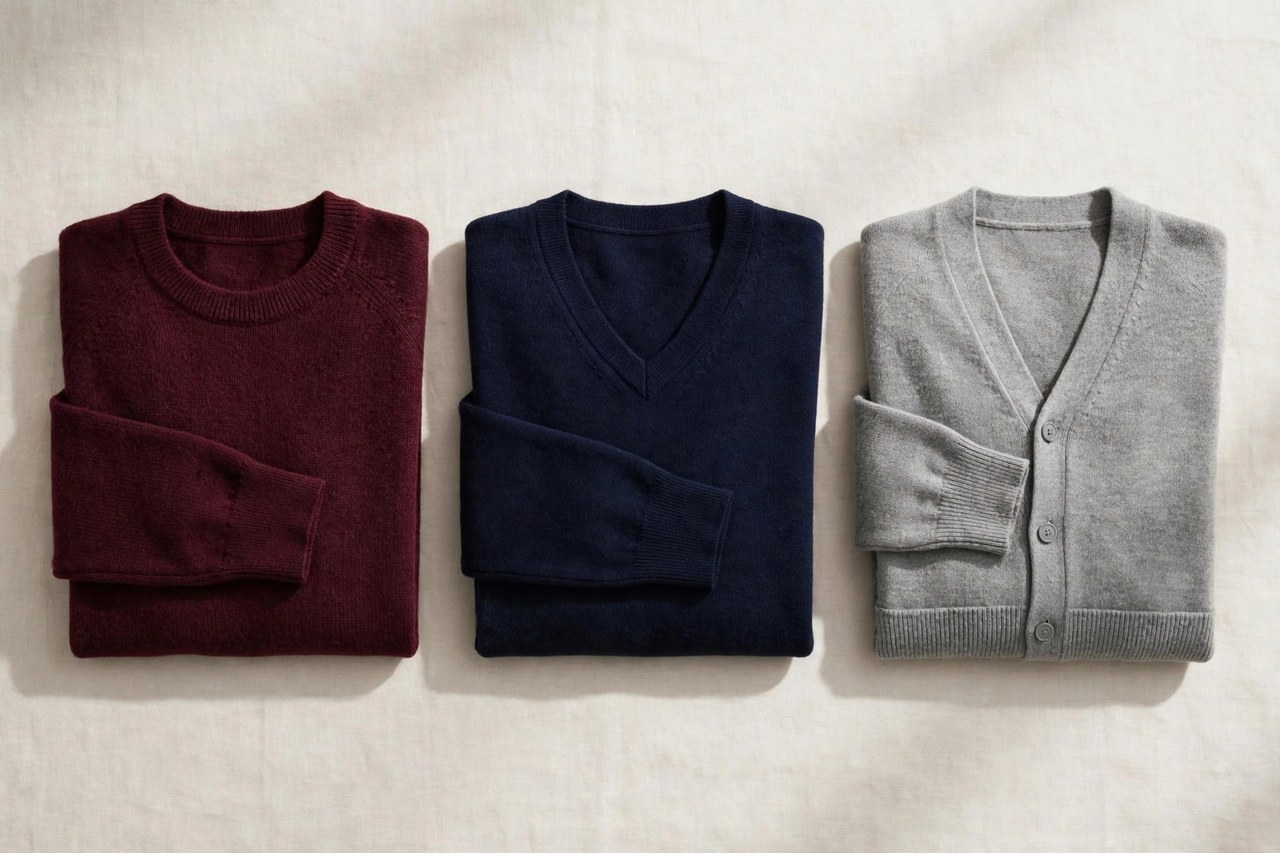
Men's knit sweaters are knitted garments intended to cover the torso and arms - a sweater, as our original guide defined it, is either a pullover or a cardigan, distinguished in that cardigans open at the front while pullovers do not. The term sweater is a catch-all for a variety of knit garments, and within either group there is a great variety of design: the V-neck, turtleneck and crew neck are the most popular necklines, and the waistline is typically at hip height or slightly longer, just overlapping the waist of one's pants. This guide walks through the choices that matter - style, fit, fabric and finish - with the practical detail a product listing rarely gives you, and closes with the care habits that keep the garment in service.
Gauge, Ply, Fibers and Fashioning
Read a sweater from the yarn outward. Gauge - stitches per inch - sets the garment's whole character: fine gauges knit flat and smooth, layer under a jacket without a fight and read dressy; medium gauges are the everyday crew and V-neck; chunky gauges insulate, read casual and show their stitches as texture. Ply counts the strands twisted into each yarn - more plies, more warmth, roundness and price. Fibers are the honest label: lambswool is the warm, springy all-rounder; merino is finer, smoother against skin and the layering choice; cashmere buys softness and warmth at the lowest weight and demands the gentlest handling; cotton knits a cool, heavy sweater for shoulder seasons that will not insulate when damp; synthetics and blends trade some warmth and breathability for price and easy washing. Construction separates the keepers: fully-fashioned sweaters are shaped in the knitting, with linked seams that lie flat, while cut-and-sew sweaters are tailored from knitted cloth and serged at the seams - serviceable, but bulkier where it shows. Because knitted fabrics are generally somewhat elastic with a softer hand than wovens, shaping can be knit into the fabric itself without the darts, flares and gores a woven garment needs - the quiet engineering that lets a sweater follow the body without tailoring.
Judge knitwear by gauge, ply and finishing rather than by softness in the shop, because every knit feels kind on day one. Gauge counts stitches per inch - finer gauges drape and layer, coarser gauges insulate and read casual. Ply counts the strands twisted into the yarn: more plies mean more warmth, roundness and price. Fully-fashioned shaping, knitted in rather than cut and sewn, marks better garments, and linked seams at the shoulders and neck lie flatter and last longer than overlocked ones.
Fit: Body, Sleeve and Neckline
Fit a sweater by the body it covers, not by the size you wear in shirts. The shoulder seam should sit at or fractionally past the shoulder bone - a dropped shoulder is a style, a slipped one is a size error. At the chest, allow ease for the shirt beneath: the knit should skim without the buttons of a cardigan pulling or a pullover's front showing every contour of what is under it. Sleeves end at the wrist bone with arms relaxed, with enough length to stay there when you reach; body length should cover the waistband and just overlap the top of the trousers, exactly where our original guide placed the classic waistline - a sweater that ends above the belt shows shirt and reads unfinished, while one that pools past the hips swamps the frame. Knits relax across a day and across a season, so a slightly firm new fit is often the right long-term one; test ribbed cuffs and hems by stretching and watching the recovery - ribbing that does not spring back in the shop will not hold a sleeve or a waist in service. Neckline fit is final: a crew should sit at the base of the neck, a V should frame a shirt collar without swallowing it.
Fit knitwear by the body, not the shoulders alone: a sweater should skim rather than cling, with ease for a shirt beneath at the chest, sleeves ending at the wrist bone, and body length covering the waistband without pooling. Knits relax with wear - a slightly firm new fit is often the right long-term fit - but ribbed cuffs and hems should recover when stretched, and a neckline should sit flat against the base of the neck, neither gaping nor strangling.
Wearing and Care
Sweater care is the gentlest in the wardrobe, and most sweater deaths are laundry accidents. Wash cool, by hand or on a wool cycle, with knitwear detergent; never wring; roll in a towel to lift the water; and dry flat, reshaped to the sweater's own measurements - a wet sweater hung or draped over a rail dries in the shape of the rail. Fold for storage, always: hangers stretch wet or dry knit shoulders into points that no pressing fully removes. Rest each sweater a day between wears so the fibers recover their loft, keep cedar or lavender in the drawer against moths - wool and cashmere are their entire diet - and depill with a comb or electric shaver as pills appear, since pilling is loose fiber migrating to the surface, not the garment failing. Air a sweater after wearing before deciding it needs washing; most need washing a fraction as often as their owners wash them, and every skipped wash is loft and color kept. A good sweater, rested, folded and gently washed, is a ten-year garment.
Knitwear care is gentle by default: wash cool by hand or on a wool cycle with knitwear detergent, never wring, roll in a towel to lift water, and dry flat on a mesh or towel, reshaped to its measurements. Fold for storage - hangers stretch shoulders into points - with cedar or lavender against moths, and rest a sweater a day between wears so its fibers recover their loft. Depill with a comb or electric shaver; pilling is loose fiber migrating, not the garment failing.
Common Questions
What is the difference between a pullover and a cardigan?
The front, exactly as our original guide put it: a sweater is either a pullover or a cardigan, distinguished in that cardigans open at the front while pullovers do not. That one difference changes the garment's job. A pullover is a single, uninterrupted layer - warmer, cleaner under a jacket, and styled by its neckline: V-neck, crew neck and turtleneck are the most popular. A cardigan fastens down the front - buttons or a zip - so it adjusts through the day, layers over a shirt and tie like a soft jacket, and comes off without disturbing anything beneath it. Most wardrobes end up needing both for different hours of the same week.
What do gauge and ply mean when buying a sweater?
Gauge is the knitting's fineness - stitches per inch. Fine-gauge sweaters are smooth and thin, layer cleanly under jackets and read dressier; coarse-gauge sweaters are thicker, warmer and more casual, with visible stitch texture. Ply is how many strands are twisted together to make the yarn: a two-ply yarn is rounder, warmer and more durable than a single-ply at the same gauge, and higher-ply cashmere and lambswool are priced accordingly. Read together they are the sweater's specification sheet: gauge tells you where it can be worn, ply tells you how warmly and for how long.
Why should sweaters be folded instead of hung?
Because a knit is a loop structure that stretches under sustained load - including its own weight. On a hanger, the garment's weight concentrates at the shoulder points and the body lengthens by gravity, and wet knits, which are far heavier, can grow inches in a single drying. Folding distributes the weight evenly and lets the loops rest in the shape they were knitted to. The same rule is why sweaters are dried flat and reshaped to their measurements: whatever shape a knit rests in, damp or stored, is the shape it keeps.
More in Men's Clothes Guide K
From Our Original Guide: Pullover, Cardigan, and Shaping Without Seams
Our original knit sweaters page defined the garment this guide keeps. A sweater is a knitted garment intended to cover the torso and arms; a sweater is either a pullover or a cardigan, distinguished in that cardigans open at the front while pullovers do not, and the term “sweater” is a catch-all for a variety of knit garments. Within either group there is a great variety of design: various necklines are found, although the V-neck, turtleneck and crew neck are the most popular, and the waistline is typically at hip height or slightly longer, just overlapping the waist of one’s pants. Knitted fabrics, the original explained, are generally somewhat elastic and have a softer hand — feel or drape — than woven fabric, so sweaters that are more tightly fitted or have a soft drape may conform well to the body without requiring the tailoring a woven garment needs, such as darts, flares and gores; even when such shaping is used, it can be knit into the fabric itself, without requiring seams. The original page pointed onward to the men’s sweater guide, the sweater definition and the knitwear factories directory; those links are carried below, along with its pointer to sweater posts on the Apparel Search blog.
More to Explore on Apparel Search
Looking for Men's Clothing Stores?
This guide explains men's knit sweaters. To browse where to buy, visit our men's clothing store directory, where you can find retailers that carry them.