Braces, Properly Worn
Trousers Carried From the Shoulders, Not Squeezed at the Waist
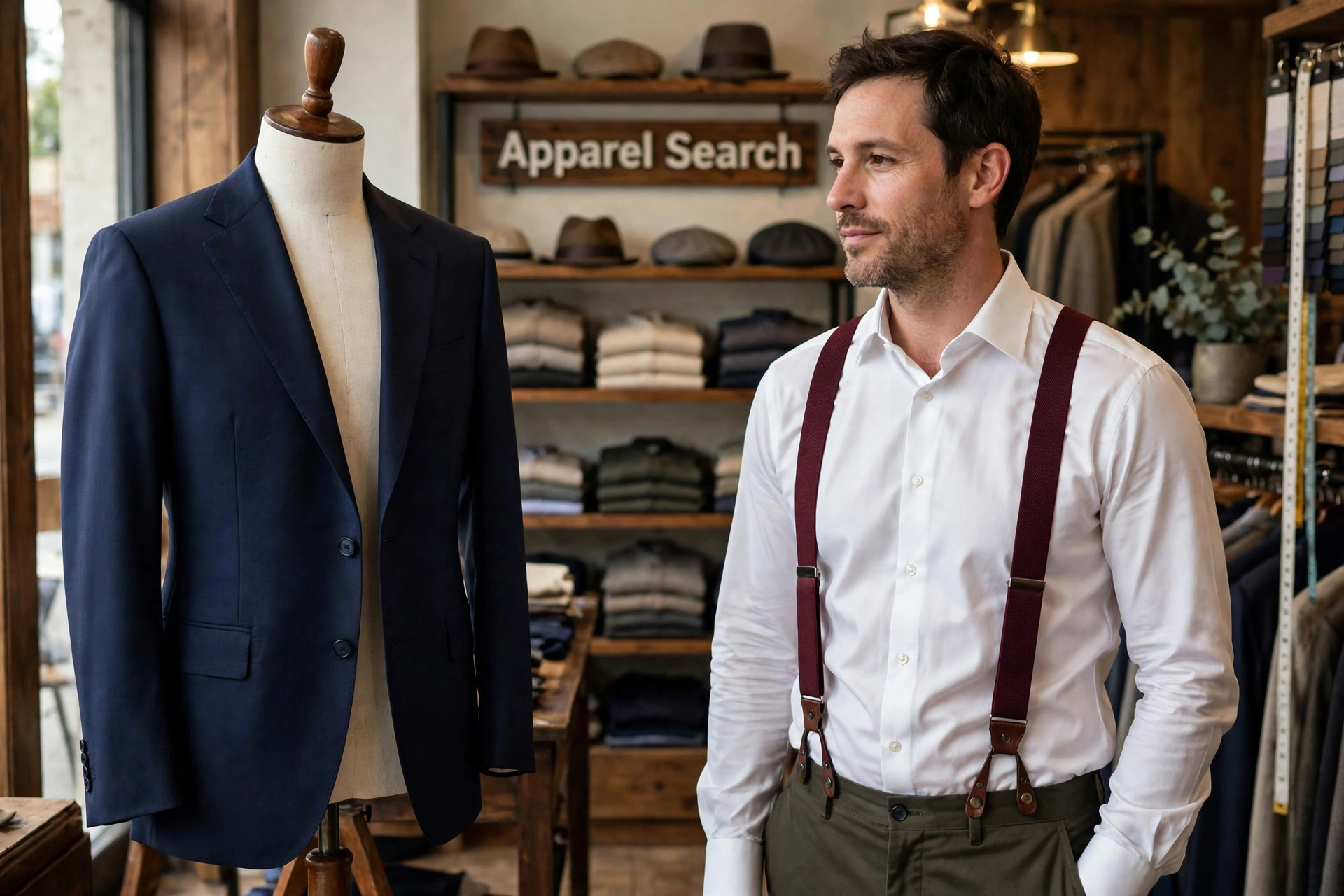
Suspenders — braces, in British English — hold trousers up from the shoulders instead of cinching them at the waist. The difference sounds small and feels enormous: the trousers hang at their natural waist, the waistband never folds or bites when you sit, and the front crease falls in one unbroken line from waist to shoe. It is the older system — the belt only took over in the twentieth century — and for suited and high-waisted trousers it remains the better engineering.
The terminology is worth one sentence, because it trips up shoppers across the Atlantic: the suspenders definition explains that the word means shoulder braces in American English and stocking straps in British English. This guide is about the shoulder kind — the straps that attach at the trouser waistband, front and back, and pass over the shoulders in a Y or X at the back.
Clip vs Button-On
The Two Closures, Compared Honestly
| Clip-on | Button-on | |
|---|---|---|
| How it attaches | Metal clips grip the waistband anywhere; no preparation needed | Leather or fabric tabs button onto buttons sewn inside the waistband |
| Best for | Jeans, chinos and casual trousers; trying suspenders out; trousers without brace buttons | Suits and tailored trousers; any trousers worn with braces regularly |
| Watch out for | Clips can mark or chew a fine waistband and can pop off under strain | Needs the buttons fitted — a tailor adds them in minutes, inside the waistband so they never show |
The rule of thumb follows from the table: clips are for casual trousers, buttons are for tailoring. Clips on a fine suit are the suspender equivalent of a clip-on tie — everyone in the room can tell, and the clips will eventually scar the waistband they grip. If you wear braces with suits more than occasionally, have brace buttons sewn into each pair and switch to button-on straps for good. Convertible braces, with both fittings, are the sensible first purchase while you decide.
Width, Fit & Occasions
Choosing, Adjusting, and Knowing When Braces Beat a Belt
Width and material
Dress braces run about 1 to 1.4 inches wide in silk, grosgrain or fine elastic; casual braces run wider, up to 2 inches, in sturdy elastic, canvas or leather. Match the material to the outfit: silk under a suit, rugged elastic with jeans or work trousers.
Measuring and adjusting
Attach the back first, then the front, and adjust the front sliders until the trousers sit at your natural waist with the straps flat and untwisted. The back should form a clean Y or X between the shoulder blades — never pulled so tight the waistband rides up.
With suits, braces are the traditional and better choice whenever the trousers have no belt loops or sit at the natural waist: the jacket hides the straps in formal settings, which is exactly how they were designed to be worn. With chinos, either closure works and the look is relaxed tailoring. With jeans, wide casual braces are a deliberate workwear statement — wear them knowingly, on show, and skip the belt. Braces beat a belt whenever the waistband would otherwise be squeezed: high-rise trousers, long days of sitting and standing, and any outfit where an unbroken trouser line matters.
Two mistakes account for nearly every bad suspender outfit. The first is wearing a belt and suspenders together — the famous redundancy — which announces that you trust neither; pick one system. The second is wearing braces as pure costume, dangling unused at the sides or strained over a T-shirt two sizes small. Worn properly, adjusted once and forgotten, they are the most comfortable way ever devised to hold up a pair of trousers. Compare the alternative in our belt definition, and see how braces sit inside the wider world of men’s tailored clothing.
Questions
Common Questions
Are suspenders better than a belt?
For tailored and high-waisted trousers, often yes: suspenders carry the trousers from the shoulders, so the waistband is never squeezed, the trousers hang at the natural waist and the front line stays unbroken when you sit and stand. A belt suits casual and low-rise trousers better. Never wear both at once.
Should suspenders clip on or button on?
Button-on for suits and tailored trousers — clips can mark a fine waistband and read as makeshift under tailoring. Clip-on is fine for jeans, chinos and casual wear, and for trying suspenders before having brace buttons sewn in. Convertible braces offer both fittings in one pair.
How wide should men’s suspenders be?
Dress braces are about 1 to 1.4 inches wide, in silk, grosgrain or fine elastic. Casual braces run wider, around 1.5 to 2 inches, in sturdy elastic, canvas or leather for jeans and work trousers. Match width and material to the formality of the trousers.
More to Explore
Search Apparel Search