Women's Henley Shirts Guide
The henley is a collarless shirt defined by one detail: a short button placket below a round neckline. Its heritage runs from English rowing crews to the undershirt drawer — and it is still the easiest way to make a plain top interesting.
Shop Women's Henley Shirts Now
Shop Women's Henley Shirts on Amazon Shop Women's Henley Shirts on eBayThe Amazon and eBay links on this page are affiliate links. If you make a purchase through them, Apparel Search may earn a commission.
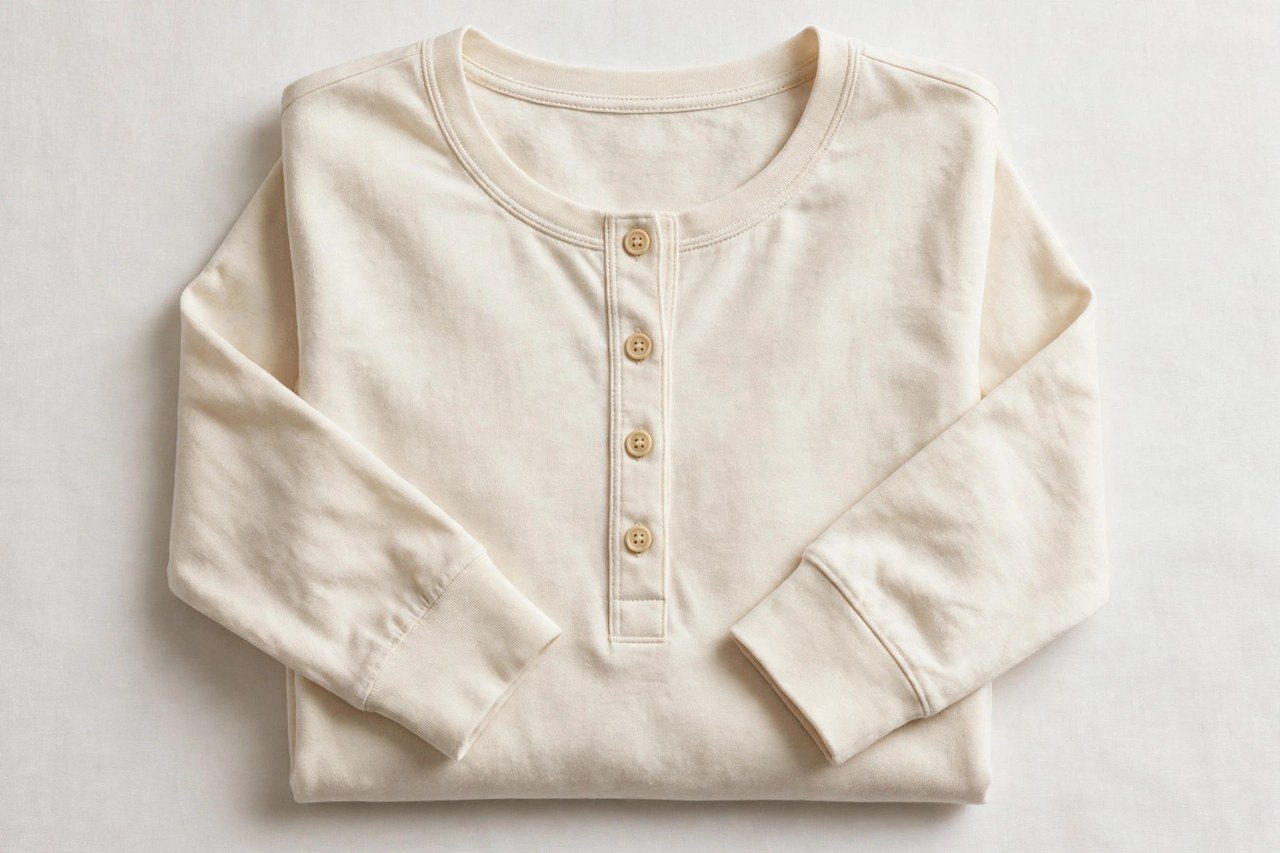
A henley shirt is a collarless pullover shirt recognised by a single detail: a placket roughly 10 to 15 centimetres (4 to 6 inches) long set beneath a round neckline and fastened with two to five buttons. It is essentially a collarless polo shirt, and that is still the fastest way to picture it — take the polo's buttoned opening, remove the collar, and what remains is a henley. This guide is about the garment itself: where the placket came from, what it is made from, and how the shirt is cut.
Its companion page, our henley t-shirts guide, takes the lighter tee-weight version and treats it as a styling piece. Here the focus is the henley as a garment type — the construction and heritage that every version, from a fine cotton shirt to a chunky thermal, shares.
From Henley-on-Thames to the Undershirt Drawer
The name comes from Henley-on-Thames, the English town famous for its royal regatta, where the style was the traditional uniform of the rowers. A collarless shirt with a buttoned vent suited the sport: nothing flapped at the neck, and the placket could be opened to cool down after a race or closed against the river wind. The working version travelled further than the rowing one, though. Through the late 19th and early 20th centuries the henley became a standard undershirt and work shirt in Britain and America — warm, washable, and easier to pull on than a fully buttoned shirt.
That double heritage explains the henley's modern character. It keeps the tidy, finished look of sportswear at the neckline while behaving like the humblest layer in the drawer. When fashion rediscovered it — first as workwear styling, then as a women's wardrobe staple — it never lost either identity, which is why the same placket appears on a thermal base layer and on a dressed-up ribbed top.
The Placket: The Garment's Signature
The placket is not decoration; it is engineering. A round neckline alone must stretch to pass over the head, which strains the fabric and eventually bags the neck out. The buttoned opening lets the neckline keep its close, neat shape while still opening wide enough to dress comfortably, and modern plackets are reinforced with fabric facings or attached bands around the fasteners so the buttonholes survive years of use. Buttons may be shell, wood-look, metal or simple plastic, and the count — usually two to five — changes the look more than the function.
Worn open, the placket drops the neckline into a soft V that reads relaxed; buttoned to the top, the same shirt looks almost like a crew neck with a seam of detail. That one-gesture range, from tidy to undone, is the henley's whole personality, and it is why a plain top in the same fabric looks unfinished beside it.
Fabrics: Cotton, Blends and Thermals
The henley can be made in almost any fabric, but cotton, cotton-polyester blends and thermals are by far the most popular. Plain cotton jersey gives the classic soft shirt; a cotton-poly blend holds its shape and colour longer and dries faster. Thermal henleys use a waffle or honeycomb knit whose pockets trap warm air — the direct descendants of the undershirt originals — and make the best cold-weather base layers.
Beyond the classics, look for rib knits that hug the body and recover their shape, slub jerseys with a faintly irregular texture, and linen or silk blends for warm weather. Heavier interlock and French terry versions bridge the gap between shirt and light sweater. Whatever the cloth, check that the placket band is cut on a stable grain; a placket that twists after washing is the mark of a cheaply made henley.
Fits, Sleeves and How It Differs From a Plain Top
Women's henleys divide into fitted styles that follow the body in rib or stretch jersey, classic straight cuts in the workwear tradition, and relaxed or oversized versions worn as light layers. Sleeves run the full range: long sleeve, short sleeve, cap sleeve and raglan constructions such as the rib raglan cap-sleeve henley, where the sleeve seam runs diagonally to the neckline and softens the shoulder line.
Against a plain crew-neck top, the henley wins on three counts: the neckline adjusts, the placket gives the eye a vertical line that lengthens the torso, and the shirt can move between roles — sleepwear-adjacent thermal, everyday shirt, or the layer under a blazer — without changing. Fit it so the placket lies flat without gaping; if the buttons pull, the shirt is a size small, not a style statement.
More H Guides
Photos


More to Explore on Apparel Search
Looking for Women's Clothing Stores?
This guide helps you choose women's henley shirts. To browse where to buy, visit our women's clothing store directory, where you can find retailers that carry them.