Women's Rib Raglan Cap Sleeve Henley Guide
Three details in one small top: a short cap sleeve set on a raglan diagonal, a henley's buttoned placket at the neck, and a rib knit body that stretches, recovers, and textures the whole garment.
Shop Women's Rib Raglan Cap Sleeve Henley Now
Shop Women's Rib Raglan Cap Sleeve Henley on Amazon Shop Women's Rib Raglan Cap Sleeve Henley on eBayThe Amazon and eBay links on this page are affiliate links. If you make a purchase through them, Apparel Search may earn a commission.
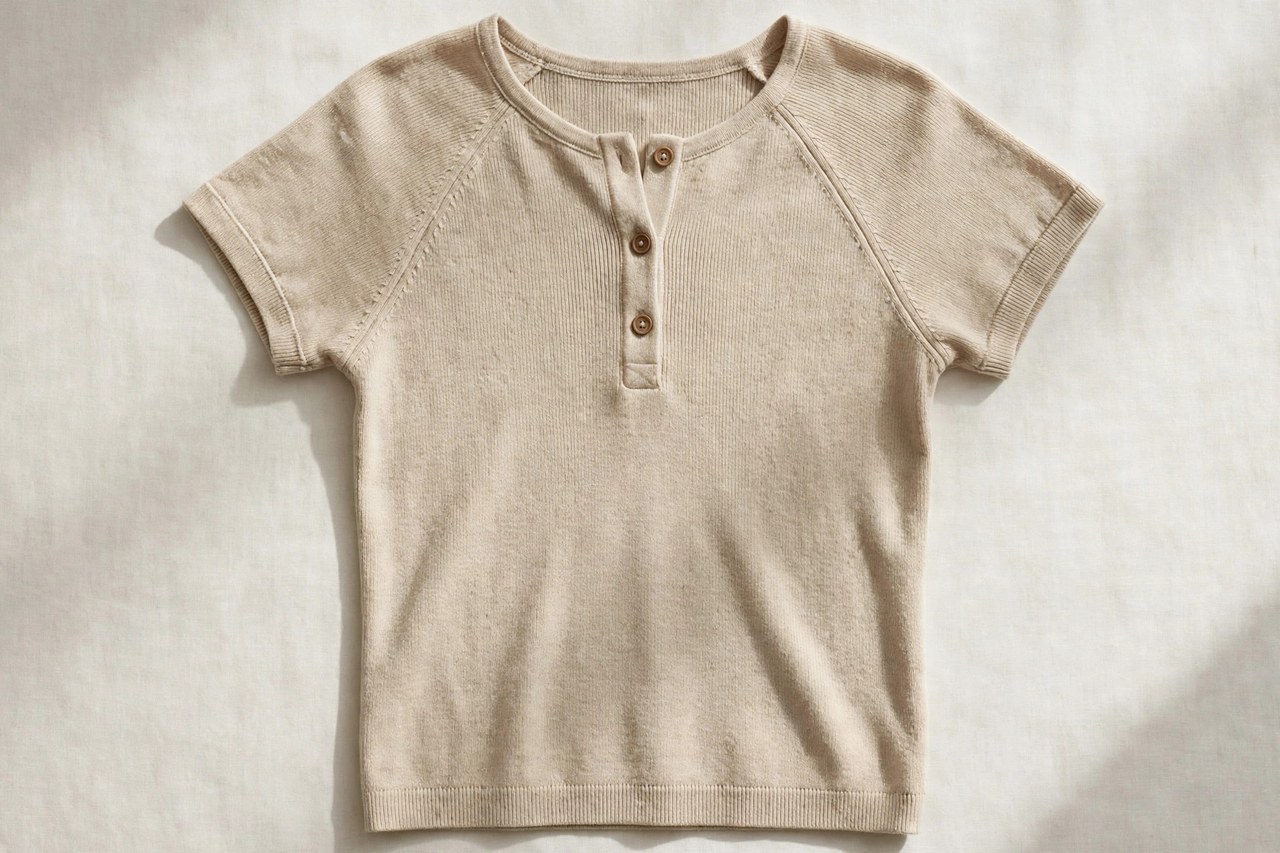
A rib raglan cap sleeve henley combines three named features, and each one changes how the top wears. The henley contributes the neckline: a round, collarless neck with a short buttoned placket down the front, borrowed long ago from men's rowing shirts and now a staple of women's casual tops. The raglan contributes the shoulder: the sleeve is cut in one piece with the body, seamed diagonally from neck to underarm. The cap sleeve keeps that sleeve very short, just capping the shoulder point.
Underneath all three sits the rib knit itself, the fine vertical-ribbed fabric whose crosswise stretch and recovery let a close, short-sleeved top stay comfortable instead of binding. This guide takes the combination apart — the placket, the cap sleeve on its raglan seam, the rib fabric that holds the fit — and explains what to check when you buy one, because each feature has its own small failure mode that is easy to spot in advance.
A Henley Placket in Rib Knit
The placket is a reinforced slit at the front neck, usually two to four inches long, closed with buttons, snaps or occasionally a short zip. Worn buttoned, it finishes the neckline neatly; worn open, it deepens the neck into a soft V and lets air in, which is half the henley's practical charm. On a rib knit body the placket matters structurally: rib fabric stretches, so the placket band is the stable, often self-fabric or woven-tape-backed strip that keeps the neckline from growing wider with every wear.
Check the placket first when you shop. It should lie flat and straight against the body, with buttons spaced so the fabric between them does not gape when you move or sit. Buttons need firm stitching and a placket sturdy enough to take their daily pulling, because this little strip absorbs more handling than any other part of the top. A placket that waves, twists or pulls to one side on the hanger will do worse on the body.
Why the Cap Sleeve Changes the Fit
A cap sleeve is the shortest sleeve that is still a sleeve: a small extension that covers the top of the shoulder and ends high on the arm. Set on a raglan seam, it has no round armhole to bind across the shoulder, so the top moves easily. It is a warm-weather answer to the raglan shape — the same easy construction as the long sleeve version, cut back to a cap for summer and for layering under sleeveless dresses and overalls.
Fit lives at two points. First, the cap should sit on the shoulder point, not creep toward the neck or slide off the arm; a rib knit's grip helps here, holding the cap where a slippery fabric would wander. Second, because the sleeve is short, the underarm seam sits high and close, so check that the body of the top is long and stretchy enough to stay put when you reach up. The rib's crosswise stretch does most of this work.
Choosing Fabric, Buttons and Neckline
Most rib raglan henleys are knitted in cotton rib or a cotton blend, sometimes with a touch of elastane for recovery, and in a fine 1x1 rib that keeps the top light and close. Cotton-rich versions breathe best in heat and feel most like a classic tee; blends with polyester or modal hold their color and shape longer and dry faster. Whatever the fiber, stretch the fabric and release it before you buy: it should recover completely, because a bagged-out henley loses its neatness.
Then read the small hardware. Buttons in shell, coconut, wood-look or matte plastic should match the top's casual register and be sewn, not glued; a spare button on the care label is a good maker's sign. The neckline band should be ribbed to match the body and cut so it sits flat whether the placket is open or closed. Finally, hold it to the light: a very fine rib can go sheer where it stretches, so choose a slightly heavier knit to wear alone.
Styling and Care
The henley's working heritage makes it a natural with denim, shorts, utility skirts and anything else in the casual drawer, and the rib texture lifts it a step above a plain tee with the same outfit. The cap sleeve keeps the silhouette open at the arm, so the top layers cleanly under cardigans, blazers and jackets without sleeve bulk bunching at the shoulder. Buttoned fully it reads tidy; opened one or two buttons, it reads relaxed — the same top covers both registers.
Care follows the rib knit rules. Wash cool and gentle to protect the fabric's recovery and the placket's stitching, fasten the buttons before washing so the placket does not twist in the machine, and dry flat or on a low setting, reshaping the neckline while damp. Fold the top for storage rather than hanging it. Treated that way, the placket stays straight and the rib keeps the spring that makes this small, three-way hybrid of a top work.
Related Women's Guides
More to Explore on Apparel Search
Looking for Women's Clothing Stores?
This guide helps you choose women's rib raglan cap sleeve henley tops. To browse where to buy, visit our women's clothing store directory, where you can find retailers that carry them.