Women's Raglan Long Sleeve Tops Guide
A raglan long sleeve top is defined by its seam — the sleeve runs in one piece from cuff to collar, so shoulder fit, movement and layering all start with that diagonal line.
Shop Women's Raglan Long Sleeve Tops Now
Shop Women's Raglan Long Sleeve Tops on Amazon Shop Women's Raglan Long Sleeve Tops on eBayThe Amazon and eBay links on this page are affiliate links. If you make a purchase through them, Apparel Search may earn a commission.
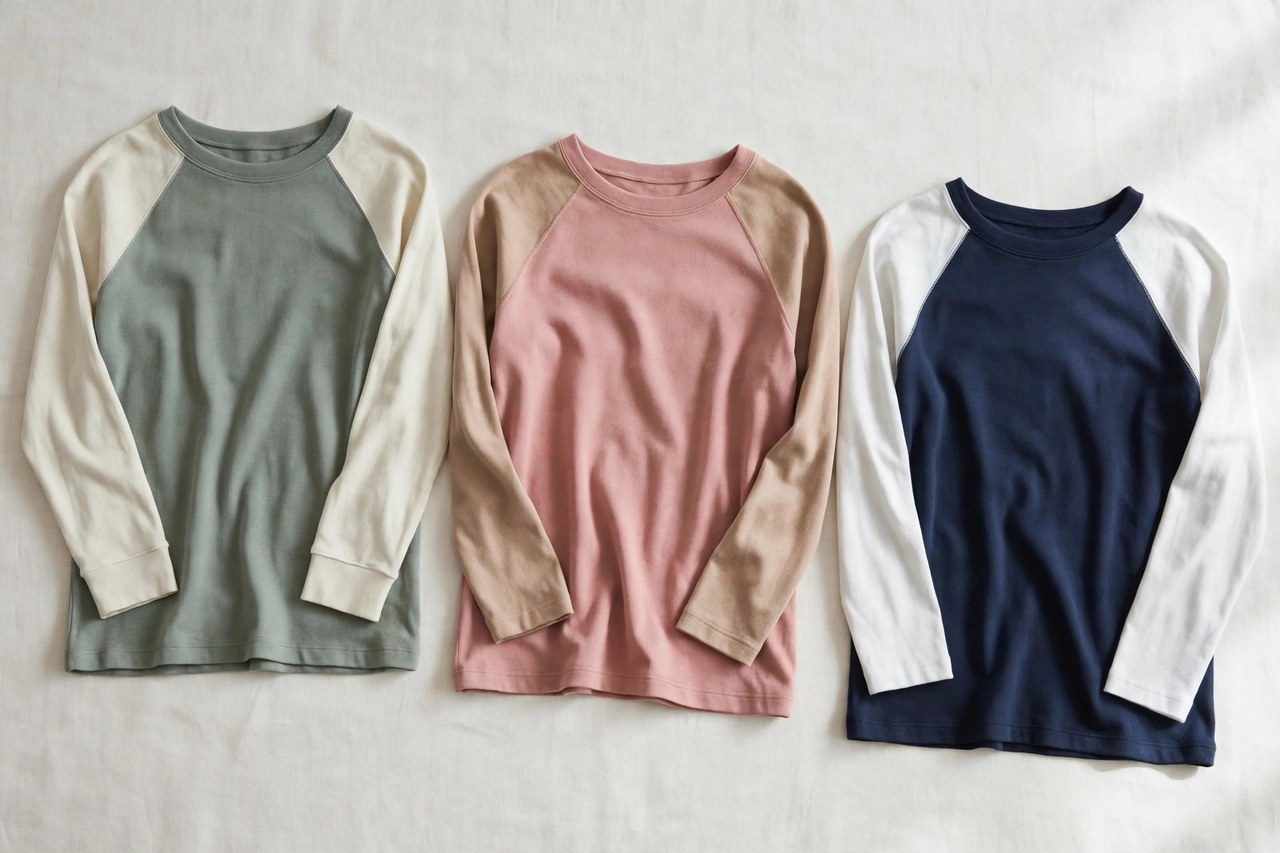
A raglan long sleeve top is first a piece of garment construction. In a conventional top the sleeve is a separate tube set into a round armhole, with a seam circling the shoulder. In a raglan, the sleeve extends in one piece all the way to the neckline, joined to the body by two diagonal seams that run from underarm to collarbone. Those seams are the whole identity of the garment, and on a long sleeve version they run beside a full-length sleeve that ends at the wrist.
This guide treats the raglan long sleeve top as construction and fit, rather than as a printed style. It explains how the diagonal seam changes shoulder shape and movement, which fabrics make the seam lie well or fight it, how necklines pair with the seam, and how to size and layer a top that has no fixed shoulder point to measure against. If you want the short, sporty tee version, that is a different page; here the focus stays on the full sleeve.
How the Raglan Seam Works
Because the sleeve and part of the shoulder are one piece, a raglan has no shoulder seam sitting on top of the shoulder and no firm point where sleeve ends and body begins. The diagonal seam does the shaping instead, and its angle matters: a high, curved seam close to the neck gives a neat, tailored look, while a deeper diagonal dropping lower under the arm gives the relaxed, athletic drape most people picture. Two-seam and three-piece raglans add a dart or panel for closer shaping.
The practical payoff is movement. Raising your arms, reaching forward or carrying a bag across the body pulls less, because fabric can shift along the diagonal instead of straining a circular armhole. That is why raglan construction appears so often in active tops, sleepwear and layering knits. The trade-off is definition: without a set shoulder line, a soft raglan can look slope-shouldered in limp fabric, so structure has to come from the knit itself, from ribbing, or from a firmer yoke around the neckline.
Fabrics, Necklines and Sleeve Finishes
Long sleeve raglans work best in knits with a little recovery: cotton jersey with elastane, cotton-modal blends, merino jersey and brushed thermal knits all follow the diagonal without puckering it. Very stiff fabrics fight the seam and are rare here; very slinky fabrics need a stabilized neckline so the opening does not grow during the day. Contrast sleeves are common, but on a long sleeve top the more useful contrast is weight — a slightly firmer sleeve knit can keep the longer seam line smooth from collarbone to underarm.
Necklines sit directly at the end of the raglan seam, so the two must agree. Crew necks and mock necks finish the diagonal cleanly, scoop and V-necks open it up, and henley plackets cut through the seam junction, which better-made tops reinforce. At the other end, look at the cuff: a plain hem is lightest, a ribbed cuff holds the sleeve at the wrist over a watch or under a jacket, and a thumbhole cuff belongs to athletic versions made for cold-weather layering.
Fit, Sizing and Layering
Size a raglan by bust and by the feel across the upper back, not by shoulder width — there is no fixed shoulder seam to line up with your own shoulder. The diagonal seams should lie flat and roughly parallel to your collarbones, without pulling toward the neck or sagging into folds under the arm. Sleeve length is the second check: with arms down, the cuff should reach the wrist bone, because a raglan that is short in the body will also ride short in the sleeve when you reach.
For layering, the raglan's smooth shoulder is an advantage under jackets and cardigans, since there is no bulky armhole seam stacking under a coat seam. As a base layer it works in thin merino or synthetic jersey; as the outer layer, choose a heavier knit and let the diagonal seam be the design detail, worn plain rather than covered. Between sizes, size up for a layering top you will wear over camisoles, and stay true to size for a base layer, where extra fabric bunches along the seam lines and shows through outer clothing.
Care for Seams and Knits
The diagonal seams carry more length than a normal shoulder seam, so they are where a raglan ages first. Wash knit raglans inside out on a gentle cycle, reshape the neckline and seam lines while damp, and dry flat or on a wide hanger — a thin hanger point pushes through exactly where the seam meets the collar and can stretch that junction out of shape. Avoid hanging heavy wet thermal or sweater-knit raglans at all; fold them instead.
Check the seam stitching when you buy and again each season. Quality raglans use a stretch stitch or flatlock along the diagonal so the seam gives with the knit; a rigid straight stitch there will pop under reach. Small pulls at the neckline junction can be reinforced by a tailor cheaply.
Related Women's Guides
Photos


More to Explore on Apparel Search
Women’s Clothes Guide by Letter: Women's Clothing Directory S · Women's Clothes Directory T · Women's Fashion Directory U · Women's Clothes Directory V · Women's Clothes Directory W · Women's Clothing Directory X · Women's Clothes Directory Y · Women's Clothes Directory Z
Looking for Women's Clothing Stores?
This guide helps you choose women's raglan long sleeve tops. To browse where to buy, visit our women's clothing store directory, where you can find retailers that carry them.