Apparel Search Garment Care Guides
Decorative Darning and Patching
Woven darning, loom darning, Swiss darning and the patch styles — the two great repair families, worked so they show.
Two families of repair cover nearly every hole a wardrobe can produce, and this guide — the technique companion to the visible mending guide — takes them in turn. Darning rebuilds the fabric itself, weaving new yarn where the old yarn failed, so the garment's own cloth continues across the gap. Patching covers the gap with new cloth and stitches the two together. Our basic clothing mending guide teaches both in their discreet, matched form; here the same sound methods get the decorative treatment — contrast yarns, patterned patches, stitches laid where everyone can enjoy them.
Woven Darning: The Classic Grid
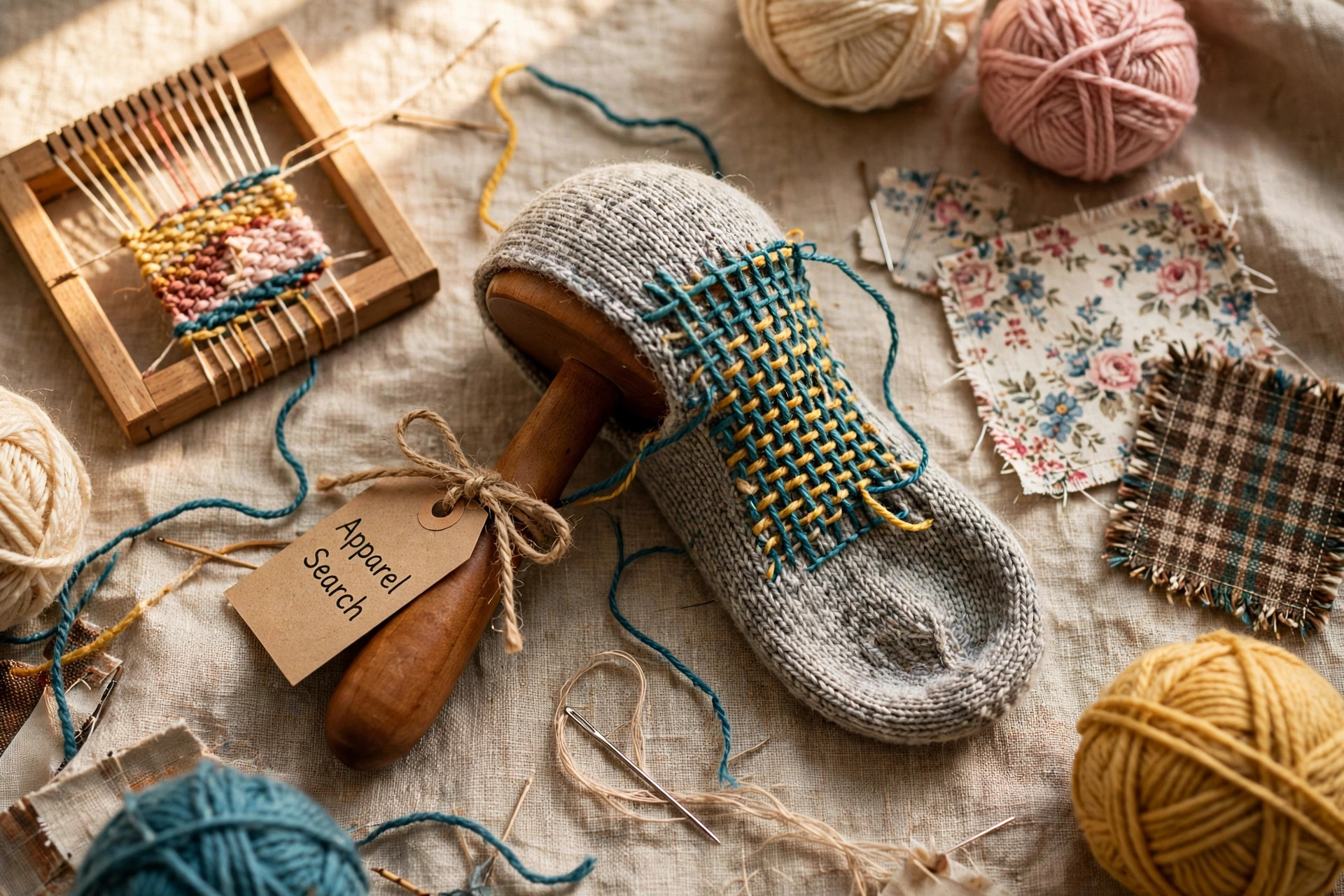
Freehand darning is weaving in miniature. Stretch the damaged area smoothly over a darning mushroom — or an egg, a light bulb, the rounded end of a jar — turn the garment so you work on its inside or outside consistently, and lay the warp: long parallel stitches across the hole, anchored a quarter inch into sound fabric on both sides. Then weave the weft at right angles, over and under, packing each row snug against the last with the needle. What results is a small firm woven patch with no knot and no raw edge — a new piece of cloth grown in place, flexing with the knit around it.
Two habits make darns last: anchor every thread in fabric that is still strong (a darn is only as good as its border), and match the yarn's weight and fiber to the garment before you think about its color. A thick yarn in a fine sweater wears a hole around itself; a matched yarn in a wild color wears for years.
Loom darning
Small darning looms — the speedweave type, a little frame of hooks that holds the warp threads under even tension — turn the same woven grid into a faster, tidier operation. Warp threads are hooked on in seconds, the weft woven with a long needle, and the finished darn comes off the loom with machine-even edges. Looms shine on flat, repeatable work: sock heels, sweater fronts, the knees of children's trousers. Freehand darning keeps the advantage everywhere the surface curves or the spot is small.
Swiss darning for knits
Swiss darning — duplicate stitch — takes a different route across a knit: instead of weaving a grid, the needle retraces the garment's own stitch pattern, following each V of yarn with new yarn laid over it. Worked before a thin spot becomes a hole, it reinforces invisibly-in-structure (the color choice decides visibility); worked across a small hole with a strand held behind, it can rebuild missing stitches outright. For anyone who loves a sweater, it is the single most valuable darning skill, and the most satisfying to watch come right.
Patch Styles
On-top (appliqué) patch
The patch sits on the garment's face, edges turned under for a clean outline or left raw for a workwear look, and is stitched down by machine or hand — a running stitch border in contrast thread is the visible mender's signature. The appliqué patch is the most decorative style and the kindest to tired fabric, because its stitching can land well outside the damaged zone. It is the natural home for patterned cloth: a floral patch on a plain shirt is a design decision, not an apology.
Under-patch
The patch goes behind the hole, and the garment's own frayed edges stay on display, stitched down to the patch beneath. This is the classic jeans repair — the hole becomes a window showing new cloth — and boro's favorite arrangement, usually quilted across with sashiko stitching so patch and garment become one layered textile. Under-patches keep the garment's original surface character; choose a patch fabric whose color works in the window it will fill.
Reverse appliqué
The mirror trick: a contrasting cloth is layered under the garment, stitched in a motif outline from the front, and then the garment's top layer is cut away inside the stitching to reveal the cloth beneath. More garment-decoration than first aid, but a legitimate rescue for a stained or scorched area on an otherwise sound piece — the damage is quite literally cut out of the picture.
Thread and Color: Match, or Contrast?
The visible mender's real medium is this choice. Matching — yarn close in color, fiber and weight — produces the traditional quiet repair, and even visible menders match when the garment's own looks should lead. Contrasting — a complementary color, a brighter value, a patch print against a plain ground — declares the repair. Between the poles sits the connoisseur's option: match the color, contrast the texture, or the reverse, so the mend reveals itself only at conversational distance. One firm rule survives every style: weight and fiber matching are structural, color matching is taste. Get the structure right and the taste is yours.
Where Each Technique Works Best
- Sock heels and toes — woven darning, freehand or loom; fine matched-or-contrast darning yarn.
- Sweater elbows and moth holes — woven or Swiss darning; patches only in sturdy knits, where they read as deliberate elbow patches.
- Jeans knees and inner thighs — under-patch with sashiko, or appliqué patch for large blowouts; denim wants area coverage, not point repair.
- Shirt cuffs, collars and hems — patches and appliqué; frayed folds can also be bound with a contrast strip.
- Thin spots caught early, any garment — reinforcement stitching or Swiss darning before the hole exists: the cheapest repair is always the one done a season early.
A Basic Woven Darn, Step by Step
- Set the stage. Turn the garment inside out if the mend should sit flatter inside; stretch the area over the mushroom smooth but not tight, and trim loose frayed ends.
- Choose the yarn. Match weight and fiber to the garment; pick the color — matched for quiet, contrast for show.
- Lay the warp. Parallel stitches across the hole, spaced about a yarn's width apart, every one anchored in sound fabric beyond the damage.
- Weave the weft. At right angles, over-under-over, packing rows closely; alternate the starting side so the grid stays even.
- Shrink the grid home. Ease the finished darn off the mushroom, flex it gently, and press if the fabric allows. The mend should move with the garment, not sit on it like a coin.
Small holes and worn patches anywhere in the wardrobe follow the same principle the hand sewing guide teaches for split seams: support the area, stitch into sound fabric, and the repair becomes part of the garment. And when the garment's problem is bigger than any mend — fabric failed everywhere, not at a point — the making clothes last longer guide's repair-or-replace arithmetic decides honestly.
Common Questions
Darning or patching — which repair is stronger?
They are strong in different ways. A patch is stronger across a large area: it replaces failed fabric wholesale and spreads strain over its whole stitched border, which is why big blowouts — a shattered jeans knee, a torn elbow — get patches. Darning is stronger at a point: it rebuilds the exact fabric that failed, with no edges to catch or lift, which is why heels, toes and moth holes get darns. The strongest repairs often combine them: a patch for coverage, darned or sashiko-stitched across its face so the whole area shares the work.
Can you darn stretchy fabric?
Yes, with adjustments. Stretch the area over a darning mushroom only to its natural, unstretched size — a darn woven into overstretched fabric puckers badly when the fabric relaxes. Use a yarn or thread with some give, keep the woven grid a little looser than you would for a woven cloth, and anchor well into sound fabric so the mend can flex as one piece with the garment. For knitted garments, Swiss darning — duplicate stitch that retraces the knit structure itself — flexes best of all, because the repair is knitted in everything but name.
What yarn should I use for darning socks?
Match the sock. A darning yarn close in weight and fiber to the original wears at the same rate and feels the same underfoot: fine wool-blend darning thread for dress socks, sturdier wool or cotton yarn for work and hiking socks. Purpose-made darning and mending yarns exist in many colors, which makes the visible version easy — pick a contrast and let the little woven grid show. Avoid yarn much thicker than the sock's own: a bulky darn is a blister with good intentions.
Do I need a darning loom?
No — heels were darned freehand over mushrooms, eggs and light bulbs for centuries, and freehand darning remains the flexible method for elbows, toes and awkward curves. A small darning loom (the speedweave style) earns its place if you darn often: it holds the warp threads evenly, speeds the weaving, and produces very tidy grids on flat areas like sock heels and sweater fronts. Think of it as the difference between a whisk and a mixer — the loom is faster and neater, the hand method works everywhere.
Back to the Visible Mending Guide
The technique map, structural vs decorative repair, and the garments that take a visible mend best.