Choli
Clothing Definitions — definitions of garments and clothing terms from Apparel Search
Search Apparel Search
At a Glance
Definition: A choli is a short, close-fitting, midriff-baring blouse worn under a sari in India, traditionally cut from the sari's own blouse piece and tailored to measure, with styles from closed-backed to halter and open-backed.
Pronunciation: CHOH-lee
Category: Clothing Definitions
Word Origin
Choli is the Hindi name of the garment (from Sanskrit colaka, a bodice or jacket). The word travelled into English with the sari itself, and in North India it is simply the ordinary word for the sari blouse.
The choli is the smallest garment in the sari ensemble, and one of the most considered. It is the short, fitted blouse worn under the sari — midriff-baring, tailored to the individual wearer, and designed from the start to be seen only in part: the sari is draped over it, covering the front and one sleeve completely, while the other sleeve and much of the back stay on show. This page explains where the choli's fabric comes from, how it is fitted, and the styles — halter, open-backed, closed-backed — in use today.
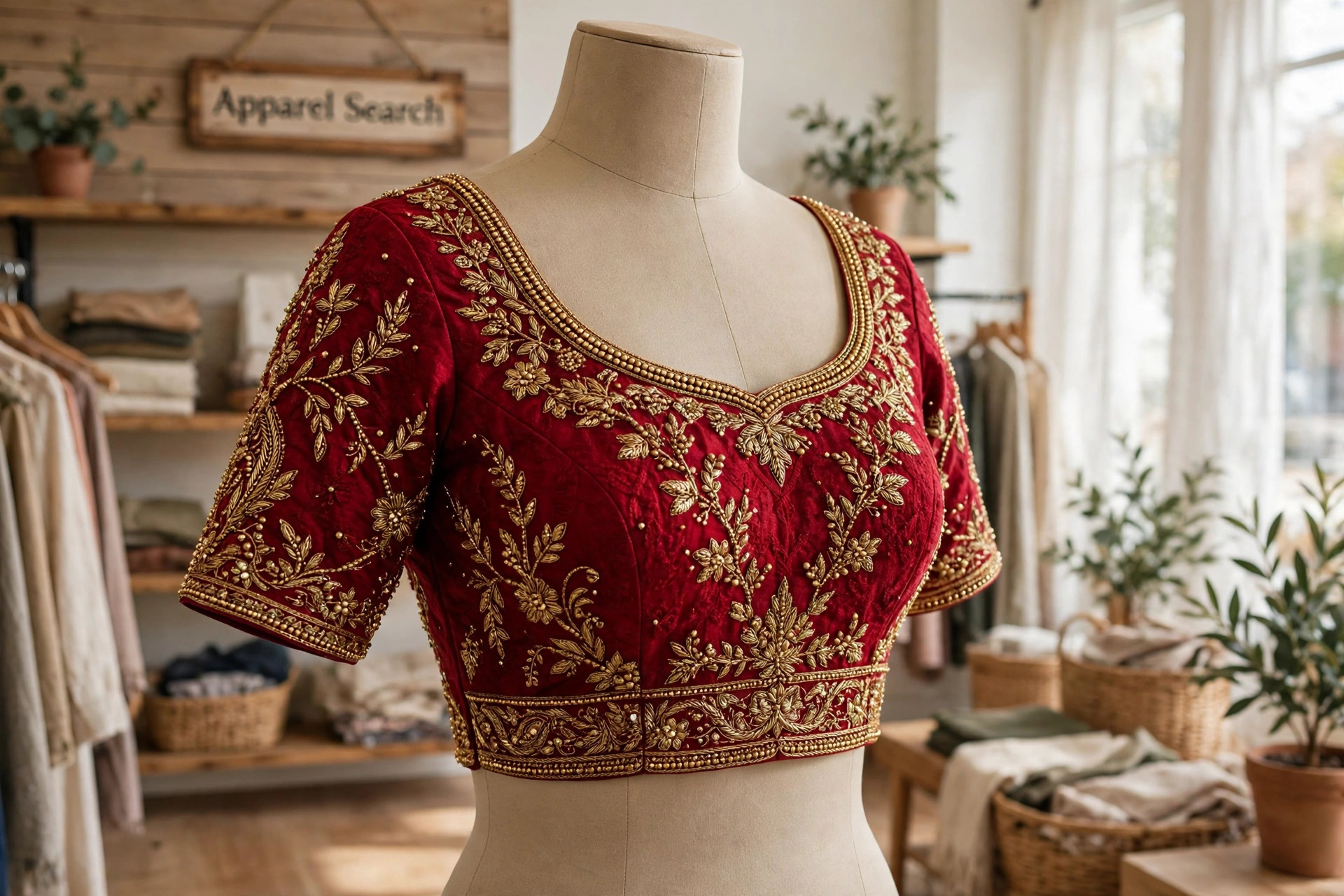
The Blouse Under the Sari
A choli — the name used in North India — is a blouse worn with a sari (also spelled saree). It is short by design, ending above the waist and leaving the midriff bare between blouse and sari skirt, and it is close-fitting where a Western blouse is usually loose. The sari itself is a single unstitched length of cloth; the choli is the tailored garment that gives the ensemble its structure at the top.
The drape decides what is seen. Wound and pleated over the choli, the sari covers the front of the blouse and one sleeve entirely, while the other sleeve is exposed — so the blouse's colour and design show exactly where the drape intends them to. The effect is calculated, whether the blouse matches the sari for a unified formal look or contrasts with it deliberately.
Cut from the Sari Itself
Traditionally, the choli's fabric arrives with the sari. The pallu — the decorated end panel of the sari — is often woven or printed with extra length that is meant to be cut off and made into the choli, so the blouse matches the sari exactly, border and motif included. Saris are still commonly sold with this blouse piece attached, and the tailor's first job is to separate and cut it.
Matching is a choice, not a rule. Blouses of contrasting colours are worn just as often — a plain sari set off by a brocade choli, or a heavily worked sari calmed by a plain blouse. Because the exposed sleeve and back carry so much of the outfit's effect, the choli fabric is chosen as part of the ensemble's design, not as an afterthought.
Fitting a Garment That Barely Covers
Because the choli is short and close-fitting, its tailoring concentrates on the bust and the armhole. A well-made choli supports and shapes without digging at the sleeve or gaping at the neckline, and it is usually made to measure by a tailor from the sari's blouse piece or from a chosen contrast fabric. Small details do much of the work: darts or princess seams shape the front, hooks or a zip close the back or front, and a drawstring at the back neckline on many traditional styles lets the fit be adjusted and gives the open back its finished edge.
Embellishment follows the same seen-in-part logic. Cholis are finished with embroidery and beadwork concentrated where the drape leaves them visible — sleeves, back, neckline edge — to suit personal taste or traditional style. A heavily worked bridal or festive choli can be a substantial garment in its own right, even though only part of it ever shows.
Styles Today, and the Lehenga Connection
Many styles are used today, including halter, open backed and closed backed designs, along with sleeveless, cap-sleeved and long-sleeved versions that follow fashion and occasion. The closed-backed, round-necked choli remains the everyday standard; open backs, deep necklines and halter cuts belong more to festive and evening wear.
The same blouse form, adapted in length and coverage, is also worn with the lehenga — the long skirt of festive dress — where the choli is fully on display rather than half-hidden by a drape, and is often correspondingly richer. Within the wider wardrobe of the subcontinent, the choli sits alongside the salwar kameez, the tunic-and-trouser ensemble, and the dhoti, the draped lower garment for men — three different answers, stitched and unstitched, to dressing in a hot climate.
Regional styles give the choli much of its variety. Gujarati and Rajasthani festive cholis are famous for mirror work, bandhani tie-dye and dense embroidery, worn with full skirts for garba dancing during Navratri, often backless or low-backed and fastened with decorative ties. Elsewhere the everyday cotton choli, plainly cut and closed with hooks, does quieter work under working saris. The garment's range — from a tailor's plain cotton staple to a heavily jewelled bridal piece — is contained in the same few inches of cloth.
Not to Be Confused With
A choli is sometimes described simply as an Indian blouse, but it is not interchangeable with a Western blouse. A Western blouse is a complete top worn as the visible garment; a choli is a short, made-to-measure under-blouse designed to be worn beneath a sari drape, ending above the waist and finished to be seen only in part — one sleeve, a decorated back, an embroidered edge.
Common Questions
What is a choli?
A choli is a midriff-baring blouse worn with a sari, the name used in North India. It is a short, fitted blouse that ends above the waist, over which the sari is draped.
Where does the fabric for a choli come from?
Traditionally the choli is cut from the sari itself: the pallu, the decorated end of the sari, is often made with extra length meant to be cut off and made into the blouse, so the blouse matches the sari exactly. Contrasting blouse fabrics are also commonly chosen on purpose.
What styles of choli are worn?
Many styles are used today, including halter, open backed and closed backed designs. Cholis can be embellished with embroidery and beadwork to suit personal taste or traditional style, and the exposed sleeve and back make the blouse a visible part of the whole outfit.