Dhoti
Clothing Definitions — definitions of garments and clothing terms from Apparel Search
Search Apparel Search
At a Glance
Definition: A dhoti is a rectangular length of unstitched cloth, usually white or cream cotton, draped and tucked around the waist and legs and worn by men in India.
Also known as: Dhooti (variant spelling); veshti in Tamil Nadu
Pronunciation: DOH-tee
Category: Clothing Definitions
Word Origin
Dhoti comes from Hindi, from Sanskrit dhauti. The word travelled with the garment itself: wrapped lower garments of unstitched cloth have been worn in India for many centuries, and the dhoti's name, like its draping, is part of that long, continuous tradition rather than a modern coinage.
The dhoti is one of the classic draped garments: a single rectangle of unstitched cloth that becomes clothing only when it is wrapped, pleated and tucked on the body. Worn by men across India, usually with a kurta above it, it serves as everyday dress in many regions and as formal dress in much of the country. This page explains how a dhoti is worn, the standing of the dhoti kurta combination, its southern form the veshti, and the etiquette that governs how it is folded and worn.
The Garment and How It Is Worn
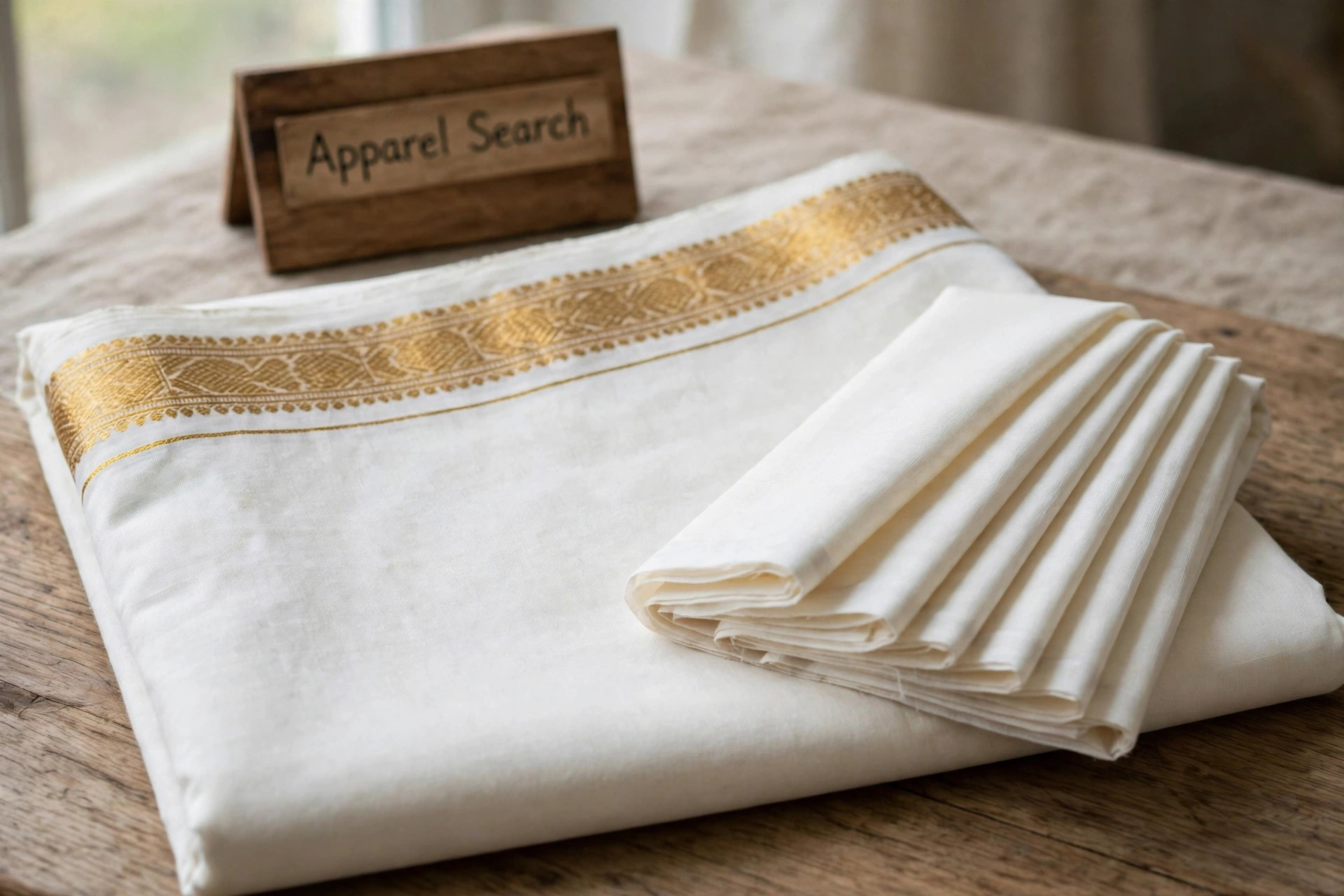
A dhoti is a length of cloth roughly four to four and a half metres long, woven in cotton — traditionally white or cream, with a woven border that may be plain, striped or, for formal wear, edged with gold thread. There are no seams, buttons or fastenings: the garment is made fresh each time it is put on. The cloth is wrapped around the waist, pleated at the front, and tucked firmly at the waistband; in the most common styles one end is drawn between the legs and tucked in at the back, so the dhoti divides like loose trousers and allows a full stride, while in other styles it falls as a straight wrapped skirt of cloth.
Dozens of regional ways of draping exist — the original record for this garment counts more than sixty — differing in pleat placement, length and how the ends are secured, and a practised wearer drapes a dhoti in well under a minute. The skill is part of the garment: because nothing is sewn, fit is created by the tension of the wrap and the security of the tucks, and the cloth can be re-draped, washed flat and used for years with no tailoring at all. It is an efficient answer to a hot climate — loose cotton, open to the air, with no constriction at the waist from belts or elastic.
Dhoti Kurta and the Dhoti's Formal Standing
In northern India the dhoti is worn with a kurta, a long shirt reaching to the knees or below, and the combination — dhoti kurta — is a complete outfit in its own right. The dhoti carries formal standing in most of India: a white dhoti with a fine border and a well-kept kurta is correct dress for ceremonies, religious observance, weddings and formal public life, and it has never carried the purely casual meaning that wrapped garments hold in some other cultures. Mahatma Gandhi made the plain dhoti world-famous as his invariable public dress, choosing homespun cloth as a statement as much as a garment, and the association of the dhoti with dignity and public life in India still owes much to that example.
Daily wear has nonetheless shifted in the large cities, where trousers and the international suit have taken over office dress for many men, and the dhoti is worn more for festivals, ceremonies and home than for the working day. That change is one of context rather than status: the same garment that is everyday dress in one district remains the formal choice in another, and politicians and public figures across India still wear dhoti kurta deliberately, as dress that speaks to their constituents.
Regional Forms: The Veshti of the South
In Tamil Nadu the garment is called the veshti, and it is draped more simply — wrapped around the waist and allowed to fall straight, often with a coloured or gold border showing at the hem, and worn with a shirt rather than a kurta. The same straight-wrapped style is common in neighbouring Kerala and Karnataka. Southern public life kept the dhoti in daily use longer and more widely than the north: it remains ordinary dress for men of all ages in much of the south, and formal dress there as well.
The dhoti belongs to a family of South Asian dress that includes the saree, the great draped garment worn by women, and the stitched salwar kameez; together they show the two great systems of Indian clothing — cloth draped whole, and cloth cut and sewn — living side by side in one wardrobe culture. A shawl or upper cloth is often added over the shoulder with a dhoti for formal and religious occasions, completing the outfit without changing the draped principle.
Etiquette, Work and Care
Unwritten rules govern the dhoti in use. For work, cycling or walking any distance, men commonly fold the lower half of the garment up and tuck it, shortening it to about the knee for freedom of movement. The folded form is working dress: on meeting an elder, a woman or anyone to whom respect is due, the fold is released with a quick flick and the cloth falls to its full length again. Knowing when the dhoti is worn long and when it may be folded is part of wearing it correctly, and the gesture of letting it down is a small, recognised act of courtesy.
Care is as simple as the construction. A cotton dhoti is washed flat, dried in the sun and often lightly starched so the pleats hold crisply when draped; the border is the part that shows, so borders are woven to survive repeated washing. With no seams to fail and no fit to outgrow, a good dhoti lasts for years — a garment whose entire technology is a rectangle of cloth, a practised pair of hands, and the conventions this page describes.
Not to Be Confused With
A dhoti and a lungi are both wrapped cloths worn by men in South Asia, and they are often mistaken for each other outside the region. The dhoti is an unstitched length of plain cloth, usually white or cream, draped with pleats and tucks and worn with the legs partly divided; it can be formal dress. The lungi is a sewn tube of cloth, usually coloured or checked, stepped into and folded down at the waist; it is informal dress, worn at home and for work, and never as formal wear.
Common Questions
What is a dhoti?
A dhoti is a men's garment worn in India, made from a single rectangular length of unstitched cloth, usually white or cream cotton. It is wrapped around the waist, pleated and tucked so that it covers the legs, and it is commonly worn with a kurta.
What is dhoti kurta?
Dhoti kurta is the combination of a dhoti with a kurta, a long shirt worn above it. In northern India it is a complete outfit with formal standing, worn for ceremonies, religious observance and public life as well as daily wear in many regions.
What is the difference between a dhoti and a lungi?
A dhoti is an unstitched length of plain cloth, usually white or cream, draped with pleats and tucks so the legs are partly divided, and it can be formal dress. A lungi is a sewn tube of usually coloured or checked cloth, stepped into and folded at the waist, and is informal dress worn at home and for work.