High-Visibility Clothing
Clothing Definitions — definitions of garments and clothing terms from Apparel Search
Search Apparel Search
At a Glance
Definition: High-visibility clothing is clothing designed to make its wearer conspicuous, using fluorescent colours by day and retroreflective bands that return light to its source by night.
Also known as: Hi-vis
Category: Clothing Definitions
High-visibility clothing is any clothing designed to make its wearer easy to see against any background — the fluorescent vest of the road worker, the reflective-banded jacket of the cyclist, the blaze-orange vest of the hunter. It works by two different systems, one for daylight and one for darkness, and it is regulated by formal standards that class garments by how much of each system they carry. This page explains how fluorescence and retroreflection work, the garments and standards in use, and the care the materials need to keep performing as designed.
Two Systems: Fluorescence by Day, Retroreflection by Night
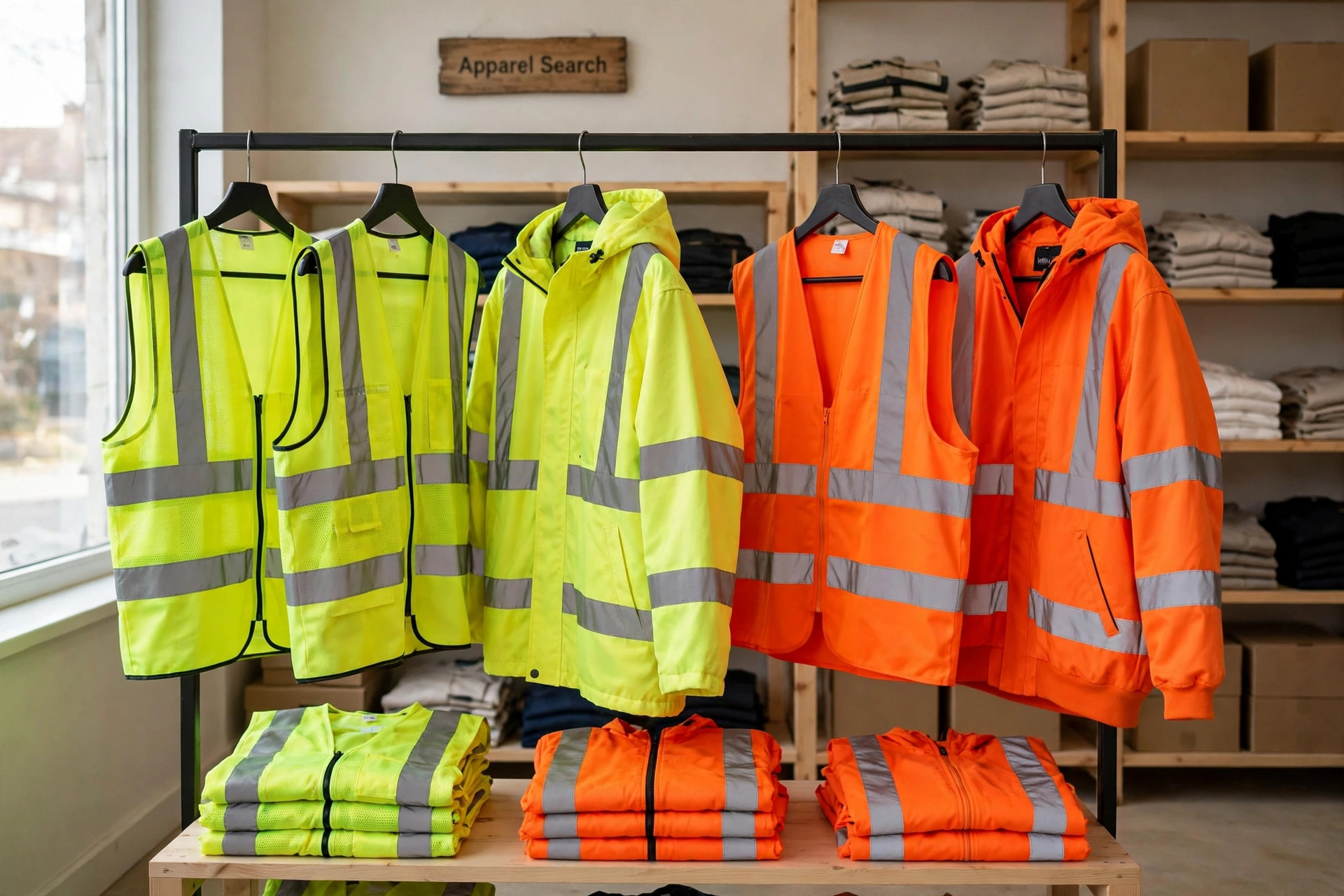
High-visibility clothing works in two different lighting conditions, and it uses a different system for each. In daylight, visibility comes from colour: fluorescent yellow-green, orange-red and red fabrics absorb ultraviolet light and re-emit part of it as visible light, so the colour appears brighter than anything natural around it and is easily discernible from any background. That is the principle of the orange hunting vest: the colour stands out against woodland and, just as importantly, identifies the wearer as a person rather than game — the reason hunting clothing adopted blaze orange long before workplace standards existed.
After dark, colour alone fails, and the second system takes over. Retroreflective material — cloth or tape surfaced with microscopic glass beads or prisms — returns light directly back toward its source instead of scattering it. A band on a jacket therefore lights up brightly for a driver in the car's own headlights, while remaining an ordinary grey strip in daylight or to anyone standing away from the beam. Part of a garment may be retroreflective — small parts of an ordinary coat, large parts of specialist safety clothing for rescue workers — and the pattern of the bands is itself information: bands arranged around a torso and limbs outline a human figure in motion, which helps an observer distinguish a person from a signpost, a fence or a parked vehicle.
Garments and Where They Are Worn
The garments themselves are deliberately simple. The standard forms are the sleeveless tabard vest worn over ordinary work clothes, the jacket and the coverall, with trousers and bib overalls at the fuller end of the range; the safety surface is added to a standard garment pattern rather than the garment being redesigned around it. Vests dominate because the system is an overlay: hi-vis is worn over whatever the job already requires, put on when the worker enters the hazardous area and taken off when they leave it.
Enhanced-visibility workwear is standard wherever people work on foot near vehicles or machinery — road and rail work, construction, airports, warehouses, delivery and emergency services. The same clothing, in lighter forms, serves runners, cyclists and motorcyclists on the road, and children outdoors near traffic. In every setting the design purpose is the same: to give drivers and operators the maximum possible time to see the person and react — the clothing is designed to be conspicuous, and its correct use, worn fastened and uncovered, is what lets it do that job.
Standards and Classes in Plain Terms
Because lives depend on the difference between a fashion-bright jacket and a rated safety garment, high-visibility workwear is standardised. The two widely used standards are ANSI/ISEA 107 in the United States and EN ISO 20471 internationally. Both work the same way in outline: they set minimum areas of fluorescent background material and of retroreflective tape, require the tape to encircle the torso and limbs so the wearer is outlined from every angle, and divide garments into classes — Class 1, Class 2 and Class 3 — according to how much of each material the garment carries.
In plain terms, the class rises with the risk. Class 1, the lightest, suits low-speed, off-road settings where the wearer is well separated from traffic. Class 2 adds more background material and tape and is the common roadside vest. Class 3 carries the most material and adds reflective bands on the sleeves or trouser legs, so arm and leg movement is visible too, and suits work beside fast traffic in poor light. ANSI/ISEA 107 also groups garments by use type — off-road, roadway and public safety — but the class number is the figure a buyer compares. High-visibility clothing sits within the wider family of protective workwear alongside extreme environment clothing, which protects against the conditions themselves rather than against being unseen.
Care and Limits
Both visibility systems wear out, and care is part of the garment's working life. Fluorescent dyes fade with ultraviolet exposure and repeated washing, so a sun-bleached vest no longer delivers its rated brightness; retroreflective tape cracks, peels and loses its return when it is abraded, contaminated with dirt or grease, or washed beyond the number of cycles the maker rates it for. Rated garments carry a maximum wash count for exactly this reason, and a garment that has passed it should be retired from safety use however sound it otherwise looks.
The design also has conditions. Retroreflection only works for an observer near the light source — it does nothing for someone approaching from the side without lights — and fluorescent colour needs daylight or good artificial light to perform. Worn open, covered by a backpack or under a coat, even a Class 3 garment cannot present its bands as designed. High-visibility clothing is an engineered system of colour, light and placement, and it performs as designed when it is the right class, in sound condition and worn as intended.
Not to Be Confused With
High-visibility clothing is the deliberate opposite of camouflage. A camouflage pattern breaks up the wearer's outline so the eye cannot separate the person from the background — the goal of women's camouflage clothing and men's camouflage hunting clothing. High-visibility design does the reverse in every particular: unbroken fluorescent colour, straight reflective bands and maximum contrast against any background, so the wearer is the first thing the eye finds.
Common Questions
What makes clothing high-visibility?
Two systems working together: fluorescent background material that appears brighter than its surroundings in daylight, and retroreflective bands that return light directly back to its source, so the garment lights up in headlights after dark. Either system alone qualifies a garment as high-visibility; safety garments use both.
How does retroreflective material work?
Retroreflective material is covered in microscopic glass beads or prisms that bounce light back toward where it came from instead of scattering it. A driver therefore sees the bands on a jacket shine brightly in the car's own headlights, while to anyone standing away from the light source the same bands look like ordinary grey strips.
What do the high-visibility classes mean?
Under ANSI/ISEA 107 and EN ISO 20471, garments are classed — Class 1, 2 and 3 — by how much fluorescent background material and retroreflective tape they carry and where it is placed. Higher classes carry more of both and suit higher-risk settings such as working beside fast traffic; Class 3 adds reflective bands on sleeves or trouser legs.