Youghal Lace
Fabric Definitions — definitions of fabrics, cloths, laces and textile materials from Apparel Search
Youghal lace (or Yougal lace) is a needle lace inspired by Point de France developed in Youghal, County Cork, Ireland. Youghal lace was a top quality commercial product that ended with the First World War, and lace making was taught in Youghal from 1845 by the Presentation Sisters.
Youghal lace was a top quality commercial product that ended with the First World War. Lace Making was taught in Youghal from 1845 by the Presentation Sisters. Among the finest pieces of lace made in Youghal was a train for Queen Mary worn on her visit to India in 1911 as its Empress. The skill of Lace Making is still retained in Youghal to this day. There is no written record of either the stitches or the general technique at the Convents themselves, but the puzzling obscurity is illuminated by four important survivals:
1. A sampler of 43 stitches, preserved at St Clare's Convent in Kenmare.
2. A court train made for Queen Mary and worn by her at the Delhi Durbar of 1911.
3. Two books of designs drawn in Chinese white on paper tinted beige, pink, azure, crimson or midnight blue.
4. The Needlecraft Practical Journal no.106, published by William Briggs under the Penelope trademark, c1909.
|
|
Learn more about fabric.
Learn about knit fabrics.
Learn about woven fabrics.
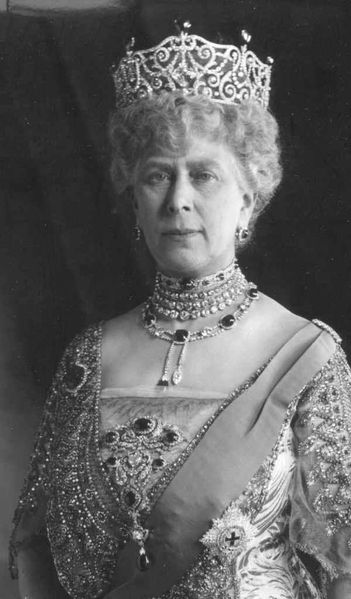
Victoria Mary of
Teck. Image by Lafayette of Bond
Street London. Image copyright V&A Museum, London. NOTE; she is wairing the Durbar Tiara, now worn by the duchess of Cornwall. |
|
| Fashion Network |
| Clothing Industry Directory Fashion Terms |
An Irish Needle Lace on a French ModelYoughal lace belongs to the needle lace family: lace made not on a pillow with bobbins, but with a single needle working buttonhole stitches over a foundation thread, building the pattern stitch by stitch on a drawn design. Its stated inspiration, Point de France, was the prestige French needle lace of the seventeenth century, famous for bold raised designs worked over a cordonnet outline. An Irish lace 'inspired by' that tradition is making a claim about quality and method — fine thread, raised work, and floral patterns of professional finish — and the definition's verdict supports the claim: Youghal lace was a top quality commercial product. That commercial character distinguishes it from purely domestic or famine-relief lace making. Youghal lace was taught systematically, made to a saleable standard, and sold into the market for luxury dress trimmings, trains and ecclesiastical and presentation pieces, until the trade ended with the First World War, when war, fashion change and the collapse of the handmade lace market closed the industry that had sustained it. The Presentation Sisters and the Queen Mary TrainThe institution behind the lace was the Presentation Sisters, who taught lace making in Youghal from 1845. Convent lace schools were a distinctive Irish pattern: religious orders provided the teaching, the designs, the quality control and the marketing connections, while local women and girls provided the skilled handwork — a structure that turned a domestic needle skill into an export industry in towns across Ireland, of which Youghal, Kenmare and Limerick, all linked from this page, are examples. The summit of Youghal's reputation was royal: among the finest pieces of lace made in Youghal was a train for Queen Mary, worn on her visit to India in 1911 as its Empress — the court train worn at the Delhi Durbar of 1911. A royal train is the largest and most visible commission a lace workshop can receive, yards of flawless needlework meant to be seen at state ceremony and recorded in photographs, and its survival gives Youghal lace a documented masterpiece. The skill of lace making, the definition adds, is still retained in Youghal to this day, even though the commercial industry ended in 1914–18. Four Survivals in Place of a Written RecordThe definition records a genuine historical puzzle: there is no written record of either the stitches or the general technique at the convents themselves. The technique lived in hands and teaching, not in books — which is why the four survivals it lists matter so much to lace historians. A sampler of 43 stitches, preserved at St Clare's Convent in Kenmare, is effectively the stitch dictionary of the craft, each numbered motif demonstrating a filling or ground that a written description could only approximate. The Queen Mary court train demonstrates the stitches at full scale in a finished, dated, documented work. Two books of designs drawn in Chinese white on paper tinted beige, pink, azure, crimson or midnight blue preserve the pattern repertoire — the tinted grounds made the white design lines legible to the lace makers who worked from them. And the Needlecraft Practical Journal no.106, published by William Briggs under the Penelope trademark around 1909, carried Youghal work into print for the wider needlework public while the industry still lived. Together, sampler, masterpiece, design books and journal reconstruct what the convents never wrote down — the same evidence trail, incidentally, that the photograph on this page serves, showing Queen Mary in the Durbar Tiara worn with the lace of the period. Common QuestionsWhat kind of lace is Youghal lace?Youghal lace is a needle lace — lace built up with a needle and thread rather than with bobbins — inspired by Point de France, the French needle lace tradition. It was developed in Youghal, County Cork, Ireland. Who taught lace making in Youghal?Lace making was taught in Youghal from 1845 by the Presentation Sisters. It became a top quality commercial product, and among the finest pieces made was a train for Queen Mary, worn on her visit to India in 1911 as its Empress. How is Youghal lace technique known today if no written record was kept?No written record of the stitches or the general technique was kept at the convents themselves, but four survivals illuminate it: a sampler of 43 stitches preserved at St Clare's Convent in Kenmare, Queen Mary's court train worn at the Delhi Durbar of 1911, two books of designs drawn in Chinese white on tinted paper, and the Needlecraft Practical Journal no.106, published by William Briggs under the Penelope trademark, c1909. More to ExploreMore from Apparel Search: Fabric Definitions | Clothing Industry Glossary | Fashion Terms | Apparel Search Home
|