Inishmacsaint Lace
Fabric Definitions — fabric and textile definitions from Apparel Search
Search Apparel Search
At a Glance
Definition: Inishmacsaint lace is a raised needle lace worked in fine linen thread, given its three-dimensional relief by a cordonnet outline sewn onto the finished lace around its flowers and other principal motifs.
Category: Fabric Definitions
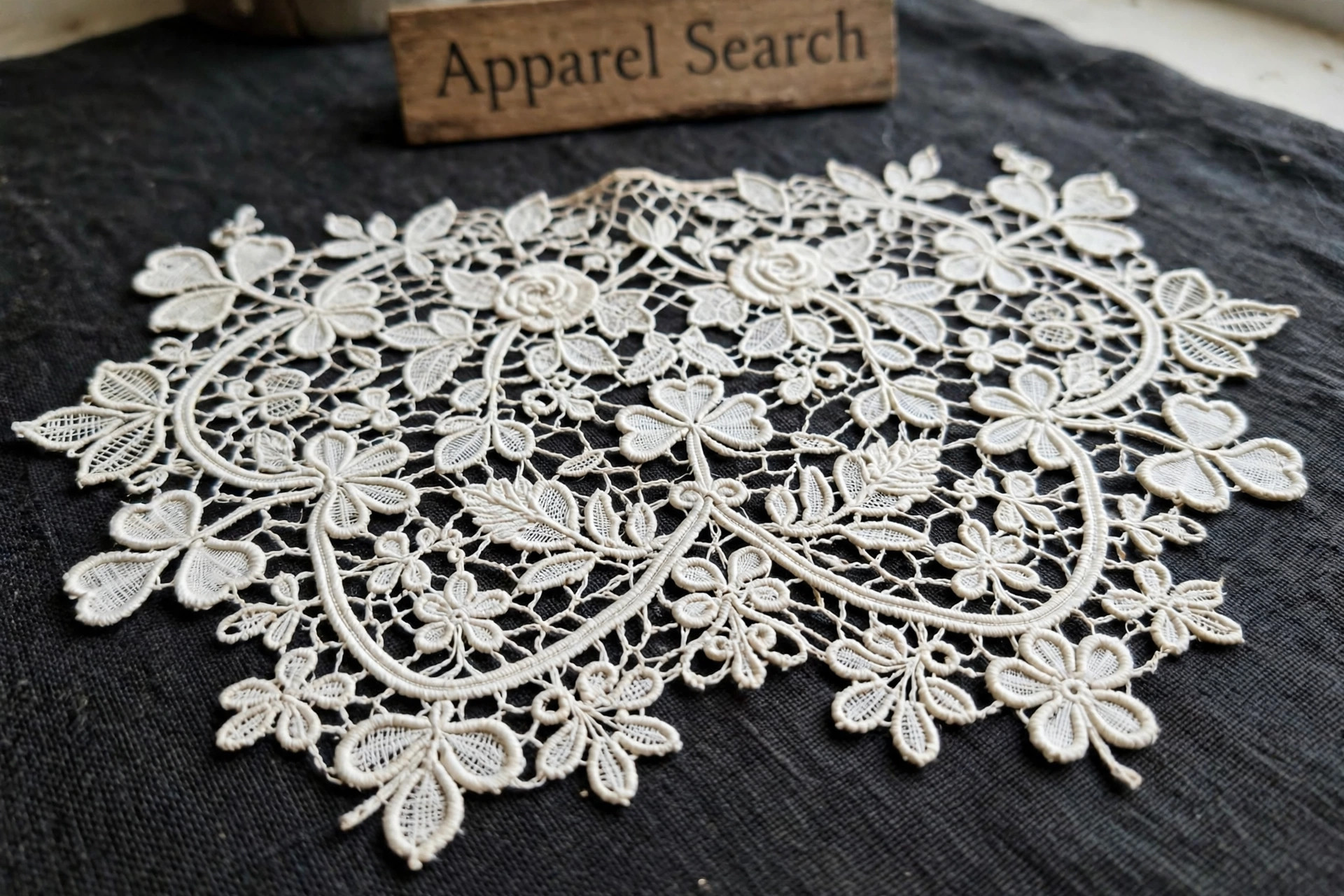
Inishmacsaint lace is worked in fine linen thread. It is a raised needle lace, similar in method to the flat Youghal needle lace, but the raised effect is achieved by additional outlining sewn on to the lace after completion — usually around the outside of flowers and other important parts of the design. The outlining is the cordonnet, a thickish cord that can be further elevated by couched padding oversewn with buttonhole stitching, giving the finished lace a raised, three-dimensional appearance. This definition was provided to Apparel Search by the Sheelin Antique Irish Lace Museum.
Relief Added After the Lace Is Made
Inishmacsaint reverses an expectation: in most laces, the pattern relief is built during the making, stitch by stitch. Here the needle lace ground is first completed by a method close to flat Youghal work, and only then does the defining step begin — the outlining. The maker lays the cordonnet along the contours that matter, chiefly flower outlines and other principal motifs, couches it down, and where greater height is wanted builds padding beneath it before oversewing with buttonhole stitching.
The result reads almost like sculpture at textile scale: flat stitched grounds, then a corded ridge rising around the flowers, casting tiny shadows and catching the light differently from the ground. That two-stage making is also an identification key. A raised Irish lace whose relief sits only on the outlines, in a visibly corded line, over an otherwise flat needle-lace fabric, is showing the Inishmacsaint method; laces raised throughout their motifs were built differently.
The thread supports the effect. Fine linen gives the needle lace its crisp stitch definition and matte character, so the flat ground stays quiet and the padded, buttonhole-oversewn cordonnet reads cleanly against it. Because the outlining is added to a completed lace, its line can be judged on its own: an even, corded ridge following the flower outlines, rising highest where the padding beneath it is deepest, is the mark of the technique done as the definition describes.
Inishmacsaint Among the Irish Needle Laces
The Irish lace industries of the 19th century each fixed on a distinguishing technique, and Inishmacsaint's distinction is relief. Youghal pursued flat needlepoint fineness; Kenmare developed its own needlepoint school and design tradition; Limerick embroidered on machine net; Carrickmacross appliquéd muslin on net. Inishmacsaint, worked in fine linen thread, kept the needle-lace base and added the corded outline — a comparatively economical route to a luxurious effect, since hours of padding go only where the eye lands first, on the motif edges.
The finished lace served the same markets as its sisters — collars, cuffs, trimmings, ecclesiastical and presentation pieces — where a raised floral outline reads richly at a distance. For collectors and students, the account preserved here matters as well as the technique: it was provided by the Sheelin Antique Irish Lace Museum, and the cordonnet test it describes remains the practical way to separate Inishmacsaint from the flat needle laces it grew beside.
Common Questions
What is the cordonnet in Inishmacsaint lace?
The cordonnet is the outlining cord applied to the finished lace: a thickish cord laid around the outside of flowers and other important design parts and sewn on, further elevated where wanted by couched padding oversewn with buttonhole stitching. It is the cordonnet that turns a flat needle lace into the raised, three-dimensional Inishmacsaint finish.
How does Inishmacsaint lace differ from Youghal lace?
By the raised finish. The underlying method is similar — needle lace worked in fine thread — but Youghal stays flat, while Inishmacsaint adds the outlining cordonnet after completion, raising the principal motifs in relief above the ground. The raised areas concentrate on flowers and other important parts of the design.
What thread is Inishmacsaint lace worked in?
Fine linen thread, as stated in the definition provided by the Sheelin Antique Irish Lace Museum. Linen gives the needle lace its crisp stitch definition and matte character, and takes the padded buttonhole work of the cordonnet cleanly.