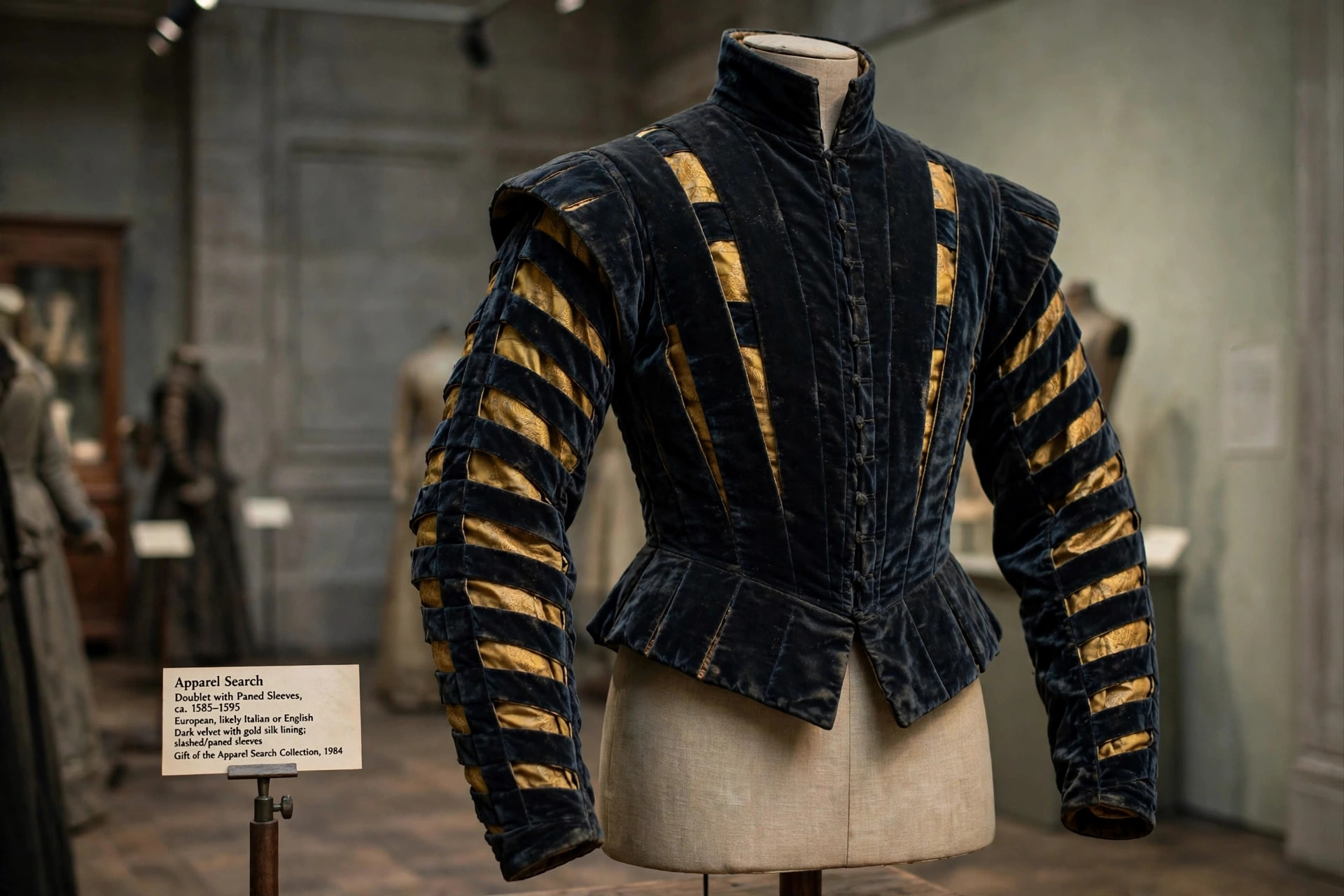
The paned sleeve was a sleeve built from separate strips of fabric — panes — joined at the shoulder and wrist and left open along the arm, so that a contrasting lining or the fine linen shirt beneath showed through the gaps in puffs and flashes of colour. It was one of the most eye-catching devices of Renaissance dress, worn at the courts of the 16th and early 17th centuries by men and women alike.
Paning belonged to the same family of techniques as slashing and pinking, in which cloth was deliberately cut so that another material could be pulled through. In the world of 1550–1600 fashion, a paned sleeve announced wealth twice over: costly fabric outside, and costly fabric deliberately displayed inside.
Panes, Slashes, and Puffs
A tailor made a paned sleeve by cutting the outer material — velvet, satin, or brocade — into longitudinal strips, finishing each edge, and mounting the strips over a full sleeve of contrasting silk or linen. The panes were fixed at top and bottom and sometimes caught at intervals with buttons, points, or jewels, letting the inner layer billow between them. Portraits show the effect at its richest on doublets, gowns, and trunk sleeves, the panes striped in heraldic or livery colours.
The fashion drew on the slashed dress associated with German and Swiss soldiers, whose cut clothing became a court craze in the early 1500s. Refined at the Tudor, Valois, and Habsburg courts, paning turned a military conceit into jewellery for the arm, and sumptuary complaints of the period testify to how much expensive cloth it consumed.
Into the 17th Century and Revival
Paned sleeves continued in 1600–1650 fashion, softening as doublets grew looser in the 1620s and 1630s; panes appeared on the great slops and hanging sleeves of the period before the plainer dress of the mid-century swept them away. The technique never entirely vanished — it survived in ceremonial and theatrical dress — and it enjoyed a self-conscious revival in the 1830s, when Romantic fashion plundered the Renaissance for gigot sleeves decorated with panes and slashes in conscious imitation of Tudor portraits.
That revival is a useful reminder that the 1830s looked backward as eagerly as any decade since. Dressmakers copied paning from paintings, and fancy-dress and historical novels kept the look familiar long after everyday fashion moved on.
Legacy
The paned sleeve survives today in historical costume, stage dress, and the ceremonial uniforms that preserve Renaissance forms. Its principle — a garment constructed to reveal a second, contrasting layer — still shapes modern design, from cut-out panels to layered sleeves, and few details identify a portrait's date as quickly as a well-paned arm.
Common Questions
- What is a paned sleeve?
- A paned sleeve was a sleeve made of separate strips of fabric, called panes, joined at the shoulder and wrist so that a contrasting lining or shirt showed through the gaps between them.
- When were paned sleeves worn?
- Paned sleeves were worn mainly in the 16th and early 17th centuries at European courts, with a notable revival in the 1830s, when Romantic fashion copied Renaissance dress.
- What is the difference between paning and slashing?
- Slashing meant cutting small slits in a fabric so a lining could be pulled through. Paning went further, building the sleeve from separate strips with open spaces between them.
Historic Garments & Accessories
- Fashion History Guide
- Pelisse
- Polonaise
- Robe à la Française
- Robe à l'Anglaise
- Robe en Chemise (Chemise à la Reine)
- Justacorps
- Inverness Cape
- Kirtle
- Bliaut
- Houppelande
- Poulaine
- Pomander
- Caraco
- Banyan
- Pagoda Sleeve
- Paned Sleeve
- Kokoshnik
- Hennin
- Bergère Hat
- Capeline
- Cartwheel Hat
- Cocktail Hat
- Gainsborough Hat
- Halo Hat
- Shako