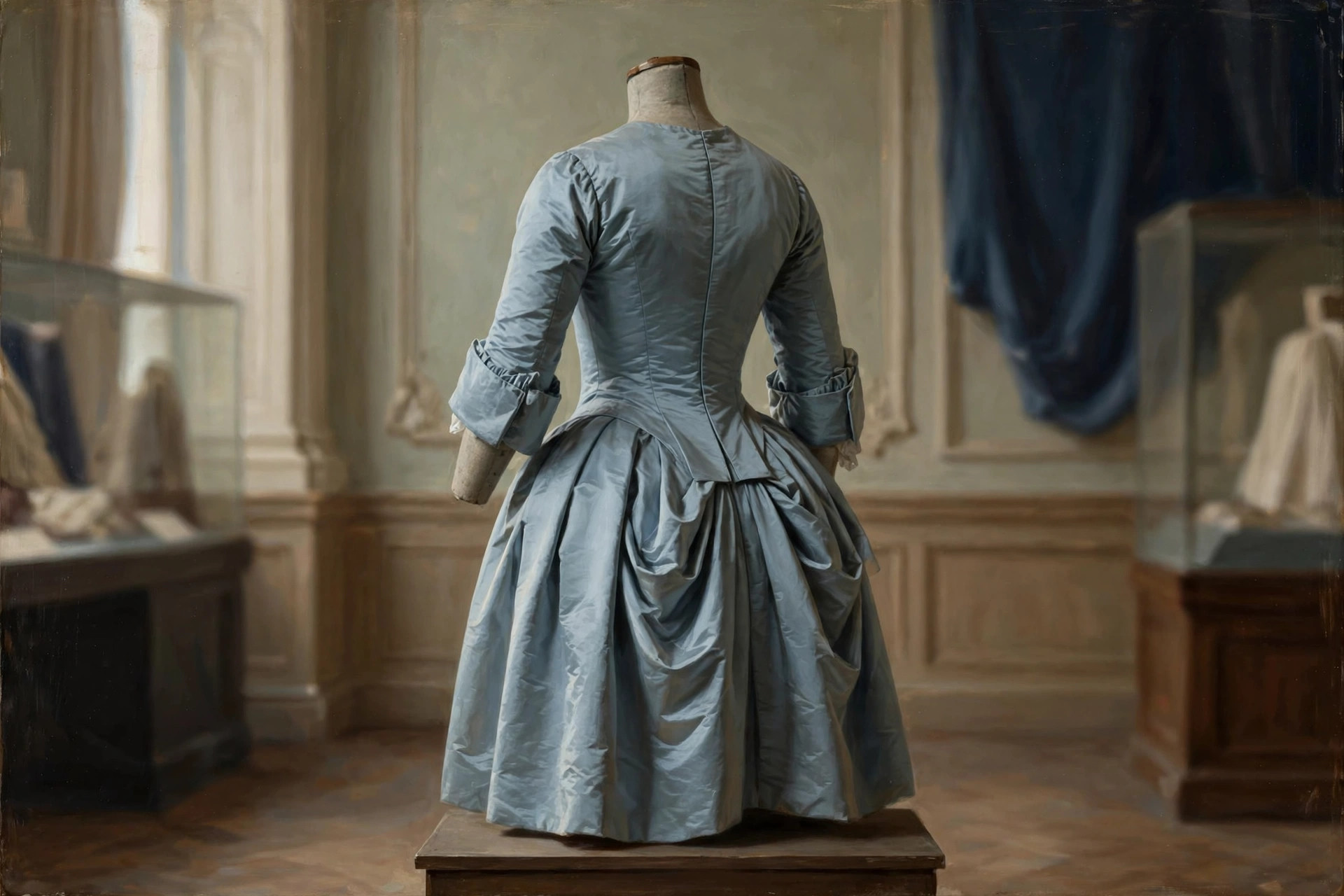
The robe à l'anglaise — the “English gown” — was the close-bodied dress that challenged the flowing sack back in the second half of the eighteenth century. Where the française fell free from the shoulders, the anglaise was cut to fit: its back was shaped with seams to follow the body over stays, in the manner of a man's tailored coat.
French fashion named it for England because the fitted, comparatively plain style embodied what the French admired — and sometimes mocked — as English taste: good cloth, neat construction, and suitability for walking and country life. Through the 1770s and 1780s, within 1750–1795 fashion, it became the standard smart day dress of fashionable women in both countries.
Construction and Fit
The anglaise bodice was cut in shaped panels, the back pieces seamed and sometimes finished with a small point or a short skirt of pleats at the centre back. There were no free Watteau pleats. Early versions retained an open front with a stomacher; later ones closed in front with hooks, pins, or buttons, and the skirt could be looped up behind in the retroussé manner for walking.
Sleeves were long and close, ending at the elbow or wrist, and the supporting hoops shrank to small hip pads or a modest bum roll. The gown was made in silk for formal wear, but its natural materials were wool, linen, and above all printed cotton, whose neat floral patterns suited its tidy character.
A Dress for the Day
The anglaise was the dress of active fashionable life: morning calls, shopping, travelling, country visiting, and promenading. It asked for no attendant to arrange pleats, could be put on with relative ease, and looked correct rather than ceremonial. Writers of the period praised Englishwomen's morning dress precisely for this combination of fit and simplicity.
It also crossed classes more readily than court dress. In sturdy fabrics the close-bodied gown was worn by shopkeepers' and farmers' wives in their best versions, making it one of the most widely shared silhouettes of the century.
Decline and Legacy
In the 1790s the waistline climbed and the fitted bodice dissolved into the high-waisted round gown of the Revolutionary and Regency years, ending the anglaise's reign. Its principle, however — a dress shaped by tailoring rather than drapery — never disappeared. Every fitted day dress, shirtwaist, and tailored dress since descends in part from the close-bodied English gown.
Common Questions
- How is a robe a l'anglaise different from a robe a la francaise?
- The anglaise is close-bodied: its back is cut in fitted, seamed panels that follow the body. The francaise has loose box pleats at the back that fall free from the shoulders over wide paniers.
- Was the anglaise an English invention?
- It developed in England from tailored riding and country dress, which is why French fashion called it the English gown, though French dressmakers adopted and refined it enthusiastically.
- What fabrics suited the anglaise?
- Silk for formal versions, but characteristically wool, linen, and printed cotton, whose neat patterns matched the gown's tidy, practical character.