Justacorps
Fashion Definitions — fashion history and style definitions from Apparel Search
Search Apparel Search
At a Glance
Definition: The justacorps was the long, waist-fitted coat that defined men's dress from the 1660s to the later 18th century, worn with a waistcoat and breeches in the three-piece arrangement that leads directly to the modern suit.
Also known as: Justaucorps
Pronunciation: ZHOOST-uh-kor
Category: Fashion Definitions
Word Origin
Justacorps is French — juste au corps, "close to the body" — a name that describes exactly what the coat did: it fitted the torso through the waist before flaring into stiffened skirts.
The justacorps — from the French juste au corps, "close to the body" — was the long coat that defined men's dress from the 1660s to the later eighteenth century. Knee-length, fitted through the waist and flaring into stiffened skirts, it was worn with a waistcoat and breeches in the three-piece arrangement that leads directly to the modern suit. The style crystallised at the court of Louis XIV of France, where the King used splendid, regulated dress as an instrument of rule. From Versailles it spread across Europe, structuring 1700–1750 fashion and remaining the formal coat well into 1750–1795 fashion.
Cut and Construction
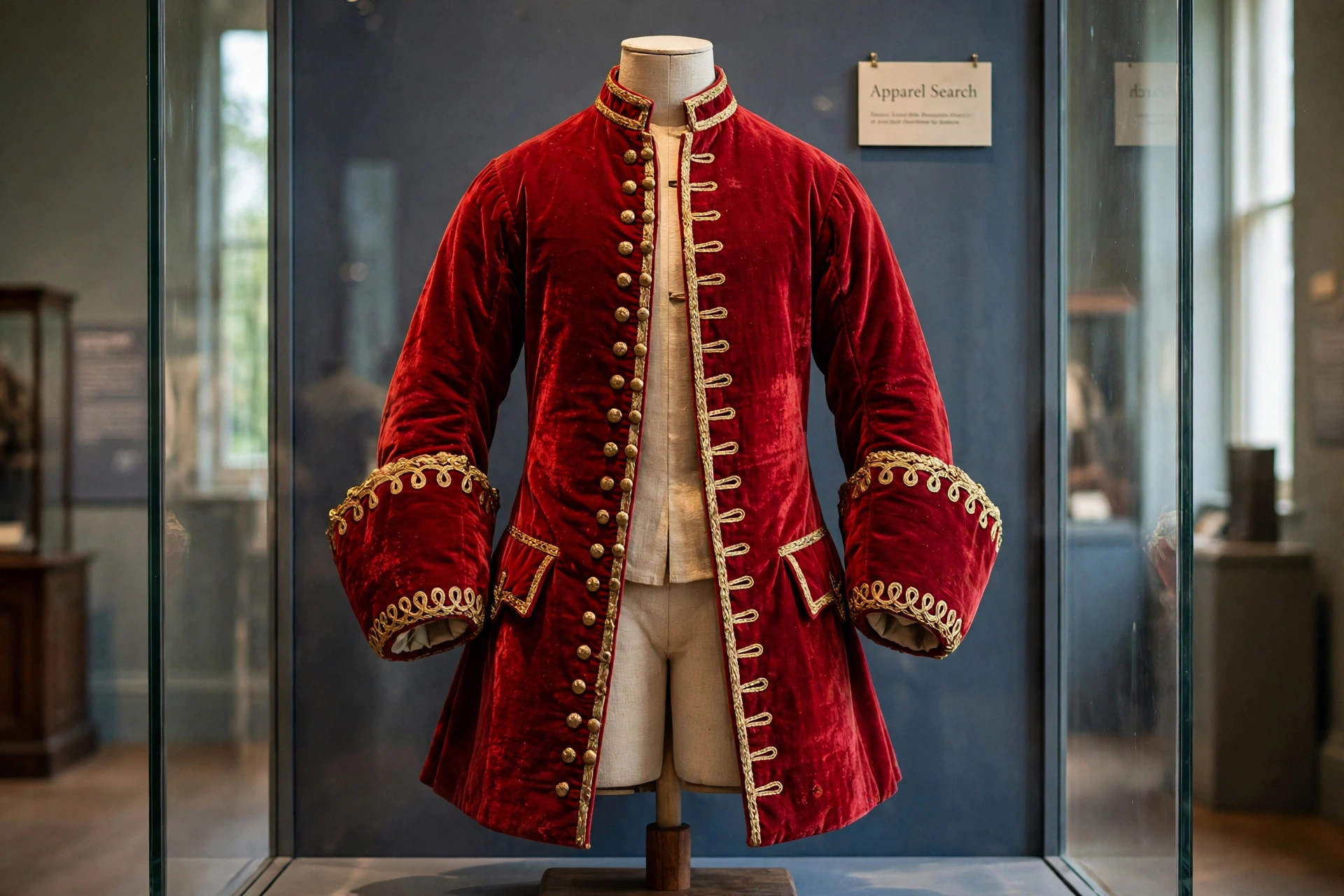
A justacorps of the 1680s and 1690s reached the knee and fastened down the front with closely set buttons — many of them decorative, since the coat was often worn partly open over a long waistcoat. It carried enormous turned-back cuffs, low pockets with deep flaps, and skirts stiffened with buckram or horsehair so that they stood away from the legs. Early examples were collarless; a small standing collar appeared in the eighteenth century.
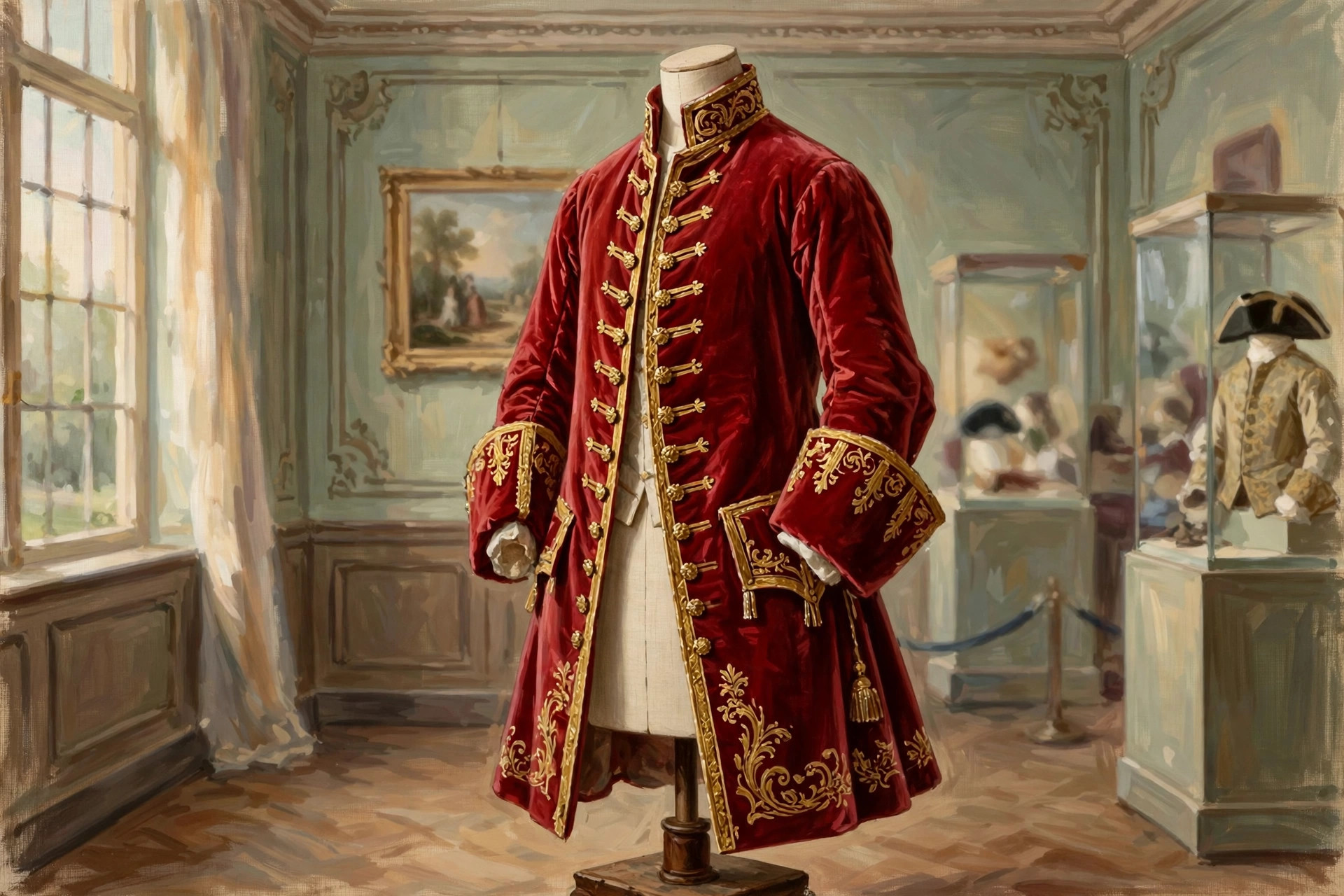
The finest examples were of velvet or rich wool, embroidered down the fronts and cuffs with gold or silver thread, their buttons of gilt metal, enamel, or covered silk. Livery and military justacorps translated the same cut into regimental colours with contrasting braid, fixing the visual grammar of the uniform coat.
Court, City, and Uniform
At court the justacorps was the required dress of a gentleman, and its cost in cloth, braid, and buttons announced rank as surely as a title. The justacorps à brevet, a blue coat with special embroidery, was granted by Louis XIV as a coveted mark of favour. In the city, merchants and professionals wore plainer versions in dark cloth, and the cut's discipline spread into everyday male dress.
Through the 1700s the coat grew slimmer, its skirts narrower and its cuffs smaller, and the waistcoat shortened beneath it — but the essential silhouette of fitted torso, flared skirt, and decorated front held for a century.
From Justacorps to Suit Coat
In the later eighteenth century the formal justacorps relaxed into the frock coat and the cutaway tail coat, and the nineteenth century shortened the line into the lounge jacket. Yet the inheritance is plain: the modern suit coat keeps the justacorps' fitted waist, front buttons, and cuffed sleeves, together with the three-piece logic of coat, waistcoat, and legwear that Louis XIV's court standardised.
Women borrowed the justacorps as well. The tailored riding habit of the late seventeenth and eighteenth centuries copied its fitted body, deep cuffs, and braided fronts, making the coat one of the earliest examples of menswear tailoring deliberately adopted into female dress — a borrowing fashion has repeated ever since.
Common Questions
What does justacorps mean?
It is French for close to the body, describing a coat fitted through the torso. In English sources it is sometimes spelled justaucorps.
What was worn with a justacorps?
A long waistcoat, knee breeches, stockings, and buckled shoes, with a cravat at the neck and usually a sword at court. The three pieces established the pattern of the modern suit.
How long was a justacorps fashionable?
From about the 1660s through most of the 18th century, gradually slimming down before evolving into the frock coat and tail coat in the later 1700s.