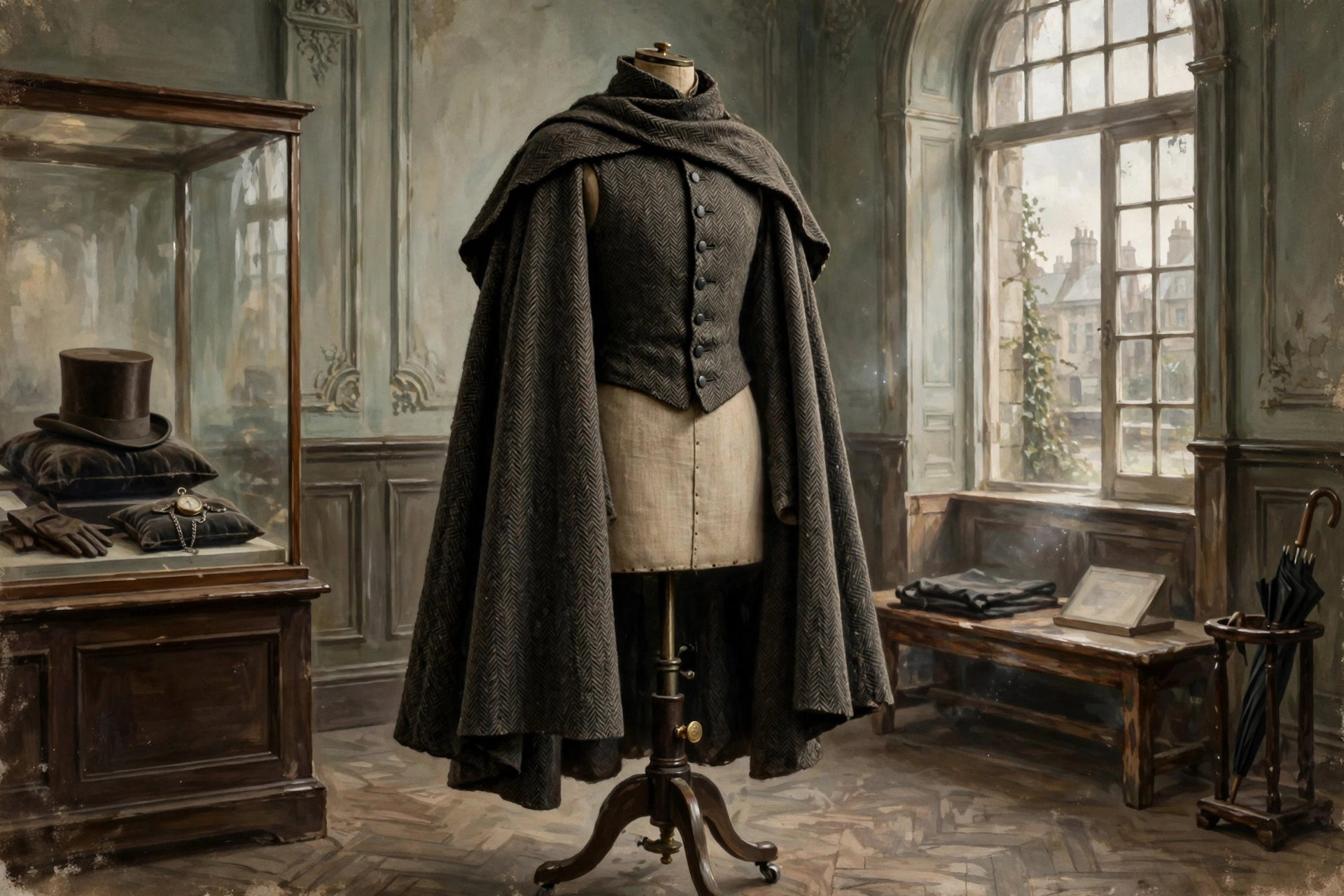
The Inverness cape was a men's overcoat of the Victorian era whose body had no sleeves at all. Instead, a deep cape fell from the shoulders over the arms, while the wearer's hands emerged through openings in the front of the coat. The result was a long, swirling silhouette perfectly adapted to rain, travel, and the draughty platforms of the railway age.
Named for the Scottish Highland town of Inverness, the coat emerged in 1850s fashion, flourished through 1870s fashion and 1890s fashion, and became a staple of Victorian fashion for town and country alike.
Construction: A Coat Without Sleeves
Beneath the cape, the Inverness body was a loose, single- or double-breasted coat reaching below the knee, with arm slits rather than sleeves. The cape itself was cut in one with the back or buttoned at the neck, falling to about the fingertips and covering the arms to the elbow and beyond. In formal town versions the cape was shorter and the coat faced with silk; in country versions both were of heavy tweed.
The design solved real problems. The cape shed rain away from the arms, allowed a gentleman to consult a watch, open a carriage door, or handle reins without fighting coat sleeves, and layered comfortably over the frock coats and lounge suits beneath.
Holmes and the Inverness Image
Illustrators fixed the coat in the public imagination. Sidney Paget's drawings for the Sherlock Holmes stories dressed the detective in an Inverness cape and ear-flapped travelling cap, and although Arthur Conan Doyle rarely specified the coat, the pairing of cape and deerstalker became the universal visual shorthand for the great detective — and, by extension, for Victorian rationality itself.
Beyond fiction, the Inverness was respectable, unshowy professional dress: doctors, academics, and travellers wore it because it was warm, weatherproof, and correct with both morning dress and country tweeds.
Decline and Revival
In the early twentieth century, motoring coats, trench coats, and shorter tailored overcoats displaced the Inverness, and by the 1920s it looked like a survival from another age. It never entirely vanished: formal caped overcoats persisted for evening wear, and fashion periodically rediscovers the drama of the cape coat — in mid-century couture, in modern heritage menswear, and on screen whenever a period detective appears.
Surviving examples reward close looking. The best Inverness coats were waterproofed tweeds from Scottish mills, their capes cut to swing clear of a walking stick, their seams taped against Highland rain. What began as regional weatherproofing became, through the railways and the illustrated press, an international uniform for the travelling professional man.
Common Questions
- Why does an Inverness cape have no sleeves?
- The deep shoulder cape covers the arms instead, shedding rain and leaving the hands free through front openings to handle reins, watches, and doors. It layered easily over the tailored coats worn beneath.
- Did Sherlock Holmes wear an Inverness cape?
- Yes, in the famous illustrations by Sidney Paget, which fixed the cape and deerstalker cap as Holmes's visual signature, even though the stories themselves seldom describe his coat.
- When was the Inverness cape worn?
- Chiefly from the 1850s to the early 1900s, as a town and travelling overcoat, with tweed versions for the country and silk-faced versions for formal wear.