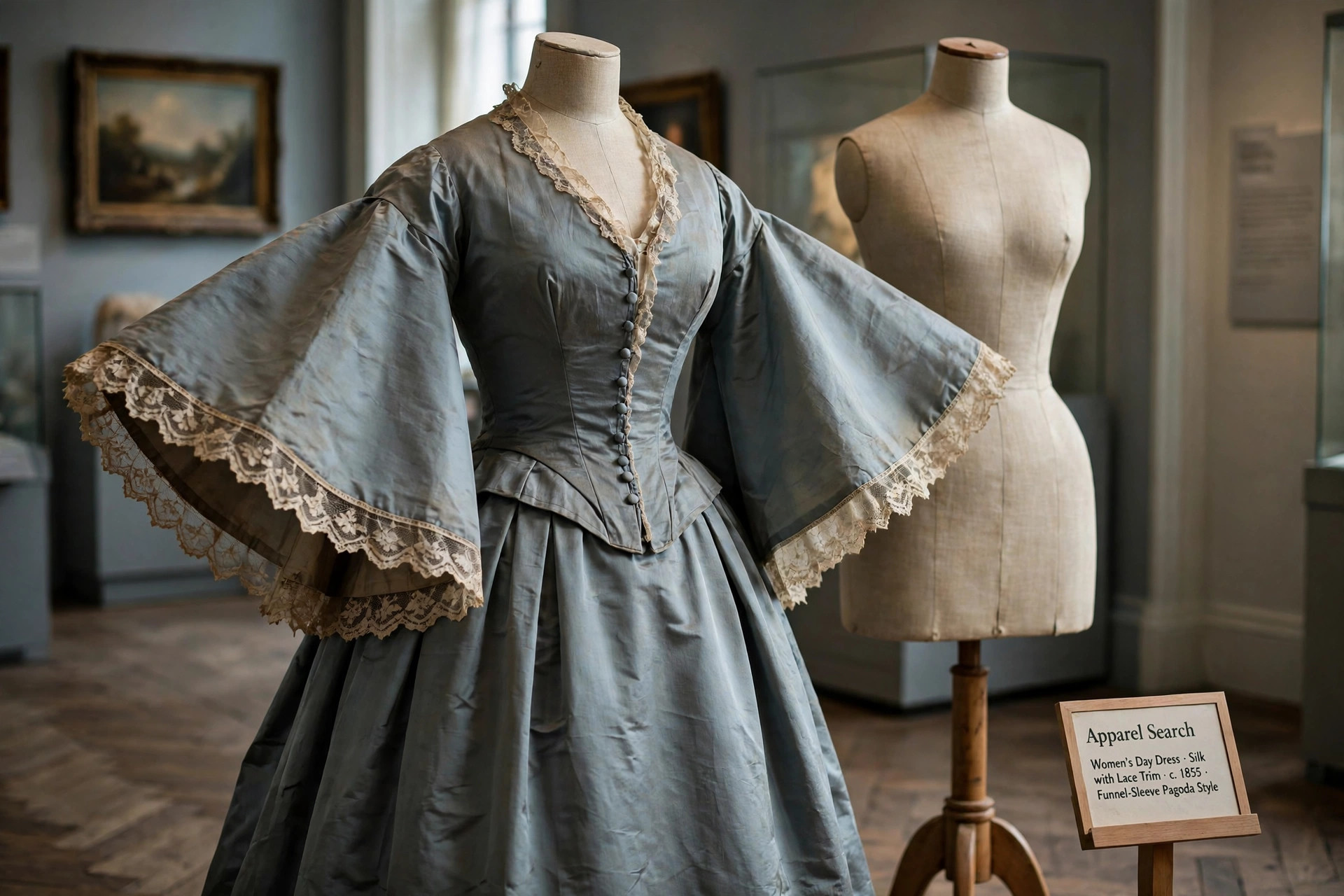
The pagoda sleeve was the wide, funnel-shaped sleeve that dominated women's dress in the 1850s and early 1860s. Narrow at the shoulder, it opened dramatically toward the wrist into a flared bell or trumpet shape, its name borrowed from the tapering tiers of a Chinese pagoda. Beneath the opening, women wore separate white undersleeves, called engageantes, of muslin, lace, or embroidery, which filled the funnel and changed with laundering.
The sleeve belonged to the silhouette of 1850s fashion: a small, sloping shoulder, a wide bell of a sleeve, and a vast crinoline skirt below. Together they made the fashionable figure a study in widening triangles, and the pagoda sleeve was the element contemporaries noticed first.
Construction and Undersleeves
A pagoda sleeve was cut in shaped pieces so that it fitted the top of the arm smoothly, then flared without gathers into its wide mouth. Trimmings emphasised the tiers: rows of ribbon, fringe, lace, or velvet bands echoed the stepped outline that gave the sleeve its name. Because the open mouth would otherwise expose the forearm, the engageante was essential — a gathered or pleated white undersleeve, often beautifully worked with broderie anglaise, that could be removed and washed while the silk dress could not.
The combination was practical as well as pretty. White undersleeves showed cleanliness, could be replaced cheaply, and let one bodice present several looks. Fashion plates of the period show pagoda sleeves on morning dresses, silk visiting dresses, and evening bodices alike, the width varying with the hour and the fabric.
Change Through the 1860s
In 1860s fashion the sleeve gradually narrowed. The early years of the decade kept a moderate pagoda, often with a deep cuff effect, but by the middle 1860s sleeves had become straighter, with the coat sleeve — cut close to the arm — taking over as skirts began to move toward the bustle silhouette. The great funnel sleeve, impossible to reconcile with the narrower lines that followed, disappeared with remarkable speed.
Its passing also marked a shift in how sleeves were made. The pagoda had been a dressmaker's showpiece, its flare depending on careful cutting on the cross of the cloth. The plainer coat sleeve that replaced it suited the growing trade in ready-made bodices and the sewing machine's strengths.
Legacy
The pagoda sleeve remains the instantly recognisable sign of the crinoline era in photographs, fashion plates, and surviving dresses. Its idea — a sleeve treated as architecture, widening in deliberate tiers — returns whenever designers revive bell and trumpet sleeves, and the detachable white undersleeve survives in spirit in every layered cuff and removable trim in modern dress.
Common Questions
- What is a pagoda sleeve?
- A pagoda sleeve was a wide, funnel-shaped sleeve of the 1850s and early 1860s, narrow at the shoulder and flaring dramatically toward the wrist, named for its resemblance to the tiers of a pagoda.
- What were engageantes?
- Engageantes were separate white undersleeves of muslin, lace, or embroidery worn beneath the open mouth of a pagoda sleeve. They could be removed for washing and changed to vary a dress.
- When did pagoda sleeves go out of fashion?
- Pagoda sleeves narrowed through the early 1860s and were replaced by the closer-fitting coat sleeve by the middle of the decade, as the crinoline silhouette began to change.
Historic Garments & Accessories
- Fashion History Guide
- Pelisse
- Polonaise
- Robe à la Française
- Robe à l'Anglaise
- Robe en Chemise (Chemise à la Reine)
- Justacorps
- Inverness Cape
- Kirtle
- Bliaut
- Houppelande
- Poulaine
- Pomander
- Caraco
- Banyan
- Pagoda Sleeve
- Paned Sleeve
- Kokoshnik
- Hennin
- Bergère Hat
- Capeline
- Cartwheel Hat
- Cocktail Hat
- Gainsborough Hat
- Halo Hat
- Shako