Balaclava
Hat & Headwear Definitions — hats, caps, helmets and headwear terms from Apparel Search
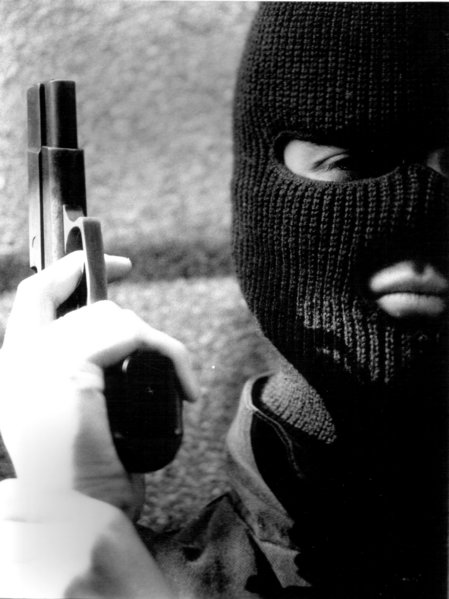
A balaclava, balaclava helmet or ski mask is a form of headgear covering the whole head, exposing only the face and often only the eyes. The name comes from Balaklava in the Crimea, where during the Crimean War knitted balaclavas were sent to British troops to protect them from the bitter cold weather. Traditionally knitted from wool, a balaclava can be rolled up into a hat to cover just the crown of the head.
They are often associated with special forces units such as the SAS, or with the IRA or with muggers where they act as a form of disguise.
See also: Mask.
| The above article is licensed under the GNU Free Documentation License. From Wikipedia, the free encyclopedia https://en.wikipedia.org/wiki/balaclava 6/13/05 |
 |
Learn about additional fashion or textile industry topics:
Fabric & Textile Industry Definitions
Embroidery Industry Definitions
Hat & Headwear Industry Definitions
Shoe & Footwear Industry Definitions
Full Coverage Against Bitter Cold
The balaclava solves a simple problem completely: in bitter cold, a cap alone leaves the ears, cheeks, chin and neck exposed, and those exposed edges are where warmth is lost and discomfort begins. A balaclava covers the whole head in one piece, exposing only the face, and often only the eyes, so the protection is continuous, with no gap at the collar and no separate scarf to slip or unwrap. That is exactly the need it was sent to meet during the Crimean War, when knitted balaclavas were sent over to British troops to help protect them from the bitter cold weather. Soldiers serving outdoors in severe conditions, standing, marching and working in the wind for hours, needed headgear that stayed in place and covered everything at once, and a knitted full-head covering did that work with no fastenings, no brim to catch the wind, and nothing to lose or break. The name records the place of that service: balaclava comes from Balaklava in the Crimea, and the garment carried the name home with the troops who had worn it.
Wool, the traditional material, suits the job in ways that explain why the knitted form lasted so long. A knitted balaclava stretches to fit closely over different head shapes, sits flat under other headgear or a helmet, and can be produced and repaired with ordinary knitting skills, which mattered when garments were supplied in quantity to troops far from home. Modern balaclavas can be made from a number of materials, and the choice of material changes the feel and the best use of the garment: the underlying design, however, stays the same in every version, a single close-fitting covering for the whole head with an opening for the face. When choosing one, coverage is the first thing to check. A face opening that sits correctly, large enough to see and breathe comfortably but small enough to keep the cheeks and chin protected when the wind turns, is what separates a balaclava that gets worn all day from one that gets pulled off after an hour. Length matters in the same practical way, because a balaclava long enough to tuck into the collar keeps the continuous coverage the design promises, while one that rides up at the neck reopens exactly the gap between cap and coat that the garment exists to close. Care follows from the construction: a knitted wool balaclava wants gentle washing and flat drying so the close fit is not stretched out of shape, and any version, wool or modern material, should be checked before winter for thinning or damaged stitching around the face opening, since that opening is shaped and finished to sit against the skin and takes the most handling every time the garment is rolled up, pulled down, washed and worn again through a season of cold weather.
One Garment, Several Ways to Wear It
Versatility is the balaclava's second strength. Because the traditional knitted balaclava can be rolled up into a hat to cover just the crown of the head, the same garment works across changing conditions during a single day outdoors. Rolled up in milder weather or during hard exertion, it is simply a warm cap. Pulled down as the temperature drops or the wind rises, it becomes full protection for the head, ears, face and neck without the wearer needing to carry or find a second item. That roll-up, pull-down adjustability is a large part of why the form has endured from its Crimean War service to modern winter use, and why the same garment is also known by the practical names balaclava helmet and ski mask: the ski mask name in particular points to its everyday cold-weather sporting life, where skiers and other winter sports users need exactly this combination of warmth, close fit and an unobstructed view.
The balaclava's full coverage also gives it other associations, and they are best understood as a consequence of the design rather than part of its purpose. A garment that exposes only the eyes conceals identity as a side effect, so balaclavas are often associated with special forces units such as the SAS, and they have also been linked in the public mind with groups and individuals who wanted disguise. For most wearers, then and now, the garment's meaning is the one it was made for: protection against the cold, in a form that covers everything, adjusts in seconds, and takes up almost no space when it is carried rather than worn. Judged on that original purpose, few pieces of headgear are as complete. The cap protects the crown, the scarf protects the neck, and the balaclava, in one knitted or modern-made piece named for a Crimean town, protects both together, which is why it remains the standard answer wherever cold weather is serious enough that exposed skin is the problem to be solved. That completeness also makes the balaclava easy to pack and easy to justify carrying: rolled up, it takes almost no room in a pocket or pack, yet it offers more protection than a cap and scarf carried separately, and it offers it instantly, with no knots, ends or fastenings to manage with cold hands. Few garments in the whole headwear family deliver so much function from so simple a pattern, a single covering for the whole head with a single opening for the face, unchanged in its essentials from the knitted coverings sent to the Crimea to the versions made from modern materials today.
Common Questions
Where does the name balaclava come from?
The name balaclava comes from Balaklava in the Crimea. During the Crimean War, knitted balaclavas were sent over to the British troops serving there to help protect them from the bitter cold weather, and the place name stayed attached to the garment.
How much of the head does a balaclava cover?
A balaclava covers the whole head, exposing only the face and often only the eyes. That full coverage is what gives it its value in cold weather, since the head, neck and face are protected together by one garment.
Can a balaclava be worn as an ordinary hat?
Yes. Balaclavas are traditionally knitted from wool and can be rolled up into a hat to cover just the crown of the head. Rolled up it works as a warm cap, and pulled down it gives full cold-weather coverage again.