Beefeater Hat
Hat & Headwear Definitions — hats, caps, helmets and headwear terms from Apparel Search
The Yeomen Warders of Her Majesty's Royal Palace and Fortress the Tower of London, popularly known as the Beefeaters, are ceremonial guardians of the Tower of London. In principle they are responsible for looking after any prisoners at the Tower and safeguarding the British crown jewels, but in practice they act as tour guides and are a tourist attraction in their own right. There are 36 Yeomen Warders, all retired from the British armed forces.
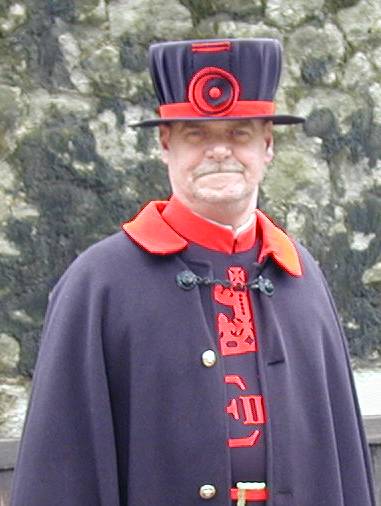
Beefeater at the Tower Of London, taken by Adrian Barnett with digital camera.
The Yeomen Warders of Her Majesty's Royal Palace and Fortress the Tower of London, popularly known as the Beefeaters, are ceremonial guardians of the Tower of London. In principle they are responsible for looking after any prisoners at the Tower and safeguarding the British crown jewels, but in practice they act as tour guides and are a tourist attraction in their own right.
There are 36 Yeomen Warders. All warders are retired from the British armed forces and must have at least 22 years of service with good conduct, at the rank of, or equivalent to, Sergeant Major or above.
The Yeomen Warders are often incorrectly referred to as Yeomen of the Guard, which is actually a distinct corps of Royal Bodyguards. Gilbert and Sullivan shared this confusion by naming their operetta The Yeomen of the Guard when it appears to be about Yeomen Warders.
The Yeomen Warders normally wear an 'undress' uniform of dark blue with red trimmings. When the sovereign visits the tower, or the warders are on duty at a state occasion, they wear red and gold uniforms very similar to those of the Yeoman of the Guard.
The origin of the term 'Beefeater' is unclear. It may originate from the fact that early Warders were paid in beef, amongst other things. Count Cosimo, grand duke of Tuscany, visited the Tower in 1669 and commented on this "A very large ration of beef is given to them daily at court...that they might be called Beef-eaters" and earlier references can also be found. Other suggestions include that it was either, a corruption of a French term buffetier an archaic term for the guard of the king's food, or, a derogatory term used when they were relatively well fed at the side of many ordinary people who lived near them in London. The warders themselves often comment that the "real beefeaters" at the Tower of London are the ravens, which receive a daily ration of beef.
The term "beefeater" is also used to refer to the traditional headgear of the Yeoman Warders.
Beefeater gin is a brand of gin produced in the U.K..
This article incorporates text from the public domain 1911 Encyclopedia Britannica.
Learn about additional fashion or textile industry topics:
Fabric & Textile Industry Definitions
Embroidery Industry Definitions
Hat & Headwear Industry Definitions
Shoe & Footwear Industry Definitions
Shipping & Freight Industry Definitions
Miscellaneous Fashion Industry Definitions
| The above article is licensed under the GNU Free Documentation License. From Wikipedia, the free encyclopedia https://en.wikipedia.org/wiki/beefeater 5/15/05 |
|
|
Guardians of the Tower in Two Uniforms
The Beefeater image begins with the uniform, because the uniform is what visitors to the Tower of London actually see. The Yeomen Warders normally wear an undress uniform of dark blue with red trimmings, the working dress of their daily duties as guides and guardians. When the sovereign visits the Tower, or the warders are on duty at a state occasion, they wear red and gold uniforms very similar to those of the Yeoman of the Guard, and it is that scarlet state dress, with its traditional headgear, that fixes the Beefeater in postcards, photographs and the public imagination. The term beefeater is also used to refer to the traditional headgear of the Yeoman Warders, so the hat and the man share one name, and describing the headgear without the corps that wears it would miss the point: at the Tower, dress is duty made visible, marking the warders out instantly from the crowds they guide.
The distinction between the two uniforms also untangles a famous confusion. The Yeomen Warders are often incorrectly referred to as Yeomen of the Guard, which is actually a distinct corps of Royal Bodyguards, even though the warders' red and gold state uniform is very similar to the Guard's. Gilbert and Sullivan shared this confusion by naming their operetta The Yeomen of the Guard when it appears to be about Yeomen Warders, so the mix-up has been sung on stage for well over a century. Keeping the corps apart matters for describing the dress correctly: the dark blue undress with red trimmings is the Tower warders' own everyday uniform, the red and gold is their state dress, and neither makes them members of the separate Yeoman of the Guard, however alike the state uniforms look at a distance.
Who the Warders Are and Where the Name Came From
The men inside the uniforms are selected as carefully as the dress suggests. There are 36 Yeomen Warders, and all warders are retired from the British armed forces and must have at least 22 years of service with good conduct, at the rank of, or equivalent to, Sergeant Major or above. That requirement shapes the corps' character: every Beefeater a visitor meets is a senior career soldier in a second, ceremonial career. In principle they are responsible for looking after any prisoners at the Tower and safeguarding the British crown jewels, but in practice they act as tour guides and are a tourist attraction in their own right, so the modern warder's real work is knowledge and presentation, telling the Tower's story to the public while standing, in full traditional dress, for the institution itself. Few guiding jobs in the world come with a uniform that is itself one of the sights.
The name they carry has resisted a single explanation. The origin of the term Beefeater is unclear, and the leading suggestion is that early Warders were paid in beef, amongst other things. The evidence most often quoted is early and vivid: Count Cosimo, Grand Duke of Tuscany, visited the Tower in 1669 and commented that a very large ration of beef is given to them daily at court, so that they might be called Beef-eaters, and earlier references can also be found. Other suggestions include that it was a corruption of a French term, buffetier, an archaic term for the guard of the king's food, or a derogatory term used when they were relatively well fed at the side of many ordinary people who lived near them in London. The warders themselves often comment that the real beefeaters at the Tower of London are the ravens, which receive a daily ration of beef, a joke that keeps the beef tradition at the centre of the story. The name has travelled beyond the Tower as well: Beefeater gin is a brand of gin produced in the United Kingdom, borrowing the warder's instantly recognised image, headgear and all, for a product with no connection to the fortress except the figure on its identity.
Common Questions
Who can become a Yeoman Warder?
All warders are retired from the British armed forces and must have at least 22 years of service with good conduct. They must hold the rank of, or equivalent to, Sergeant Major or above, and there are 36 Yeomen Warders in total.
What uniforms do the Beefeaters wear?
The Yeomen Warders normally wear an undress uniform of dark blue with red trimmings. When the sovereign visits the Tower, or the warders are on duty at a state occasion, they wear red and gold uniforms very similar to those of the Yeoman of the Guard.
Where does the name Beefeater come from?
The origin of the term is unclear, but it may originate from the fact that early Warders were paid in beef, amongst other things. Count Cosimo, Grand Duke of Tuscany, visiting the Tower in 1669, commented on the very large ration of beef given to them daily at court.