Fedora
Hat & Headwear Definitions — hats, caps, helmets and headwear terms from Apparel Search
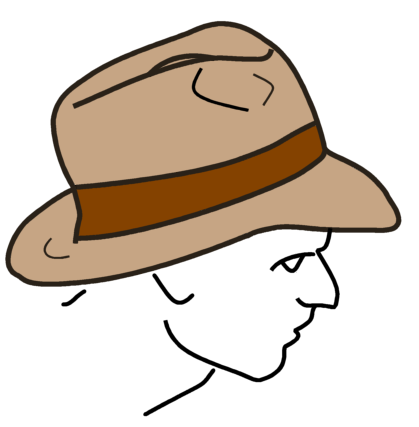
The fedora is a soft felt hat with a crease lengthwise down the crown and pinched in at the front on both sides, and any hat that resembles the soft felt version is also usually called a fedora, including straw and twill ones. Similar hats with a C-crown, an indentation for the head in the top of the crown, are occasionally called fedoras. It is usually worn by men, though ladies' versions can also be found, black, grey and brown are the most popular and universal colours, and in Europe a fedora is also called a trilby.
The popularity of the fedora has resulted in being able to purchase one in nearly any style. Fedoras can be found in nearly any color imaginable, but black, grey, and brown are the most popular and universal.
In Europe a fedora is also called a trilby. They typically have a shorter, "stingy" brim and the back of the brim is distinctively more sharply upturned as a result.
The word
comes from
the title
of a 1882
play by
Victorien
Sardou,
F
dora,
whose heroine
wore this
style of
hat.
Famous uses
The fedora was worn mostly in the early part of the twentienth century within urban industrialized settings as a stylish way to protect from the wind and weather while being compact enough to deal with the newer technologies such as the automobile. It is often associated with Prohibition-era mafia and tops off most zoot suits.
- It is the signature hat of Indiana Jones with a safari style brim.
- Many Orthodox Jews wear black fedoras.
- The comic strip hero Dick Tracy wears a yellow one.
- Clark Kent was often seen wearing one (including in the 1978 feature movie of Superman), though in more recent incarnations it has been absent.
- In the Bowery Boys movies, Slip Mahoney always wore a fedora with the brim folded up.
- Larry Campbell, the mayor of Vancouver, British Columbia, is known to be quite fond of wearing a fedora.
- Frank Sinatra, performer of the mid-1900s and member of the Rat Pack, was often depicted wearing a fedora.
- The Red Hat logo features a red fedora on its Shadow Man logo. In addition, the Red Hat community-oriented distribution of Linux is called Fedora.
| The above article is licensed under the GNU Free Documentation License. From Wikipedia, the free encyclopedia https://en.wikipedia.org/wiki/fedora_(hat) 5/14/05 |
 |
| Textile & Clothing definitions and Glossaries: |
|
Crease, Pinch and Brim
A fedora is recognised by what has been done to its crown. The soft felt starts as a plain dome, and the style is created by a crease run lengthwise down the crown and a pinch at the front on both sides, giving the hat its familiar dented, symmetrical front. Because the name follows the silhouette rather than the material, any hat that resembles the soft felt version is also usually called a fedora, including straw and twill ones, and the boundary is generous enough that similar hats with a C-crown — an indentation for the head in the top of the crown — are occasionally called fedoras too. The hat is usually worn by men, but ladies' versions can also be found, and its popularity has resulted in being able to purchase one in nearly any style and nearly any colour imaginable, though black, grey and brown remain the most popular and universal. The European name carries a small, precise difference: a trilby typically has a shorter, stingy brim, and the back of that brim is distinctively more sharply upturned, so a trilby reads neater and sharper where a full-brimmed fedora reads broader and softer.
The fedora's great era explains its construction. It was worn mostly in the early part of the twentieth century within urban industrialised settings as a stylish way to protect from the wind and weather while being compact enough to deal with newer technologies such as the automobile. A soft felt hat can be brushed off, squeezed into a car, and reshaped by its crease and pinch in seconds, which a stiff, wide hat cannot. That urban practicality is also why the hat gathered its darker glamour: it is often associated with Prohibition-era mafia and tops off most zoot suits, the standard headwear of a city silhouette that wanted style and anonymity in the same garment.
Signature Hats and Famous Wearers
No hat has been borrowed by more fictional heroes. It is the signature hat of Indiana Jones, worn with a safari style brim; the comic strip hero Dick Tracy wears a yellow one; Clark Kent was often seen wearing one, including in the 1978 feature film of Superman, though in more recent incarnations it has been absent; and in the Bowery Boys movies, Slip Mahoney always wore a fedora with the brim folded up. Real life kept pace with fiction. Frank Sinatra, performer of the mid-1900s and member of the Rat Pack, was often depicted wearing a fedora; many Orthodox Jews wear black fedoras as part of everyday dress; and Larry Campbell, the mayor of Vancouver, British Columbia, was known to be quite fond of wearing one. The name has even left clothing altogether: the Red Hat logo features a red fedora on its Shadow Man logo, and the Red Hat community-oriented distribution of Linux is called Fedora. A hat named for an 1882 play by Victorien Sardou, whose heroine wore the style, ending as the name of an operating system is a fair measure of how completely the creased, pinched crown entered the general imagination. When buying one, the checks are the classic ones: the crease should run cleanly lengthwise, the pinches should sit evenly at the front, and the brim width should suit the wearer — full for the fedora's broader character, short and sharply upturned at the back for a trilby.
The fedora's range is part of its definition. Because nearly any style and nearly any colour can be purchased, and straw and twill versions carry the name alongside felt, fedora describes a shape language rather than a single specification: a lengthwise crease, front pinches, a brim, and proportions the wearer chooses. Black, grey and brown remain the popular and universal choices because they were the colours of the hat's urban working era, when it had to sit comfortably with a suit in an industrialised city and protect its wearer from wind and weather on the way to work, to a car, or through a station crowd. A yellow fedora works for Dick Tracy precisely because the standard colours are so well established that one bright exception becomes a character's trademark. Worn today, the hat carries that whole history lightly: the crease and pinch still do the practical work of shaping soft felt to a head, and the silhouette still reads, at a glance, as the classic city hat of the early twentieth century.
Common Questions
How is a fedora shaped?
A fedora is a soft felt hat with a crease lengthwise down the crown and pinched in at the front on both sides. Hats with a C-crown, an indentation for the head in the top of the crown, are occasionally called fedoras as well.
Where does the name fedora come from?
The word comes from the title of an 1882 play by Victorien Sardou, Fedora, whose heroine wore this style of hat. The play's name became the hat's name.
What is a trilby?
In Europe a fedora is also called a trilby. Trilbies typically have a shorter, stingy brim, and the back of the brim is distinctively more sharply upturned as a result.