Bucket Hat
Hat & Headwear Definitions — hats, caps, helmets and headwear terms from Apparel Search
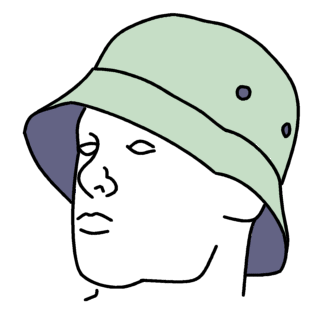
A bucket hat is a soft cotton hat with a wide and downwards sloping brim which is worn by both men and women. The brim offers shade from the sun for the eyes and face. They are usually made from heavy-duty cotton fabrics such as denim, or from canvas, and two metal eyelets are commonly placed on each side of the hat so that it is cool to wear on hot days.
In American popular culture, the bucket hat is associated with the character Gilligan, from the 1960s television comedy Gilligan's Island, who habitually wore one.
| The above article is licensed under the GNU Free Documentation License. From Wikipedia, the free encyclopedia https://en.wikipedia.org/wiki/bucket_hat 5/14/05 |
 |
| Clothing & Fashion Industry Definitions |
| Hat Definitions |
A Brim That Slopes All the Way Around
Most hats shade the front of the face. The bucket hat shades everything. Its wide brim slopes downwards on every side, so the eyes and face sit in a ring of shade as the sun moves and as the wearer turns, which is why the style suits people who are outdoors for hours rather than crossing a sunny street. Think of the difference in use: a peaked cap shades the eyes from sun ahead, a wide flat brim shades from sun overhead at midday, and the bucket hat's downward slope keeps shading at lower sun angles, early and late in the day, when light comes in sideways under a flat brim. That all-day, all-direction shade, in a hat with no stiff structure to maintain, is the whole invention. There is no blocking, no wire and no firm crown to protect, just soft cotton shaped to hang as a bucket shape around the head.
Softness brings its own practical advantages. A bucket hat can be folded, rolled, pushed into a pocket or a bag and shaken back into shape when it is needed, it can be worn by both men and women in the same unadorned form, and it asks for no careful handling of the kind a stiff straw or felt hat demands. It is headwear as equipment, closer in spirit to a work shirt than to a dress hat, and it behaves like one, improving with the kind of casual, repeated use that would ruin a formal hat.
Denim, Canvas and Eyelets for Hot Days
Material explains the bucket hat's durability. They are usually made from heavy-duty cotton fabrics such as denim, or from canvas, fabrics chosen because they survive sun, sweat, washing and being crushed without complaint. Denim brings the toughness and familiar fading of work clothing, softening with wear while keeping the brim's slope. Canvas brings a slightly firmer hand and the long association of canvas with outdoor and boating gear, where a hat is expected to get wet, dry out and go back on the head. Both fabrics breathe far better than coated or synthetic shells, and both can simply be washed when a day outdoors leaves the hat salty or dusty, then dried in roughly the shape it will be worn in.
The detail that completes the hot-weather design is the smallest one on the hat. Two metal eyelets are commonly placed on each side of the hat so that it is cool to wear on hot days. A soft crown that fits closely can trap warm air, and the eyelets answer that directly, venting the crown on both sides while the brim is doing its shading work below. Shade without ventilation would leave the head hot under a cool-looking hat; ventilation without shade would leave the face exposed. The bucket hat combines the two, which is why it keeps reappearing wherever people work, fish, garden, walk or watch sport through a full sunny day.
Cultural memory gave the practical hat a familiar face. In American popular culture the bucket hat is associated with the character Gilligan, from the 1960s television comedy Gilligan's Island, who habitually wore one, and that single association did a great deal to fix the style in the public mind as friendly, unpretentious outdoor dress. Worn today, the bucket hat still carries that ease. Choose heavy cotton, denim or canvas for durability, check that the brim slopes wide enough to shade the eyes and face from the angles you actually face outdoors, look for the side eyelets if the hat is for hot days, and treat fit as comfort rather than precision, since a soft hat that sits easily will be worn, and a hat that is worn is the only sun protection that works.
Care follows from the fabric. Heavy-duty cotton, denim and canvas all tolerate the washing that outdoor use makes necessary, and none of them needs the blocking, steaming or careful storage that a shaped hat requires. Wash the hat, let it dry, and let the brim settle back into its downward slope in use. That ease is not a compromise in the design; it is the design. A hat intended to be carried everywhere, worn in heat, packed without thought and put on without ceremony has to survive exactly that treatment, and the soft cotton bucket hat, with its metal-vented crown and all-round sloping brim, is built to do so season after season.
Common Questions
What is a bucket hat made from?
Bucket hats are usually made from heavy-duty cotton fabrics such as denim, or from canvas. The soft cotton construction is what lets the brim slope downwards all around the head rather than holding a stiff shape.
Why does a bucket hat have metal eyelets?
Two metal eyelets are commonly placed on each side of the hat so that it is cool to wear on hot days. The eyelets let air circulate through the crown while the brim shades the eyes and face.
Who is the bucket hat associated with in popular culture?
In American popular culture, the bucket hat is associated with the character Gilligan, from the 1960s television comedy Gilligan's Island, who habitually wore one. The association fixed the soft, sloping-brim hat in the public mind.