Gatsby Cap
Hat & Headwear Definitions — hats, caps, helmets and headwear terms from Apparel Search
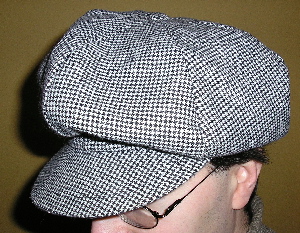
The Gatsby cap is a cap similar in style to the more common flat cap, with the same overall shape and stiff peak in front, but the body of the cap is rounder, fuller and puffier, and it has a button in the very centre. The style was popular in the early twentieth century, is sometimes associated with wealthy golfers, who are often portrayed in Gatsby caps for comic effect, and recently the cap has been more popular with women than with men.
Deerstalker Hat
(Sherlock)
| The above article is licensed under the GNU Free Documentation License. From Wikipedia, the free encyclopedia https://en.wikipedia.org/wiki/gatsby_cap 6/11/05 |
 |
|
The Fuller Variant: Panels, Pouf and a Centre Button
The Gatsby cap is best understood as the flat cap with the volume turned up. The two caps share their foundations — the same overall shape and the same stiff peak in front — and everything that makes the Gatsby distinct happens above that peak, in the body of the cap. Where a flat cap lies close and low, the Gatsby's body is rounder, fuller and puffier, standing away from the head in a soft pouf rather than settling flat against it. A fuller body is built, not accidental: extra fullness has to be gathered and held, and the cap announces how at its most recognisable point, a button in the very centre of the top. That button is the Gatsby's signature detail. It marks the centre where the body's fullness is drawn together, and it gives the eye a focal point the plain flat cap deliberately lacks. Put the two caps side by side and the difference is a matter of temperament as much as construction. The flat cap is the garment: plain, close, workmanlike, named for how flat it lies. The Gatsby is the dressed-up relative: same peak, same family outline, but cut generously, worn with presence, and finished with a button like a full stop at the crown.
That generosity changes how the cap is worn and read. A puffier body softens the whole head, rounds the silhouette and tolerates being worn at a slight angle or pushed back in a way a close flat cap, which depends on lying flat, does not. It also changes the company the cap keeps in pictures and in memory. The flat cap belongs to newsboys and working men; the Gatsby, popular in the early twentieth century, is sometimes associated with wealthy golfers, the leisured counterpart image — which is why golfers are often portrayed in Gatsby caps for comic effect, the big soft cap standing in visual shorthand for moneyed ease on the course. Two near-identical caps, divided by fullness, came to signal opposite ends of the social scale.
Popularity Then and Now
The Gatsby's period of popularity was the early twentieth century, the same decades in which the flat cap was standard wear for boys, newsboys and working-class men and a fashion for young men in the 1920s. Within that crowded cap-wearing era, the Gatsby offered a way to wear the familiar shape with more flourish: the stiff front peak kept the practical shade and structure every cap wearer expected, while the rounder, puffier body and centre button made the cap a chosen style rather than a default. Its afterlife has taken an unexpected turn. Recently the cap has been more popular with women than with men, a shift that suits its qualities: the fuller body reads as softer and more sculptural than the flat cap's close line, the centre button works as a deliberate detail, and the early-20th-century associations give the style a vintage character that a plain cloth cap does not carry in the same way.
Choosing between the two caps is therefore a genuine choice, not a near-duplicate. Choose the flat cap for the close, flat, understated garment, in the wool-and-tweed tradition of country and working wear. Choose the Gatsby for the same overall shape and stiff peak with a rounder, fuller, puffier body and the button at the very centre — the variant with more volume, more presence and, in its portrayals of wealthy golfers, more comedy. The names keep the distinction honest: one cap is named for lying flat, the other is remembered as a style of an era, popular in the early twentieth century and now finding more wearers among women than men.
The centre button deserves a final word, because it is the easiest way to settle an identification that shoppers and costume hunters regularly confuse. Stand a cap upright and look down: a button in the very centre of a round, full, puffy body is the Gatsby; a close, flat body without that fuller pouf is the flat cap, however similar the stiff front peak below may be. The peak, in other words, is the shared inheritance, and the body is the personality. One lies flat and gets on with its work; the other rises, rounds and finishes itself with a button, in keeping with a style that was popular when caps were everyday dress and a fuller silhouette was a way of standing out inside a universal garment. Worn today, by the women who now favour it more than men or by anyone drawn to its early-20th-century character, the Gatsby still does exactly that: it takes the most familiar cap shape of its era and gives it more air, more roundness and a single centred detail to be remembered by.
Fitting follows the fullness. A Gatsby should keep its pouf: a cap crushed flat by a tight fit loses the rounder, fuller body that defines it, while a cap with room lets the body stand as designed above the stiff front peak. Judged that way, the button, the pouf and the peak form one test — peak shared with the flat cap, body and button entirely the Gatsby's own.
Common Questions
How does a Gatsby cap differ from a flat cap?
It has the same overall shape and stiff peak in front as a flat cap, but the body of the cap is rounder, fuller and puffier. It also has a button in the very centre, which the flat cap does not.
When was the Gatsby cap popular?
The style was popular in the early twentieth century. It is sometimes associated with wealthy golfers from that era, and golfers are often portrayed in Gatsby caps for comic effect.
Who wears Gatsby caps today?
Recently the cap has been more popular with women than with men. Its fuller, puffier body gives it a softer, more rounded silhouette than the close-lying flat cap.