Flat Cap
Hat & Headwear Definitions — hats, caps, helmets and headwear terms from Apparel Search
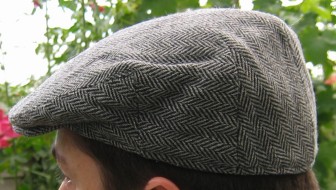
A flat cap, also variously called a cloth cap, golf cap, driving cap, Windsor cap and other names, is a round, soft men's cap with a small brim in front and a somewhat stiff peak in the back, usually made of wool or tweed. The style can be traced back to fourteenth century England, was worn in its current style in the nineteenth century by working-class men and as casual country wear by well-to-do English men, and became the popular image of the cap worn by newsboys.
A flat cap,also variously called a "cloth cap", "golf cap", "driving cap", "windsor cap", and others, is a round, soft men's cap with a small brim in front and a somewhat stiff peak in the back. The material is usually wool or tweed.
The style can be traced all the way back to fourteenth century England. In its current style the caps were worn in the nineteenth century by working-class men, and it was considered casual country wear by well-to-do English men; hence the alternate name "golf cap". Boys in Great Britain and North America of all classes wore this cap in the late 19th and early 20th centuries; the popular image of the cap is its being worn by "newsboys". Cloth caps were worn by fashionable young men in the 1920s. The style has remained popular among certain people in Europe and America. Today it is sometimes associated with old men. Some males began wearing flat caps backwards in the 1990s.
Deerstalker Hat (Sherlock)
Beanie Hat| The above article is licensed under the GNU Free Documentation License. From Wikipedia, the free encyclopedia https://en.wikipedia.org/wiki/flat_cap 6/11/05 |
 |
|
The Garment Itself: Round, Soft and Close
Start with the object. A flat cap is a round, soft men's cap, and its flatness is literal: the crown lies close and low over the head instead of puffing up or standing tall, with a small brim in front to shade the eyes and a somewhat stiff peak in the back to give the soft body its structure. The material is usually wool or tweed, fabrics that suit the cap's character — warm, hard-wearing, matte rather than shiny, and able to hold a soft shape without formality. Its many names map its many uses. Cloth cap names the material and separates it from leather or felt headwear. Golf cap names the setting in which well-to-do English men adopted it, as casual country wear. Driving cap and Windsor cap carry the same country-and-leisure associations. A cap that accumulates that many names has usually done that many jobs, and the flat cap's list — work, country sport, driving, everyday wear — is exactly the list of things a soft wool cap with a small front brim does well. It keeps the head warm, keeps sun and drizzle off the eyes, packs flat, needs no careful storage, and never looks overdressed.
Construction follows that modesty. Because the body is soft, the cap depends on its cut rather than on stiffening: panels of wool or tweed are shaped so the round crown settles flat, the front is drawn forward to meet the small brim, and the somewhat stiff peak at the back anchors the whole arrangement. Worn forwards, it is a working cap. The style also survived a deliberate inversion: some males began wearing flat caps backwards in the 1990s, turning the back peak to the front as a fashion gesture, which only works because the cap is soft and low enough to sit either way round.
From 14th-Century England to the Newsboy
The style can be traced all the way back to fourteenth century England, an unusually long pedigree for so plain a garment. In its current style, the caps were worn in the nineteenth century by working-class men, for whom a cheap, warm, durable wool cap was standard dress, and at the same time the flat cap was considered casual country wear by well-to-do English men — hence the alternate name golf cap. Few garments cross a class line in both directions like that: the same cap read as a labourer's everyday wear in town and as a gentleman's relaxed wear in the country, the difference carried by the quality of the tweed and the setting rather than by the shape. Boys completed the picture. Boys in Great Britain and North America of all classes wore this cap in the late 19th and early 20th centuries, and the popular image of the cap is its being worn by newsboys — the boy selling papers in a cloth cap became the visual shorthand for the whole style. Cloth caps were then worn by fashionable young men in the 1920s, a reminder that working dress and young fashion have borrowed from each other for a century.
The style has remained popular among certain people in Europe and America ever since, though today it is sometimes associated with old men — an association that says more about the loyalty of its wearers than about the cap, since a style kept for decades by the same men will inevitably be pictured on them. Judged as a garment, the flat cap's record is hard to argue with: traced to the 14th century, standard wear in the 19th, a boys' and newsboys' staple, a 1920s fashion, a backwards 1990s gesture, and still in use on both sides of the Atlantic. Its flat, soft, close-fitting construction is the reason: there is almost nothing in it to date, break or go out of shape.
Choosing and wearing a flat cap well comes back to the garment itself. The wool or tweed should be firm enough that the round crown keeps its flat lie, the small front brim should sit level to shade the eyes, and the somewhat stiff back peak should keep the rear of the cap settled rather than collapsing. A flat cap is casual country wear by ancestry, so it pairs naturally with the same family of clothing — jackets, knitwear and outdoor dress — and it looks wrong in the opposite direction, against formal dress that asks for a formal hat. The backwards wearing that appeared in the 1990s belongs to fashion rather than function, and it makes the point neatly: a cap this plainly built can survive even being turned around, because its identity is in its flat, soft construction and not in any ornament that reversal would ruin.
That durability of identity, across seven centuries, both classes of wearer, boys and fashionable young men, town work and country leisure, is the flat cap's real distinction. Styles with more decoration have come and gone inside a generation; the round, soft, wool or tweed cap with its small front brim has simply continued, because it answers ordinary needs — warmth, shade, portability and ease — without asking anything of its wearer in return.
Common Questions
What are the other names for a flat cap?
A flat cap is also variously called a cloth cap, golf cap, driving cap and Windsor cap, among other names. Golf cap reflects its standing as casual country wear for well-to-do English men.
What is a flat cap made of and how is it shaped?
The material is usually wool or tweed. The cap itself is round and soft, with a small brim in front and a somewhat stiff peak in the back.
Who wore flat caps in the 19th and early 20th centuries?
In the nineteenth century they were worn by working-class men, and boys in Great Britain and North America of all classes wore this cap in the late 19th and early 20th centuries. Cloth caps were also worn by fashionable young men in the 1920s.