Cocked Hat
Hat & Headwear Definitions — the black triangular formal hat of civilian, military and naval officials, from Apparel Search
Search Apparel Search
At a Glance
Definition: A cocked hat is a black, triangular form of formal headgear evolved from the bicorne, with the brim at the left and right sides turned up and pinned together, pointed front and back ends, and usually a cockade in the national colours at the right side.
Category: Hat & Headwear Definitions
The cocked hat is a form of formal headgear, worn by certain civilian, military and naval officials from the mid-19th century until the beginning of World War II, and occasionally even today. Evolved from the bicorne, the black-coloured cocked hat is triangular in shape, with the brim at the left and right sides turned up and pinned together, the front and back ends pointed, and usually a cockade in the national colours at the right side. This page explains how the shape was made, how its decoration divided naval restraint from military and civilian display, and why it survived the end of its era as ceremonial dress.
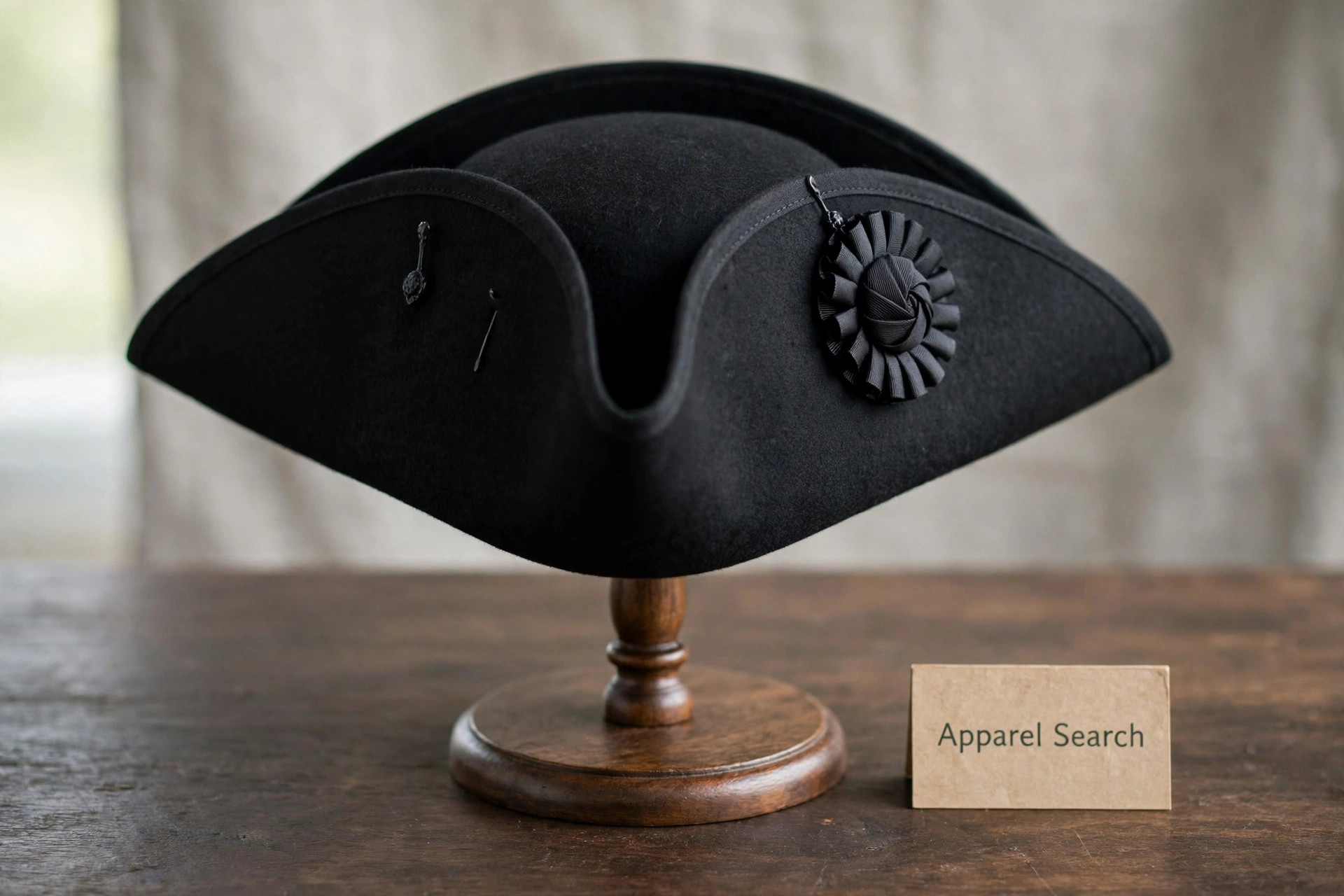
Triangular, Pinned Up and Pointed at Both Ends
The cocked hat is best understood as a brim that has been deliberately folded into architecture. The black-coloured hat is triangular in shape, with the brim at the left and right sides turned up and pinned together, and the front and back ends pointed. Nothing about that outline is accidental. Turning the brim up at the sides lifts it clear of the shoulders, gives the hat a tall, formal profile from the front, and creates the pointed fore-and-aft silhouette that reads instantly as official dress in portraits and photographs. Pinning the turned-up brim holds that engineered shape permanently, so a cocked hat is not styled each time it is worn like a soft hat; it is manufactured into its triangle and kept that way.
Its ancestry is stated plainly: the cocked hat evolved from the bicorne, and it belongs to the same family of brim-turned-up formal hats as the tricorne. The cocked hat is the settled, later form of that development — the version in which the triangular shape, side pinning and pointed ends became the standard pattern for formal official headgear. Naming matters here, because bicorne and cocked hat overlap in period writing; the triangular, side-pinned form described on this page is the cocked hat proper.
The Hat of Officials: Plain for the Navy, Feathered for Others
From the mid-19th century until the beginning of World War II, the cocked hat was worn by certain civilian, military and naval officials, and that spread across services is what its decoration maps. There is usually a cockade in the national colours at the right side, placing the wearer's allegiance at a fixed, conventional position, and the hat is often trimmed in gold or silver. Beyond that shared base, decoration divided by role. Naval officers wore this hat without further decorations, a restraint that suited naval uniform. Those worn by military and civilian officials, by contrast, may be lavishly decorated with coloured ostrich or swan feathers — so that at a state occasion the plain naval cocked hat and a feathered civilian or military one announced different kinds of authority while sharing exactly the same triangular form.
The End of an Era, and a Ceremonial Survival
The ending of the cocked hat's era was abrupt and general. Navies around the world, once almost universal in using cocked hats, ceased wearing them at the beginning of World War II, as practical wartime uniform displaced full formal dress across services. The story does not end quite there, however: after the war, some military, diplomatic and colonial officials resumed wearing the cocked hat at very formal occasions, and occasionally still do so today. That survival pattern is typical of ceremonial dress — an item stops being everyday uniform, then persists precisely because its formality, its cockade, its gold or silver trim and its feathers carry historical weight that a modern cap cannot.
In portraits, photographs and surviving examples, identification rests on the combination rather than any single feature: black colour, triangular outline, brim turned up and pinned at the left and right sides, pointed front and back ends, and a cockade at the right side. Gold or silver trim supports the identification, and coloured ostrich or swan feathers, where present, point away from naval use and towards a military or civilian official. A broad-brimmed hat at an earlier stage of the same brim-turning family belongs with the bicorne; the fully triangular, side-pinned form is the cocked hat in its settled, formal sense.
Not to Be Confused With
The cocked hat is not the bicorne it evolved from: the bicorne is the earlier, two-cornered stage of the family, while the cocked hat is the settled later form — triangular in shape, with the brim at the left and right sides turned up and pinned together, the front and back ends pointed, and a cockade at the right side. If the hat is triangular and side-pinned, it is a cocked hat; see the bicorne definition for the earlier form.
Common Questions
How did the cocked hat evolve from the bicorne?
The cocked hat evolved from the bicorne. Where the bicorne was the earlier two-cornered stage of the family, the later cocked hat became triangular in shape, with the brim at the left and right sides turned up and pinned together and the front and back ends pointed.
How were cocked hats decorated?
There is usually a cockade in the national colours at the right side, and the hat is often trimmed in gold or silver. Naval officers wore this hat without further decorations, but those worn by military and civilian officials may be lavishly decorated with coloured ostrich or swan feathers.
When did navies stop wearing cocked hats?
Navies around the world, once almost universal in using cocked hats, ceased wearing them at the beginning of World War II. After the war, some military, diplomatic and colonial officials resumed wearing the cocked hat at very formal occasions, and occasionally still do so today.