Bicorne Hat
Hat & Headwear Definitions — hats, caps, helmets and headwear terms from Apparel Search
The bicorne hat is an archaic form of headgear associated with the late 18th and early 19th centuries, much worn by European and American military and naval officers and most associated with Napoleon Bonaparte. Evolved from the tricorne, the black bicorne originally had a rather broad brim with the front and rear halves turned up and pinned together, forming a semi-circular shape, usually with a cockade in the national colours at the front.
The Bicorne hat is an archaic form of headgear associated with the late 18th and early 19th centuries. Much worn by European and American military and naval officers, it is most associated with Napol
on Bonaparte.
Evolved from the tricorne, the black-colored bicorne originally had a rather broad brim, with the front and the rear halves turned up and pinned together, forming a semi-circular shape; there was usually a cockade in the national colors at the front. Later the hat became more triangular in shape, its two ends became more pointed, and was worn with the cockade at the right side; this kind of bicorne eventually became known as the cocked hat.
Current usages
The Lord Chancellor of the United Kingdom wears a tricorne hat, but the other Lords Commissioners wear bicorne hats.
Members of the Académie française wear the habit vert (green habit) at the Academie's ceremonies. The habit includes a black jacket and bicorne hat, each embroidered in green.
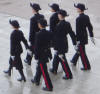
Students at the cole polytechnique wear a cocked bicorne as part of their Grand Uniforme (GU). female students used to wear a tricorne hat but now also wear a bicorne.
See also
| The above article is licensed under the GNU Free Documentation License. From Wikipedia, the free encyclopedia https://en.wikipedia.org/wiki/bicorne 5/15/05 |
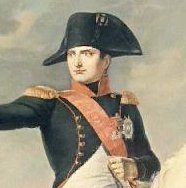 |
| Napoleon in a bicorne hat. |
|
|
Learn about additional fashion or textile industry topics:
Fabric & Textile Industry Definitions
Embroidery Industry Definitions
Hat & Headwear Industry Definitions
Shoe & Footwear Industry Definitions
| Fashion Industry |
Two Points Instead of ThreeThe bicorne's shape is its definition, and the shape is a compromise between display and practicality. Evolved from the tricorne, the black-coloured bicorne originally had a rather broad brim, with the front and the rear halves turned up and pinned together, forming a semi-circular shape. Folding a broad brim up on two sides instead of three gave the wearer a broad, flat silhouette seen from the front while keeping the sides of the head clearer than a tricorne did, an arrangement well suited to officers who needed to look imposing at a distance and still move, ride and give orders without a wide brim in the way. The national cockade at the front completed the statement, declaring allegiance in national colours where every onlooker would see it first. For European and American military and naval officers of the late 18th and early 19th centuries, this was not decoration for its own sake: uniform headgear identified rank, service and nation across a smoky battlefield or a crowded deck, and the bicorne performed that identification in its boldest form. Over time the form tightened. Later the hat became more triangular in shape, its two ends became more pointed, and it was worn with the cockade at the right side, and this kind of bicorne eventually became known as the cocked hat. The change of name is worth noticing, because cocked describes exactly what was done to the brim: cocked up on two sides. The pointed, triangular later form is the one most fixed in public memory, because it is the silhouette of its most famous wearer. The bicorne is most associated with Napoleon Bonaparte, and his image in the two-pointed black hat has carried the style far beyond its period of actual wear, into paintings, monuments and every visual shorthand for the Napoleonic age. When a single wearer defines a hat for two centuries, the details of that later form, triangular outline, pointed ends, cockade to the side, become the standard by which all other bicornes are recognised, including the broader, semi-circular early examples that came before it. Survival in CeremonyAs everyday and battlefield dress moved on, the bicorne survived where clothing's purpose is to embody an institution rather than to change with fashion. In the United Kingdom the pattern appears in legal and state ceremony with a precision that rewards attention: the Lord Chancellor wears a tricorne hat, but the other Lords Commissioners wear bicorne hats, so the two ancestral forms, three-pointed and two-pointed, still appear side by side in the same ceremony, distinguished by office. In France the survival is academic and scholarly. Members of the Academie francaise wear the habit vert, the green habit, at the Academie's ceremonies, and the habit includes a black jacket and a bicorne hat, each embroidered in green. Embroidery turns the officer's hat into a scholar's insignia, the same black two-pointed form now carrying the green ornament of learning instead of a national cockade. The second French survival belongs to education at its most formal. Students at the Ecole Polytechnique wear a cocked bicorne as part of their Grand Uniforme, and the detail of its recent history shows the old form still adapting: female students used to wear a tricorne hat but now also wear a bicorne, bringing the school's full uniform back to a single shared form. Read together, these survivals explain why an archaic hat remains worth defining carefully. The bicorne left ordinary military and naval service with the age of Napoleon, but in British ceremony, in the Academie francaise, and in the Grand Uniforme of the Ecole Polytechnique it never entirely left use. It endures as formal headgear whose two pointed ends, cocked brim and historic cockade announce, before a word is spoken, that the wearer stands there not as a private person but as the holder of an office, a membership or a place in a school with a long memory, which is precisely the work the hat was designed to do for officers two centuries ago. For anyone meeting the bicorne in a museum or a portrait, the reading order the design intends is still the practical one: note the two pointed ends and cocked-up brim first, then the cockade and its position, front on the broad early form and at the right side on the later triangular one, since those details together place an example within the hat's own development from broad semi-circular brim to the pointed cocked hat of the Napoleonic image. Common QuestionsHow did the bicorne develop from the tricorne?The bicorne evolved from the tricorne, with the front and rear halves of a rather broad brim turned up and pinned together to form a semi-circular shape. Later the hat became more triangular, its two ends became more pointed, and this kind of bicorne became known as the cocked hat. Where was the cockade worn on a bicorne?Originally there was usually a cockade in the national colours at the front of the hat. In the later, more triangular form the bicorne was worn with the cockade at the right side, so the cockade's position helps distinguish earlier from later examples. Who still wears a bicorne today?Members of the Academie francaise wear a bicorne as part of the habit vert at the Academie's ceremonies, and students at the Ecole Polytechnique wear a cocked bicorne as part of their Grand Uniforme. The other Lords Commissioners in the United Kingdom also wear bicorne hats. More to ExploreMore from Apparel Search: Hat & Headwear Definitions | Clothing Industry Glossary | Fashion Terms | Apparel Search Home
|