Tricorne
Hat & Headwear Definitions — the three-cornered hat of the 18th century, from Apparel Search
Search Apparel Search
At a Glance
Definition: The tricorne, or tricorn, is a style of hat that was popular during the 18th century, worn both by civilians and as part of military uniform. Its broad brim is pinned up on either side of the head and at the back, producing a triangular shape, and the hat was typically worn with the point facing forward.
Also known as: Tricorn
Category: Hat & Headwear Definitions
The tricorne, or tricorn, is a style of hat that was popular during the 18th century, falling out of style shortly before the French Revolution. At the peak of its popularity it was worn both by civilians and as part of military uniform. Its broad brim is pinned up on either side of the head and at the back, producing a triangular shape, and the hat was typically worn with the point facing forward. This page covers the construction that makes the three corners, the hat's range from plain to extravagant, and its descent into the bicorne and the cocked hat.
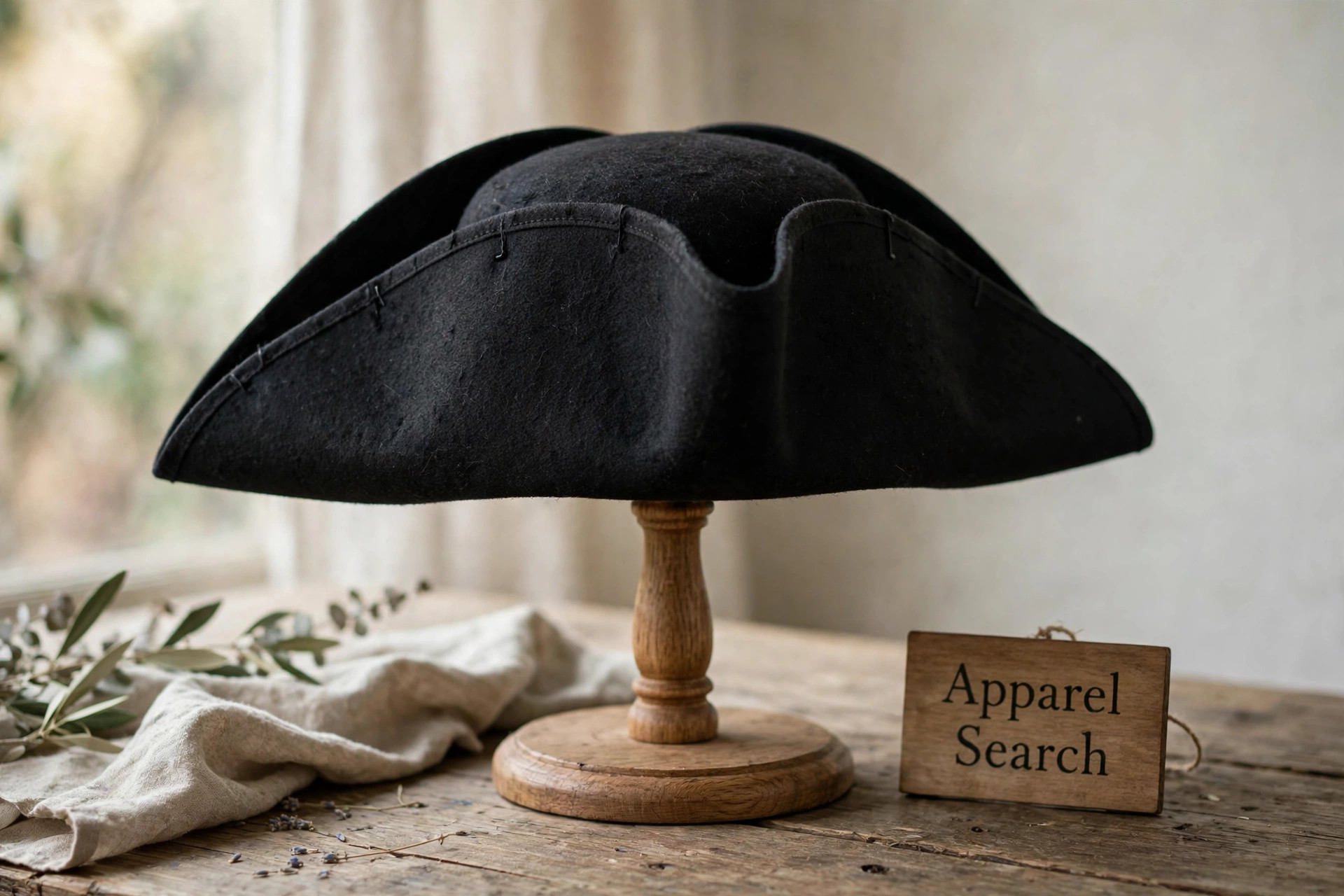
Three Turns of the Brim
The tricorne is made by construction, not by a separate pattern of crown. It begins with a hat that has a rather broad brim, and the brim is pinned up on either side of the head and at the back. Those three turn-ups — left, right and back — produce a triangular shape when the hat is seen from above or in front, and that three-cornered outline is the whole identity of the style. A hat whose brim lies flat all around is not a tricorne, and a hat turned up at only two sides belongs to its successor, the bicorne. Counting the raised sides is therefore the practical test of the name.
The crown, by contrast, is low, which keeps the silhouette wide and horizontal rather than tall. That low crown separates the tricorne clearly from the steeple hats worn by the Puritans before it and from the stovepipe hat of the nineteenth century after it — two styles defined by height where the tricorne is defined by width and angle. The hat was typically worn with the point facing forward on the head, so the triangular form had a set orientation in wear, with one corner over the face and the raised sides running back along the head.
In the 18th century, at the peak of its popularity, the tricorne was worn both by civilians and as part of military uniform — a double life that explains its range. Tricornes ranged from the very simple and cheap to the extravagant, occasionally incorporating gold or silver lace trimming and feathers. The same basic shape could therefore be a plain working hat, a gentleman's dress hat or a richly trimmed uniform piece, with cost and status shown in the trimming rather than in a change of form.
Rise, Fall and Survivals
The tricorne belongs firmly to one century. It was popular during the 18th century and fell out of style shortly before the French Revolution, so its dates frame the period dress of that era: a tricorne places a figure in the 1700s in a way few other garments can. Styles that end so cleanly usually hand something on, and the tricorne later evolved into the bicorne and eventually the cocked hat. The line of descent follows the brim: as the threefold turn-up gave way to a twofold one, the bicorne emerged, and the cocked hat carried the idea of a brim fastened up against the crown further still.
Although general fashion left the tricorne behind before the French Revolution, the hat survives today in traditional dress. Tricornes survive as part of the traditional dress of the Chelsea Pensioners and of the Guardia Civil of Spain. Survival in uniform and ceremonial dress is a common pattern for hats that fashion abandons: institutions keep the forms that identify them, long after the same shape has disappeared from ordinary streets. For anyone identifying the hat in a portrait, a museum or a ceremony, the construction points — three turn-ups, triangular outline, low crown, point worn forward — remain the reliable signs.
Not to Be Confused With
Count the corners. A tricorne's broad brim is pinned up on three sides — either side of the head and at the back — producing its triangular shape. The bicorne, which the tricorne later evolved into, is cocked up on two sides only, leaving two pointed ends. The cocked hat is the family's settled later form, with the brim at the left and right sides turned up and pinned together. Three turn-ups: tricorne; two: bicorne; side-pinned and triangular with a cockade: cocked hat.
Common Questions
Why is the tricorne triangular?
The tricorne has a rather broad brim pinned up on either side of the head and at the back. Turning the brim up at three places produces the triangular shape that gives the hat its name.
How was a tricorne worn?
The tricorne was typically worn with the point facing forward on the head. Its crown is low, unlike the steeple hats of the Puritans or the stovepipe hat of the nineteenth century.
Where do tricornes survive today?
Tricornes survive as part of the traditional dress of the Chelsea Pensioners and of the Guardia Civil of Spain. The style later evolved into the bicorne and eventually the cocked hat.