Poke Bonnet
Hat & Headwear Definitions — hats, caps, helmets and headwear terms from Apparel Search
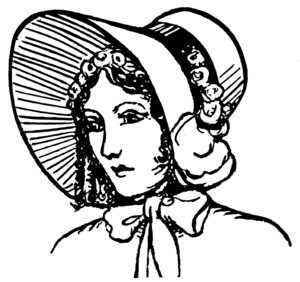
A poke bonnet is a women's bonnet, a hat, in the shape of a hood, featuring a projecting rim on the front side, which would shade the face of the wearer. The poke bonnet came into fashion at the beginning of the 19th century, and by the 1830s Englishwomen had adopted the poke bonnet. It is called a poke bonnet because all of one's hair could be poked inside it.
A poke bonnet is a women's
bonnet (hat) in the shape of a hood,
featuring a projecting rim on the front side, which would shade the face of
the wearer. The poke bonnet came into fashion at the beginning of the 19th
century. It is called a poke bonnet because all of one's hair could be poked
inside it. It is referred to in a first world war music hall song "In your
little poke bonnet and shawl". By the 1830s, Englishwomen had adopted the
poke bonnet. The new styles rendered the aristocracy less visibly distinct
from the respectable middle classes than they had ever been, as the image of
Queen Victoria makes clear. (J.S. Lewis Sacred to female patriotism: gender,
class and politics in late Georgian Britain (2003), 184).
| The above article is licensed under the GNU Free Documentation License. From Wikipedia, the free encyclopedia https://en.wikipedia.org/wiki/poke-bonnet. Modified by Apparel Search August 2013. |
A Hood Shape With a Projecting Rim
The poke bonnet combines two features that must be described together, because neither alone makes the bonnet. The first is its overall form: a women's bonnet, a hat, in the shape of a hood. A hood shape encloses the head rather than sitting on top of it, covering the hair and the sides of the head in a continuous form. The second feature is at the front: a projecting rim on the front side, extending forward beyond the face. That projecting rim would shade the face of the wearer, so the bonnet's most conspicuous feature also had a clear function, keeping direct light off the face while the hood portion covered the head and hair behind it. Together the hood and the forward rim give the poke bonnet its recognisable profile, enclosed at the back and sides, extended at the front.
The name is plainly practical. It is called a poke bonnet because all of one's hair could be poked inside it. That explanation fits the hood shape exactly: a bonnet that encloses the head needs somewhere for the wearer's hair to go, and a hood form provides the room, so the hair could be put up and poked inside rather than arranged around a small crown. Names taken from how a garment is actually used tend to be durable because they are easy to understand and easy to pass on, and this one tells a new wearer, in a single word, both what to do with the bonnet and why it is shaped as generously as it is. The bonnet is even remembered in song on those terms, referred to in a First World War music hall song, In your little poke bonnet and shawl, which shows the name and the garment staying familiar long after the bonnet's first fashion period.
Fashion at the Beginning of the 19th Century
The poke bonnet came into fashion at the beginning of the 19th century, placing its rise in the period when women's headwear was a prominent and expected part of dress outdoors. A bonnet in the shape of a hood, with a rim projecting to shade the face, answered the conventions and the practical needs of that dress together: coverage for the hair, and shade for the face, in one article. By the 1830s, Englishwomen had adopted the poke bonnet, so within a few decades the style had moved from a new fashion to established wear in England. That adoption is the point at which the bonnet stops being a novelty and becomes part of the ordinary visual record of the period, appearing on women as standard fashionable dress rather than as an exception.
Its adoption also carried a social effect noted at the time. The new styles rendered the aristocracy less visibly distinct from the respectable middle classes than they had ever been, as the image of Queen Victoria makes clear, a point made in J. S. Lewis, Sacred to female patriotism: gender, class and politics in late Georgian Britain, published in 2003, at page 184. When the same bonnet style is worn widely, dress stops separating ranks as sharply at a glance, because the visible silhouette, hood shape and projecting rim, is shared rather than reserved. The poke bonnet is therefore worth understanding on both levels at once. As an article of clothing it is a hood-shaped women's bonnet that shaded the face and took all the wearer's hair inside it. As a piece of early 19th century fashion history it is a style adopted by Englishwomen by the 1830s that helped narrow the visible distance between aristocracy and respectable middle classes, which is why a queen's image could be used to illustrate a bonnet worn across society.
Common Questions
What is a poke bonnet?
A poke bonnet is a women's bonnet in the shape of a hood, featuring a projecting rim on the front side. That projecting rim would shade the face of the wearer.
Why is it called a poke bonnet?
It is called a poke bonnet because all of one's hair could be poked inside it. The hood shape of the bonnet gave room for the hair to be put up inside it.
When did the poke bonnet come into fashion?
The poke bonnet came into fashion at the beginning of the 19th century. By the 1830s, Englishwomen had adopted the poke bonnet, as the image of Queen Victoria makes clear.