Tam O'Shanter
Hat & Headwear Definitions — hats, caps, helmets and headwear terms from Apparel Search
A tam o'shanter is a Scottish bonnet worn by men, named after a character invented by Robert Burns. The bonnet is made of wool with a toorie, or pompom, in the centre, and the crown is about twice the diameter of the head. It might be available in plain colors or in different tartans, and tam o'shanters are worn by the Scottish infantry regiments of the British Army instead of berets.
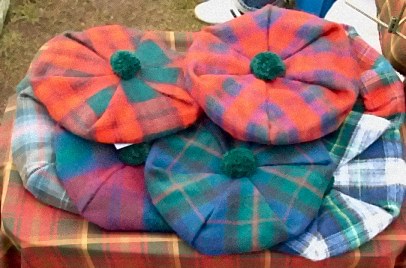 A Tam o'shanter is a Scottish bonnet worn by men which was named after a character invented by Robert Burns. The bonnet is made of wool with a toorie (pompom) in the centre, and the crown is about twice the diameter of the head. It might be available in plain colors or in different tartans.
Tam o'shanters are worn by the Scottish infantry regiments of the British Army instead of
berets. They are plain
khaki in color and are stiffer than civilian
tam o'shanters, with a narrower, flat crown often worn sloping down from back to front.
| The above article is licensed under the GNU Free Documentation License. From Wikipedia, the free encyclopedia https://en.wikipedia.org/wiki/tam_o'shanter 6/13/05 |
A Burns Character on a Scottish Head
Literature rarely names a hat, but it named this one. A tam o'shanter is a Scottish bonnet worn by men which was named after a character invented by Robert Burns. That origin gives the bonnet a double identity from the start: it is everyday Scottish headwear, and it carries a reference to Scotland's best-known poet and the figure he created. A wearer putting on the bonnet is wearing something whose name every Scots reader would recognise, which helps explain why this particular bonnet, among many soft caps, kept a distinct name and identity of its own instead of merging into the general family of wool bonnets.
The construction is distinctive and easy to verify. The bonnet is made of wool with a toorie, a pompom, in the centre, and the crown is about twice the diameter of the head. That oversized crown is the visual signature: soft wool spreads well beyond the head it covers, settling into a broad, flat disc of fabric with the small central toorie marking its middle. Wool suits the form because it can hold that soft spread while still knitting or felting into a bonnet warm enough for Scottish weather. It might be available in plain colors or in different tartans, and that choice changes the bonnet's statement, a plain bonnet reading as simple country dress, a tartan bonnet declaring a patterned affiliation across the whole wide crown where everyone can see it.
The Regimental Version: Khaki, Stiffer, Narrower
The bonnet's second life is military. Tam o'shanters are worn by the Scottish infantry regiments of the British Army instead of berets, placing a national bonnet where other regiments wear a different soft cap. The service version is adapted to uniform discipline in three specific ways. Military tam o'shanters are plain khaki in color, setting aside both bright plain colors and tartans for a single service shade. They are stiffer than civilian tam o'shanters, so the wide crown holds a neater, more uniform line on parade and on duty. And they have a narrower, flat crown, often worn sloping down from back to front, a prescribed tilt that gives a whole regiment one recognisable profile rather than each soldier's bonnet settling as it pleases.
Comparing a civilian and a regimental example side by side shows how one bonnet serves two purposes. The civilian form keeps the full soft spread, about twice the diameter of the head, the central toorie, and the freedom of plain colors or tartans for personal and regional expression. The regimental form keeps the toorie and the bonnet idea while tightening every variable, khaki color, stiffer body, narrower flat crown, and a set slope from back to front, so that the same Scottish shape can stand inspection as uniform. Both forms remain true to the Burns-named original in the ways that matter: wool construction, a crown wider than the head, and a pompom at the centre, a combination no other Scottish cap quite reproduces and the surest checklist for identifying a genuine tam o'shanter in either of its worlds.
Common Questions
Who is the tam o'shanter named after?
The tam o'shanter is named after a character invented by Robert Burns. The Scottish bonnet took its name from that literary character rather than from a place or a maker.
How wide is the crown of a tam o'shanter?
The crown is about twice the diameter of the head, which gives the bonnet its full, soft spread. A toorie, or pompom, sits in the centre of that wide wool crown.
How do Scottish regiments wear the tam o'shanter?
Tam o'shanters are worn by the Scottish infantry regiments of the British Army instead of berets. The military versions are plain khaki in color and stiffer than civilian tam o'shanters, with a narrower, flat crown often worn sloping down from back to front.