Straw Hat
Hat & Headwear Definitions — hats, caps, helmets and headwear terms from Apparel Search
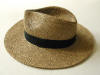
A straw hat can refer to any brimmed hat that is woven out of straw. The hat is designed to protect the head from the sun, as well as protect against heatstroke. There are several styles of straw hats, but all of them are made of woven straw, and many are formed in a similar way to felt hats, softened by steam and formed by hand or over a block.
 A
straw hat can refer
to any brimmed
hat
that is woven out of straw.
This hat is designed to
protect the head from the
sun, as well as protect
against heatstroke.
There are several styles of straw hats, but all of them are made of woven straw. Many of these hats are formed in a similar way to felt hats; they are softened by steam and formed by hand or over a block. Finer and more expensive straw hats have a tighter and more consistant weave. Since it takes much more time to weave a larger hat than a smaller one, larger hats are more expensive.
Types of straw hats
Straw hats are commonly blocked into shapes usually found in felt hats.
Panama hat - a fine and expensive hat made in Ecuador.
Conical hat - the distinctive hat worn primarily by farmers in Southeast Asia.
Boater hat - a formal straw hat with a flat top and brim.
You may want to also learn more from the following fashion industry definitions:
| The above article is licensed under the GNU Free Documentation License. From Wikipedia, the free encyclopedia https://en.wikipedia.org/wiki/slouch_hat 5/13/05 |
|
Woven Shade Against Sun and Heat
A straw hat is defined by its material and its brim working together: it can refer to any brimmed hat that is woven out of straw. The purpose is stated plainly and it is medical as much as comfortable, because the hat is designed to protect the head from the sun, as well as protect against heatstroke. A woven brim puts a layer of shade between the sun and the head, face and neck, while the woven structure itself is light on the head during hot work and hot weather. That combination, real shade without heavy material, is why woven straw became a standard warm-weather headwear material in the first place, and why the category covers several styles rather than one fixed shape.
Price and quality in straw hats can be read in the weave itself. Finer and more expensive straw hats have a tighter and more consistent weave, and consistency is the harder achievement, since every crossing of straw must sit evenly with its neighbours across the whole crown and brim. Time sets the second part of the price. Since it takes much more time to weave a larger hat than a smaller one, larger hats are more expensive, a direct relationship between the hours in the weaving and the cost of the finished hat. A buyer comparing two straw hats side by side therefore has reliable evidence in front of them: hold each to the light, look for evenness and tightness in the weave, and expect the finer, larger example to carry the higher price for reasons that are visible rather than mysterious.
Shaped Like Felt, Blocked Into Familiar Forms
Although the material is woven rather than felted, the shaping method borrows directly from felt hat making. Many straw hats are formed in a similar way to felt hats: they are softened by steam and formed by hand or over a block. Steam makes the woven straw pliable enough to take a set shape, and the block, a form in the shape of the finished crown, gives that shape its repeatable accuracy, while hand forming allows finer adjustment. As a result, straw hats are commonly blocked into shapes usually found in felt hats, so a wearer can choose a familiar crown and brim style and have it executed in cool woven straw rather than in warm felt.
Three named types show the range inside the category. The Panama hat is a fine and expensive hat made in Ecuador, standing at the quality end of the family where tight, consistent weaving is prized most. The conical hat is the distinctive hat worn primarily by farmers in Southeast Asia, a working form whose wide sloping shape serves outdoor labour in strong sun. The boater hat is a formal straw hat with a flat top and brim, proof that woven straw can be blocked into dress shapes as readily as into working ones. Fine, working and formal examples all remain straw hats under the one definition, any brimmed hat woven out of straw for protection from the sun and heatstroke, and that breadth is the category's strength: one breathable woven material, shaped by steam and block, serving farmers, formal wearers and everyone who needs shade in hot weather.
Common Questions
What defines a straw hat?
A straw hat is any brimmed hat woven out of straw. There are several styles, but all of them share that woven straw construction and a brim.
How are straw hats shaped?
Many straw hats are formed in a similar way to felt hats: they are softened by steam and formed by hand or over a block. Straw hats are commonly blocked into shapes usually found in felt hats.
Why do finer and larger straw hats cost more?
Finer and more expensive straw hats have a tighter and more consistent weave. Since it takes much more time to weave a larger hat than a smaller one, larger hats are more expensive as well.