Boater Hat
Hat & Headwear Definitions — hats, caps, helmets and headwear terms from Apparel Search
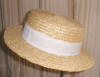
A boater is a kind of hat associated with sailing and boating. It is normally made of straw and has a flat crown and brim, typically with a ribbon around the crown, which is often in colours representing a school, rowing crew or similar institution. Boaters were popular as summer headgear in the late 19th century and early 20th century, and nowadays they are rarely seen except at sailing or rowing events, period theatrical musical performances or as part of old-fashioned school uniform.
A boater is a kind of hat associated with sailing and boating.
It is normally made of straw and has a flat crown and brim, typically with a ribbon around the crown, which is often in colors representing a school, rowing crew or similar institution. Boaters were popular as summer headgear in the late 19th century and early 20th century, and were supposedly worn by FBI agents as a sort of unofficial uniform in the pre-war years. Nowadays they are rarely seen except at sailing or rowing events, period theatrical musical performances or as part of old-fashioned school uniform.
Sun Hats - protect yourself from the sun if you are going to be out on a boat all day.
Loafers - fabulous boating shoes.
|
|
Learn about additional fashion or textile industry topics:
Fabric & Textile Industry Definitions
Embroidery Industry Definitions
Hat & Headwear Industry Definitions
Shoe & Footwear Industry Definitions
| The above article is licensed under the GNU Free Documentation License. From Wikipedia, the free encyclopedia https://en.wikipedia.org/wiki/boater_(hat) 5/15/05 |
|
Clothing & Fashion Directory |
||
|
Apparel Search is the worlds largest and fastest growing business to business database dedicated solely to the Clothing, Fashion & Textile Industry. Through the use of cutting edge technology, and a tremendous amount of "human" effort, we will continue to expand the Apparel Search directory. Our intention is to provide information regarding all aspects of clothing and fashion. If you know of any clothing, fashion, or textile related issue that is not currently listed on Apparel Search please let us know. |
||
Flat Crown, Flat Brim and a Ribbon That Means Something
The boater is one of the easiest hats to recognise and one of the hardest to confuse with anything else. The crown is flat on top, the brim is flat around it, and the whole hat is normally made of straw, held visually together by a ribbon band around the crown. That flatness is the design. A soft felt hat slouches, a cap follows the head, but a boater sits as a level, geometric disc-and-cylinder shape that looks crisp in summer light and photographs, which helped make it a uniform-like hat for warm-weather occasions. Straw suits the season as well as the silhouette: it is light, it holds the rigid flat shape the style requires, and it reads unmistakably as summer headgear rather than winter dress.
The ribbon is not a mere trimming. It is typically in colours representing a school, a rowing crew or a similar institution, so the same straw hat becomes a badge of belonging simply by changing the band. On the water and at regattas that coding is practical, letting spectators identify crews and schools at a distance, and in school uniform it turns an ordinary summer hat into part of a required, recognisable outfit. When you see a boater today, look at the ribbon first: its colours are very often the point of the hat.
From Everyday Summer Hat to Period Signal
In the late 19th century and early 20th century the boater was not a curiosity. It was popular summer headgear, the warm-weather counterpart to the formal hats men wore the rest of the year, associated from the start with sailing and boating and with the leisure that surrounded those sports. Its reach went further than the riverbank: boaters were supposedly worn by FBI agents as a sort of unofficial uniform in the pre-war years, a story that captures how standard and instantly identifiable the hat had become in American summer dress. A man in a boater looked dressed, current and ready for the heat, all at once.
That everyday role has gone. Nowadays boaters are rarely seen except at sailing or rowing events, in period theatrical musical performances, or as part of old-fashioned school uniform. Each of those survivals preserves a different part of the hat's history. Rowing and sailing events keep the sporting association and the crew colours. Period musicals use the boater as shorthand, because a stage full of flat straw boaters places a scene in that late-19th and early-20th-century summer world faster than any line of dialogue. Schools that retain it keep the uniform tradition, ribbon and all. For modern wear outside those settings, the boater works best worn deliberately, as a statement of classic summer style, paired with the boating and warm-weather clothing it was made for, and stored carefully, since stiff straw that gives the hat its flat crown and brim will crack or warp if it is crushed, soaked or left to bend out of shape. Handled well, a boater keeps its level lines season after season, which is precisely what the style is about.
Common Questions
What does a boater hat look like?
A boater is normally made of straw and has a flat crown and a flat brim. A ribbon around the crown is typical, and that ribbon is often in colours representing a school, rowing crew or similar institution.
When were boaters most popular?
Boaters were popular as summer headgear in the late 19th century and early 20th century. They were supposedly worn by FBI agents as a sort of unofficial uniform in the pre-war years.
Where are boaters seen today?
Nowadays boaters are rarely seen except at sailing or rowing events, period theatrical musical performances, or as part of old-fashioned school uniform. Their flat straw form instantly signals a period, summer setting.
More to Explore
- headgear
- uniform
- school uniform
- Straw Hats
- Sun Hats
- Loafers
- bucket hat
- fedora
- Baseball Caps
- Cap Definition
- Coif Definition
- Yarmulke
- Clothing Definition
- Hats
- GNU Free Documentation License
- https://en.wikipedia.org/wiki/boater_(hat)
- Apparel Link
- Associations
- Buying Groups
- Calendar
- Care Labels
- Classifieds
- Close Out
- Consulting
- Conversion Charts
- Customs
- Design Studio
- Education
- Employment
- Fashion
- Financial
- Glossary
- Jobber
- Licensing
- Logistics
- Manufacturer
- Merchandising
- Merchandise Marts
- Message Boards
- Modeling
- News
- Pattern Maker
- Popular Brands
- Production
- Quality Testing
- Recycle
- Retailer
- Sales Reps
- Shipping
- Technology
- Trade Leads
- Trade Shows
- Warehouse
- Wholesale
- World