Bead
Miscellaneous Definitions — the small pierced ornament used in beadwork, jewellery and trim, from Apparel Search
Search Apparel Search
At a Glance
Definition: A bead is a small, decorative object that is pierced for threading or stringing, ranging in size from under a millimetre to over a centimetre and most commonly made of glass, plastic or stone.
Category: Miscellaneous Definitions
A bead is a small, decorative object that is pierced for threading or stringing — and the piercing is the heart of the definition. A bead is made to have thread, cord or wire pass through it, so beads can be joined in lines, nets, fringes and woven structures rather than sitting alone, which separates a bead from a sequin, a button or a loose gem. Beads range in size from under a millimetre to over a centimetre. Glass, plastic and stone are probably the most common materials, but beads are also made from bone, metal, resin, wood, clay, felt, paper and other materials. Beadwork is the craft of making things with beads, by stringing them with thread or wire or sewing them to cloth. This page covers size and material, the craft of beadwork, and the named types a maker or buyer needs to tell apart.
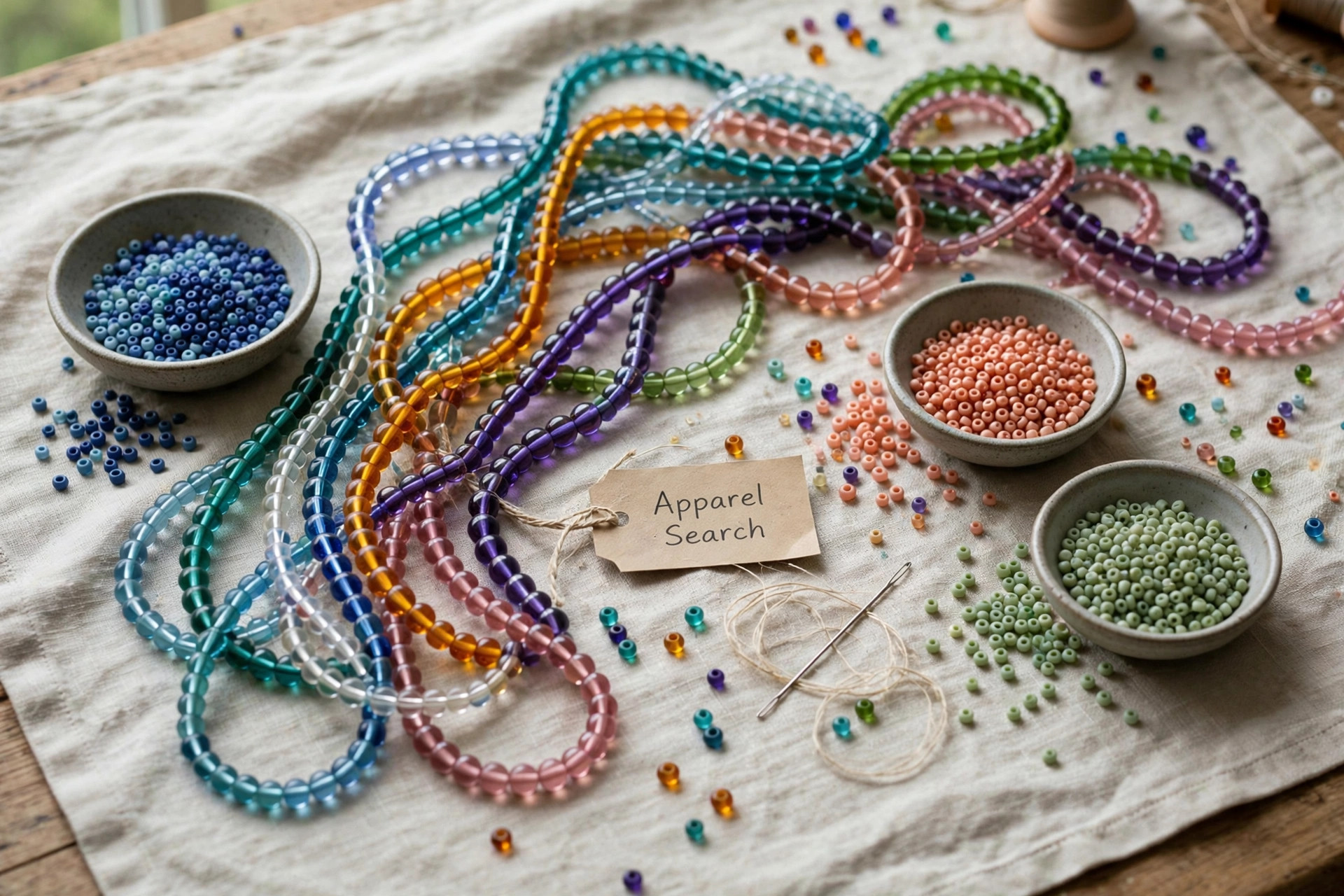
Small, Decorative and Pierced for Stringing
Beads range in size from under a millimetre to over a centimetre, a span that covers tiny seed beads used in dense embroidery at one end and large statement beads used singly or in short strands at the other. Size affects both technique and effect: very small beads create a fine, fabric-like surface when worked together, while larger beads read as individual shapes and are spaced, knotted or combined with other elements so that each one can be seen. Counting, sorting and grading by size are therefore part of working with beads, because a pattern that depends on even rows will fail if the beads vary too much in diameter.
The hole matters as much as the outside. Because a bead is pierced, its usefulness depends on the hole being large enough for the chosen thread, cord or wire and clean enough not to cut it — a heavy strand needs a stronger thread than a light one, and the thread must be matched to the beads it carries. That is why beads are described and sold by material, size and finish together: those three facts tell the buyer how a strand will look, feel and behave in a finished piece, and tell the maker how the beads should be handled before any work begins.
Materials and What They Change
Material gives beads much of their variety. Glass, plastic and stone are probably the most common materials, but beads are also made from the seeds of the bead tree, and from bone, metal, resin, wood, clay, felt, paper and other materials. Each material changes weight, shine and durability. Glass can be transparent, opaque, glossy or frosted and holds strong colour; stone is heavier and cooler to wear; wood and seeds are light and natural in appearance; metal adds brightness and weight in small amounts; plastic allows inexpensive, uniform beads in many colours; and felt, paper and clay allow handmade forms that would be impractical in harder materials.
Those differences decide where a bead can be used. A garment trimmed with heavy stone or glass beads needs cloth strong enough to carry the weight and stitching that will not pull through; a strand of light wooden or plastic beads can hang from a finer thread and move more freely. Delicate glass needs more protection from impact than wood, while paper and felt beads belong where they will not be soaked or crushed. Choosing beads is therefore a practical decision as well as a decorative one: the same pattern worked in seed beads, in stone or in plastic produces three different objects, with different weight, cost, care and life.
Beadwork and Types of Beads
Beadwork is the craft of making things with beads. More precisely, beadwork is the art or craft of attaching beads to one another by stringing them with a sewing needle or beading needle and thread or thin wire, or sewing them to cloth. Those two methods — stringing and sewing down — cover most beaded objects. Strung beads become necklaces, bracelets and fringing that move freely; beads sewn to cloth become decoration fixed to a garment, bag or hanging, where the fabric supports the weight and the pattern. Beads are used to create jewellery and other articles of personal adornment; they are also used in wall hangings and sculpture and many other artworks. In apparel, beadwork appears as trim on garments and accessories, where rows or scattered patterns of beads add colour, texture and weight to an edge, a neckline or a whole panel.
Named types help buyers and makers specify what they need. Types of beads include lampwork beads, chevrons, fire-polish beads, millefiori, pressed glass beads, seed beads and prayer beads. Lampwork and millefiori describe glass beads made and decorated by particular glassworking methods, fire-polish and pressed glass describe finishes and forming methods for glass, seed beads are the very small uniform beads used for weaving and embroidery, and prayer beads are beads made and strung for counting, where number and sequence matter as much as decoration. Related forms such as magatama and rudraksha beads show how bead traditions also develop in specific cultures and uses. For apparel and trim, the practical lesson is that bead is a structural term — pierced for threading — while the type name tells the maker the material, method and intended use of the particular bead in hand, and choosing the wrong type can change both the appearance and the durability of the finished work.
Common Questions
What is a bead?
A bead is a small, decorative object that is pierced for threading or stringing. Beads range in size from under a millimetre to over a centimetre.
What are beads made from?
Glass, plastic and stone are probably the most common materials. Beads are also made from the seeds of the bead tree, and from bone, metal, resin, wood, clay, felt, paper and other materials.
What is beadwork?
Beadwork is the art or craft of attaching beads to one another by stringing them with a sewing needle or beading needle and thread or thin wire, or sewing them to cloth. Beads are used for jewellery, personal adornment, wall hangings, sculpture and other artworks.