Stitching Awl
Sewing Definitions — stitches, seams, quilting and sewing terms from Apparel Search
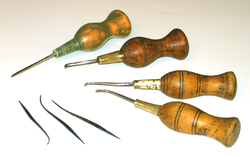
A stitching awl is a simple tool with which holes can be punctured in a variety of materials, or existing holes can be enlarged. It is also used for sewing heavy materials such as leather or canvas. It is a thin, tapered metal shaft coming to a sharp point, either straight or slightly bent, often in the form of interchangeable needles. Stitching awls usually have an eye pierced at the pointed end, as opposed to normal sewing needles, to aid in drawing thread through holes for manual lockstitch sewing, in which case the tool is also called a sewing awl.
A stitching awl is a simple tool with which holes can be punctured in a variety of materials, or existing holes can be enlarged. It is also used for sewing heavy materials, such as leather or canvas. It is a thin, tapered metal shaft, coming to a sharp point, either straight or slightly bent.These shafts are often in the form of interchangeable needles. They usually have an eye piercing in it at the pointed end (as opposed to normal sewing needles) to aid in drawing thread through holes for the purpose of manual lockstitch sewing, in which case it is also called a sewing awl. Stitching awls are frequently used by cobblers (shoemakers) and other leatherworkers. Sewing awls are useful for making lock stitches. The needle, with the thread in the eye is pushed through the material. The thread is then pulled through the eye to extend it. As the needle is pushed through the material, the extra thread from the first stitch is then threaded through the loops of successive stitches creating a lock stitch. The action is likened to that of a "miniature sewing machine". Styles may vary, as they are adapted to specific trades, such as making shoes or saddles. They are also used in the printing trades to aid in setting movable type and in bookbinding.
| The above article is licensed under the GNU Free Documentation License. From Wikipedia, the free encyclopedia (https://en.wikipedia.org/wiki/stitching_awl). 7/4/09 Modified by Apparel Search. |
|
|
|
| Clothing Industry |
A Needle With a Handle, for Materials Needles Cannot PierceLeather, heavy canvas and layered webbing defeat the ordinary sewing needle: the material is too dense to pierce by finger pressure, and forcing a needle risks snapping it. The stitching awl answers by putting the piercing point on a handle that the palm can drive. The shaft is thin and tapered so the hole it makes is no wider than the thread needs, straight for flat work or slightly bent for reaching into shaped articles such as shoes. Many awls take interchangeable needles, so one handle serves different point sizes and a worn or broken point can be replaced. The eye at the pointed end, rather than at the blunt end as in a hand sewing needle, is what turns a piercing tool into a sewing tool. The sewing awl carries its thread with it through the hole it has just made. The classic awl stitch proceeds in a rhythm likened to a miniature sewing machine: the awl, threaded, is pushed through the material; a loop of thread is drawn out on the far side; a second thread, or the free end, is passed through that loop; and the awl is withdrawn, pulling the loop tight so the two threads lock inside the material. Repeated stitch by stitch, the result is a genuine lockstitch, the same interlocked structure a machine makes, produced by hand in material no domestic machine could sew. Trades of the AwlShoemaking and saddlery are the awl's home trades. Cobblers stitch soles and uppers with awls, varying style by trade: shoe awls, saddle awls and harness awls differ in point shape and bend because each job presents the material at a different angle and thickness. Styles vary as they are adapted to specific trades, such as making shoes or saddles, and the same family of tools appears in bookbinding, where awls pierce the folds of sections for sewing, and historically in the printing trades to aid in setting movable type. Wherever the awl is used only to pierce, for marking a stitch line, starting a hole for a rivet or enlarging an existing hole in leather for a buckle tongue, it works without thread and the eye is irrelevant. For the modern leatherworker and the repairer of heavy gear, the awl remains the practical way to sew rucksack straps, belts, canvas covers and shoe uppers by hand. Its stitches are strong because they lock, repairable because each stitch is independent, and neat because the holes can be pre-marked at even spacing and the awl follows them exactly. Thread for awl work is usually waxed linen or synthetic braided thread, the wax helping the thread slide through the tight hole and resist moisture in the finished seam. The stitching awl is among the oldest sewing tools in continuous use, and its principle has never needed improvement: a sharp point, an eye where the point is, and a handle that lets human strength do what fingers alone cannot. Common QuestionsWhat is a stitching awl?A stitching awl is a thin, tapered metal shaft coming to a sharp point, used to puncture holes in materials or enlarge existing holes, and to sew heavy materials such as leather or canvas. How does a sewing awl make a lockstitch?The needle, with thread in its eye, is pushed through the material and the thread pulled through to extend it. As successive stitches are made, the thread is threaded through the loops of previous stitches, creating a lock stitch, like a miniature sewing machine. Who uses stitching awls?Stitching awls are frequently used by cobblers and other leatherworkers, and in trades such as saddlery, shoemaking, bookbinding and printing, where they aid in setting movable type. More to ExploreMore from Apparel Search: Sewing Definitions | Clothing Industry Glossary | Fashion Terms | Apparel Search Home
|