Cobbler and Shoemaker
Footwear Definitions — the hand craft of making and mending shoes, from Apparel Search
Search Apparel Search
At a Glance
Definition: A shoemaker is a craftsman who makes footwear by hand, and a cobbler is traditionally a shoe repairer; shoemaking is a traditional handicraft profession now largely superseded by industrial manufacture.
Category: Footwear Definitions
Shoemaking is a traditional handicraft profession, which has now been largely superseded by industrial manufacture of footwear. Shoemakers or cordwainers may produce a range of footwear items, including shoes, boots, sandals, clogs and moccasins, generally made of leather, wood, rubber, plastic, jute or other plant material, and often consisting of multiple parts for better durability of the sole, stitched to a leather upper. Within that one trade description sit two historic roles — the maker and the mender — that guild law once kept strictly apart.
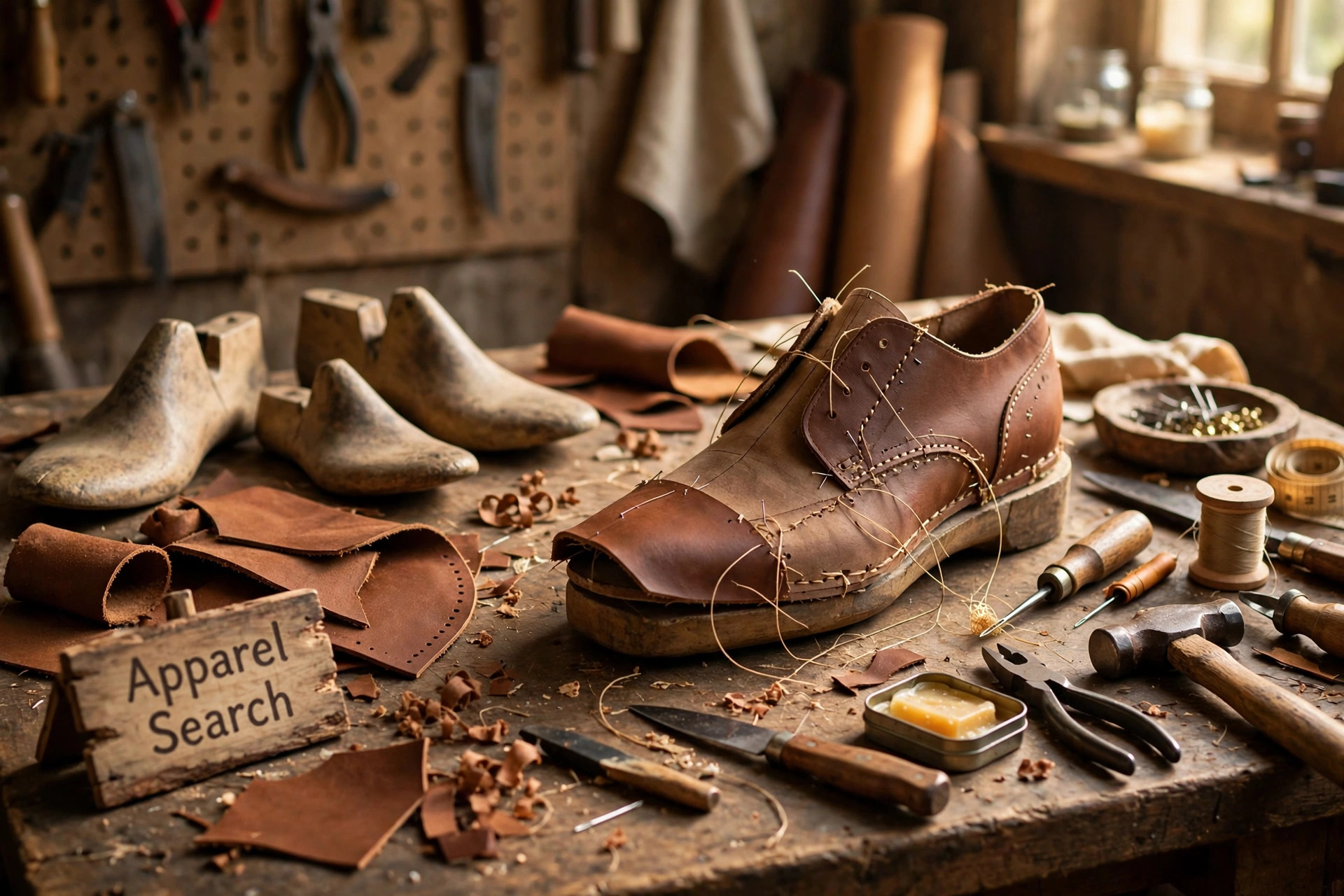
The Craft Around the Last
Hand shoemaking builds a shoe from parts around the last. Most shoemakers use a last — a foot-shaped form made traditionally of iron or wood, but now often of plastic — on which to form the shoe. Some lasts are straight, while curved lasts come in pairs: one for left shoes, the other for right shoes. The upper, usually leather, is cut, stitched and stretched over the form so the finished shoe holds the shape of a foot, then joined to a sole built from multiple parts for better durability, stitched to the leather upper rather than simply glued.
The materials reach well beyond leather: wood for clog soles, rubber and plastic for modern soles and lasts, jute and other plant material for sandals and espadrille-style work. Present-day crafters still improvise in the same spirit as the old trade, sometimes using used car tyre tread as a cheap alternative for soles. Bespoke makers still teach and practise the hand methods — a period Shoemaker’s Workshop is preserved by the Canadian Museum of Civilization — and the repair bench — the cobbler's modern home — keeps the trade visible on every high street, even though industrial manufacture now supplies everyday footwear.
Cobbler or Cordwainer: The Guild Divide
Originally, cobblers were intended to only repair shoes. Historically in the United Kingdom, they had not been permitted to produce new shoes — this was back when there was both a cobbler guild and a separate cordwainer guild. The cordwainer made new shoes from new leather; the cobbler mended shoes that were already worn. The separation was enforced by the guilds, not merely observed as custom, and it shaped who could sell a new pair of shoes and who could only keep an old pair going.
Everyday language has since blurred the line, and cobbler is now widely used for tradespeople who make or repair shoes. The distinction survives as the precise vocabulary of the trade: a customer taking worn shoes for resoling is visiting a cobbler in the original sense, and a customer ordering a new handmade pair is buying a cordwainer's work, whatever the sign over the door says.
Traditional Shoes From the Shoemaker's Bench
Some types of ancient and traditionally made shoes show how wide the craft's range is. Furs wrapped around the feet, with sandals wrapped over them, were used by Romans fighting in northern Europe. Clogs — wooden shoes, often filled with straw to warm the feet — turned a carved block into insulated footwear. Moccasins are simple shoes, often without the durability of joined shoes, although different types of leather have different wear characteristics. The Society for Creative Anachronism offers advice about making period shoes for those who still practise the old constructions, and each of these forms is a lesson in what a shoemaker can do with the materials at hand.
A Trade Written Into Stories
The shoemaking profession makes a number of appearances in popular culture, such as in stories about the shoemaker's elves, and the proverb “The shoemaker's children are often shoeless.” The patron saint of shoemakers is Saint Crispin, and in America the trade organised early and in force: the Order of the Knights of St. Crispin was an American labor union of some 50,000 shoemakers around 1870, named for the craft's patron saint.
The trade's standing reached high places. Pope Urban IV, born Jacques Pantaléon, was the son of a cobbler of Troyes, France, and Rabbi Yochanan Hasandlar, a famous sage of the third century AD, may have earned his living as a sandal maker — the nickname may also indicate that he was a native of Alexandria. The workshop stayed in the language, too: chefs and cooks sometimes use “shoemaker” as an insult, implying that the chef in question has made his food as tough as shoe leather. Few trades can claim a saint, a union, a pope's father and a kitchen insult; shoemaking earned all four because for most of history every pair of shoes began on one craftsman's bench.
Not to Be Confused With
A cobbler is not the same as a cordwainer. Historically in the United Kingdom, cobblers were intended to only repair shoes and were not permitted to produce new shoes, because there was a cobbler guild and a separate cordwainer guild: cordwainers made new shoes from new leather, and cobblers mended worn ones. Modern usage blurs the two, but the distinction is the original meaning of both words.
Common Questions
What is the difference between a cobbler and a cordwainer?
Historically in the United Kingdom, cobblers were intended to only repair shoes and had not been permitted to produce new shoes, because there was both a cobbler guild and a separate cordwainer guild. Cordwainers made new shoes; cobblers mended worn ones.
What is a last in shoemaking?
Most shoemakers use a last, a foot-shaped form made traditionally of iron or wood, but now often of plastic, on which to form the shoe. Some lasts are straight, while curved lasts come in pairs: one for left shoes, the other for right shoes.
Who is the patron saint of shoemakers?
The patron saint of shoemakers is Saint Crispin. The craft also appears across popular culture, in stories about the shoemaker's elves and in the proverb that the shoemaker's children are often shoeless.