The fashion industry & clothing guide

DIY Fashion · Upcycling & Customization

Denim Upcycling Projects

Jeans die in predictable places — inner thighs, knees, hems — while most of their fabric is still the toughest cotton in your wardrobe. That mismatch is why denim is the upcycler's favorite material. These projects use the whole pair, including the parts beginners throw away: the pockets, the waistband and the flat felled seams.

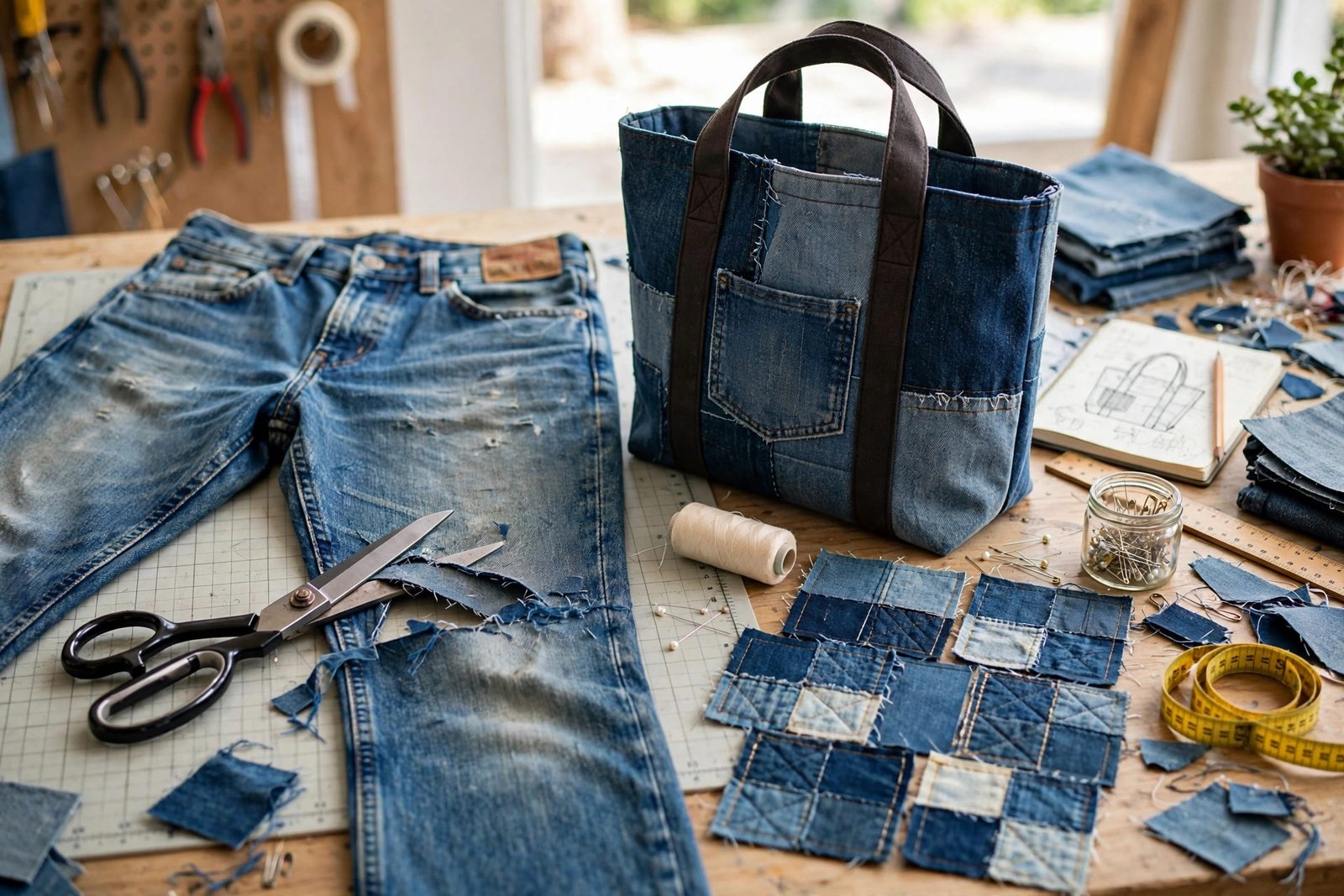
Old jeans being cut on a craft table beside a finished tote bag sewn from denim
One worn-out pair: a tote, a skirt, or a stack of patchwork — denim rarely has to leave the house.
On this pageThe Jeans ToteJeans to SkirtPatchwork & ScrapsUse Every PartCommon Questions

01 — The Classic

A Tote Bag from the Top of the Jeans

  1. Cut below the pockets

    Cut the legs off straight across, just below the bottom of the back pockets, keeping the whole seat, waistband, zip and pockets as one piece — this is the bag's body, already half-made.

  2. Close the bottom

    Turn inside out and sew the cut edge shut with a straight seam, then box the corners: flatten each end of the seam into a triangle and stitch across it, which gives the bag a flat base that stands up.

  3. Make handles from the legs

    Cut two long strips from a leg, fold each into a strap (fold the edges to the center, then fold in half), stitch down both sides, and attach the ends inside the waistband area with strong double stitching.

  4. Finish

    Turn right side out. The jeans' own pockets are the bag's pockets; the belt loops take a carabiner for keys. Line it only if you want to — denim is its own lining.

02 — The Transformation

Turn Jeans into a Skirt

The jeans-to-skirt conversion uses the pair's best fabric and removes its worst. Cut the legs at your chosen skirt length plus seam allowance. Open the inseams completely with a seam ripper, and unpick the front and back crotch seams partway up so the panels can lie flat. Overlap the front panels and pin them into a smooth placket; do the same at the back, where the V-shaped gap is filled with a triangular insert cut from a removed leg — the classic denim skirt gusset. Stitch everything down with topstitching thread if you have it, hem the bottom, and you have a skirt whose waistband, pockets and fit you already know. It is the single most satisfying first refashion: the fit is guaranteed because it was fitted all along. For the broader set of beginner transformations, see our refashioning projects.

03 — The Scrap System

Patchwork: Where the Rest of the Pair Goes

After the big projects, what remains — legs' lower panels, odd shapes around pockets — is patchwork stock. Denim patchwork works because the fabric is uniform in weight: cut squares or rectangles with a rotary cutter if you have one, mix the washes deliberately (a gradient from light to dark is the easiest design that always works), and sew with a slightly longer stitch. Good destinations for a first patchwork panel: a cushion cover, a tote front (sew the panel, then build the bag from it), a jacket back or knee reinforcement with the seams left raw-edged on the outside — denim frays to a soft fringe that is a finish in itself. Keep a scrap bag by wash: patchwork design is 90 percent having enough shades to choose from, and every retired pair adds a color you cannot buy.

04 — Use Every Part

Pockets, Waistbands and Seams

The parts beginners discard are the most characterful. Back pockets, cut out with a margin of fabric, become wall organizers, gift-card holders and appliqué pockets sewn onto plain tote bags and aprons. Waistbands — already interfaced, already buttoned — make dog collars, camera straps, key fobs and the top band of a tool roll. Flat felled seams (the double-stitched ridges down the legs) unpick into tough narrow straps and ties. Even the labels and leather patches collect into patchwork corners and bag details. When the pair on your table is truly finished — worn everywhere, fabric tired — it still has one more job: cut it into dusters and shop rags, because nothing absorbs like old denim. That is the full arc of upcycling: value extracted at every stage, and almost nothing in the bin.
Common Questions

Common Questions

Can you sew denim on a regular sewing machine?

Yes, with three adjustments: a denim/jeans needle (a standard needle will deflect and skip on thick seams), a longer stitch length, and patience at seam crossings — slow down, or hand-crank the wheel over the bulkiest joins. Flatten thick seam allowances with a hammer tap (a real tailor's trick) and avoid sewing through the metal rivets and button. Most project failures on denim are needle failures, not machine failures.

Which jeans are best for upcycling?

Straight-leg and relaxed jeans give the most usable flat fabric; heavily stretchy denim is harder to sew neatly and sags in bags, so save high-stretch pairs for no-sew uses. Check the fabric away from the worn areas — if the cloth is thin and shiny across the seat, that pair is patchwork-grade rather than tote-grade. The classic first pair to sacrifice: jeans that fit nowhere and are worn at the thigh.

What can I make from jeans without sewing?

Cut-off shorts are the famous one; beyond them, the waistband-plus-pockets section cuts off whole to become a wall or chair-back organizer with zero stitching, legs cut into strips weave into pot holders and mats (a simple over-under weave pinned then glued or stapled at the edges), and pocket squares glue or staple onto boards as instant catch-alls. Sewing widens the menu a lot, but a no-sew pair still yields an organizer and a set of coasters.

Keep Going

More to Explore

Denim projects are one branch of the upcycling tree — the general ideas guide and beginner refashioning projects cover the rest of the wardrobe.

Search Apparel Search