Terry Fabric Mills
A terry mill does far more than weave loops into cloth. It chooses the cotton, sets the loop height and ground weave, dyes and finishes the toweling, and decides whether the finished fabric will thrive in a hotel laundry, a nursery, or a robe collection.
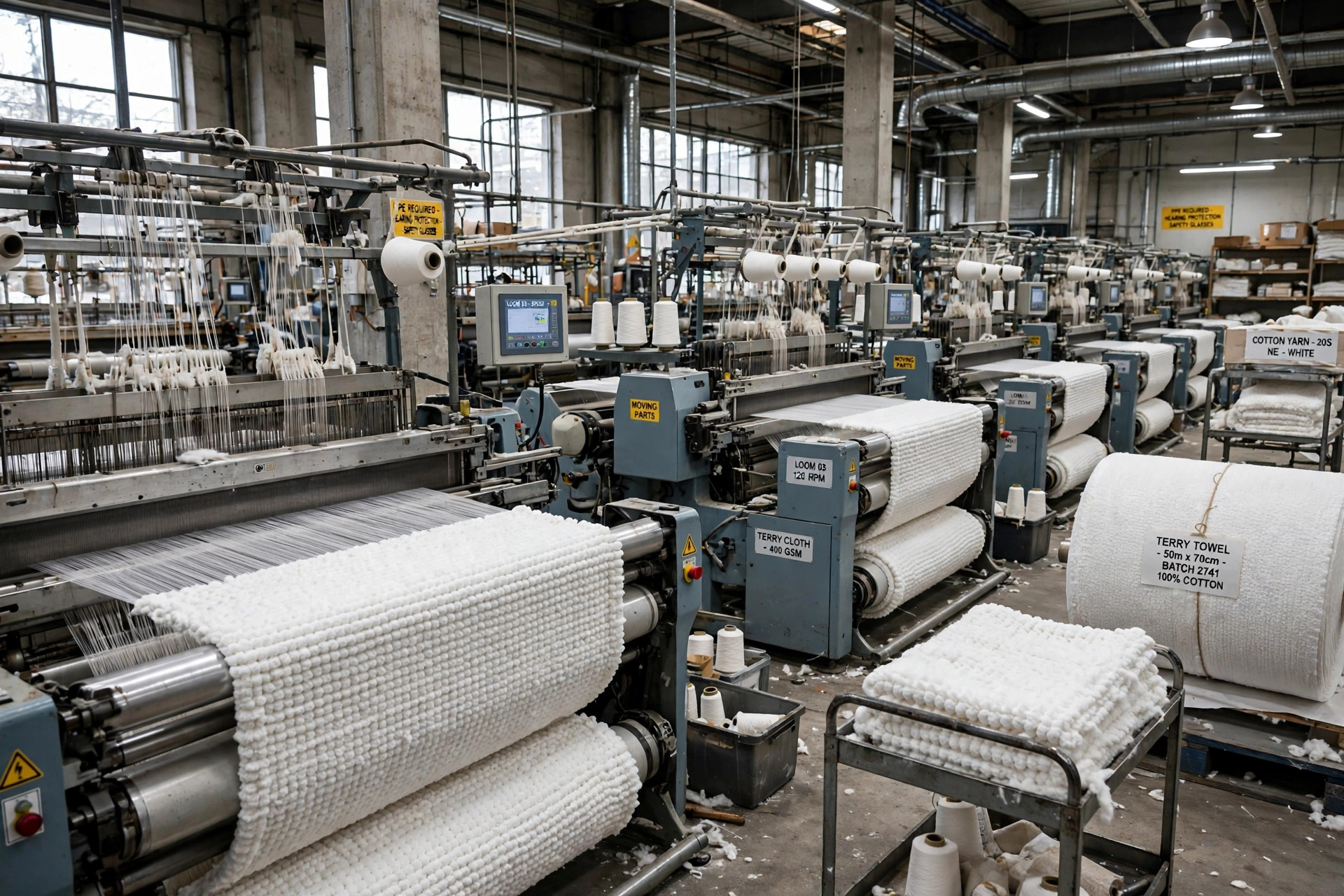
What Happens Inside a Terry Mill
Terry weaving is a specialized form of pile weaving. Alongside the ordinary ground warp and weft, an additional set of yarns is fed with controlled slack so that, as the cloth is beaten up, those yarns buckle into loops above the surface. The mill controls loop height, loop density and whether loops form on one side or both, and those settings are set long before color or pattern is discussed. A mill that weaves terry well must hold tension with unusual precision, because a small variation shows immediately as uneven pile, thin patches or towels that twist after washing. This is why experienced buyers treat terry as a mill specialty rather than a generic woven fabric any factory can add casually.
After weaving, the cloth is scoured, bleached or dyed, softened within limits that preserve absorbency, and inspected for loop defects, weaving faults and shade variation. Some mills sell greige or finished toweling by the roll to converters and wholesalers, while others cut and sew towels, robes and related goods in their own workrooms, as Sapphire, listed below, does — beginning with cotton selection and continuing through high-speed weaving to cutting and sewing. Vertically integrated mills offer one point of responsibility for the whole product, while weaving-only mills give converters more freedom to finish and sew elsewhere. Neither model is automatically better; the right choice depends on volume, control and the buyer's own capabilities.
How to Evaluate a Terry Mill
Start with the product the mill makes most, not the longest list it can claim. A mill centered on bath and institutional toweling will understand laundry durability, shrinkage control and bulk consistency in a way a general fabric mill may not. Ask about fiber sourcing and yarn quality, because long, even cotton yarns make smoother loops and less lint, while weaker yarns show up later as shedding and early wear in the customer's bathroom rather than on the mill's inspection table. Ask also about weight range, maximum width, dyeing method and testing, and request washed samples, since terry changes character after laundering and an unwashed hand sample can flatter a fabric that later turns limp or harsh.
Consistency across repeat orders deserves direct questions. Towels and robes are replenishment products: a hotel, retailer or brand will return for the same article and expect the same weight, shade and hand. Ask how the mill controls shade lots, how it handles claims for loop pulls or uneven pile, and what minimum quantities apply to custom weights or colors. If you need French terry or apparel loops rather than toweling, say so plainly, because the looms, yarns and finishing for apparel terry differ from bath terry even though the names sound close. Clear specifications at the mill stage prevent the most expensive misunderstandings, which are the ones discovered after cutting.
Reading the Mills in This Directory
Four companies are listed below. Large marketplace and sourcing portals appear under References, not as mills. Allbotex is a manufacturer and converter in Taiwan and China for many kinds of knitted fabric, including terry fleece, with its own factories and long team experience in knitted textiles. Frotex has a much older toweling story: the Polish company began as a linen factory founded in 1845, and terry fabrics and towels entered its production in 1903 — a reminder that some terry expertise is measured in generations rather than seasons.
Sapphire and Tirotex illustrate two other mill profiles. Sapphire is a quality-led producer that selects cotton carefully, weaves on high-speed looms, finishes the fabric, and then cuts and sews in its own factory — a compact picture of vertical production. Tirotex, based in Tiraspol, is one of the largest textile enterprises in its region, with a finishing operation producing bleached, dyed and printed fabrics including terry, on a very large industrial site dating to the 1970s. Read each listing as a starting point for your own current verification: company ranges, contacts and capabilities change, so confirm details directly before placing development or orders.
From Mill Cloth to Finished Product
Understanding the mill stage helps every later buyer in the chain. Wholesalers depend on mills for steady weights and shades, converters depend on clean, even cloth for cutting, and retailers depend on both for towels that still feel good after the twentieth wash.
If you are sourcing at volume, visit the wholesalers page in this section next for distributors who stock mill production, and the stores page for smaller quantities. If you are still learning the fabric itself, the main terry fabric page explains loops, French terry and care in plain terms.
Terry Fabric Mills in This Directory
Four mills are listed below, each with a short note on what it makes. Marketplace sourcing portals are listed under References, not as mills.
Allbotex
Manufacturer and converter in Taiwan and China for many kinds of knitted fabric, including terry fleece, with its own factories and over 20 years of team experience in knitted textiles.
Frotex
Polish terry producer that began as a linen factory founded in 1845, with terry fabrics and towels in production since 1903.
Sapphire
Producer that selects cotton carefully, weaves on high-speed looms, finishes the fabric, and cuts and sews in its own factory for quality, design and durability.
Tirotex
Large textile enterprise in Tiraspol whose finishing operation produces bleached, plain-dyed and printed fabrics, including jersey and terry fabrics.
Common Questions
What should I specify when contacting a terry mill?
Give fiber content, finished weight, loop type and height if known, width, color or bleaching, quantity, and the end product. Also ask for washed samples, since terry changes after laundering.
What is the difference between a mill and a converter?
A mill weaves the terry cloth. A converter typically buys mill cloth and handles dyeing, finishing, cutting or sewing, or prepares it for wholesale and retail sale.
Why do washed samples matter for terry?
Washing reveals shrinkage, twisting, linting and the true hand and absorbency of the loops. An unwashed sample can feel softer or look even in ways that do not survive the laundry.
More to Explore
References & Further Reading
Looking for Fabric Mills and Suppliers?
For the full mill landscape beyond terry, browse the fabric directory on Apparel Search and return to the Fabric Search hub for related fabric sections.