Yarn-Dyed Fabric Mills
Mills that weave yarn-dyed fabric control the dyeing, warping and weaving under one roof or one plan, and the pattern quality depends on it. This guide introduces the listed yarn-dyed mills and manufacturers and explains how to approach a mill with a workable specification.
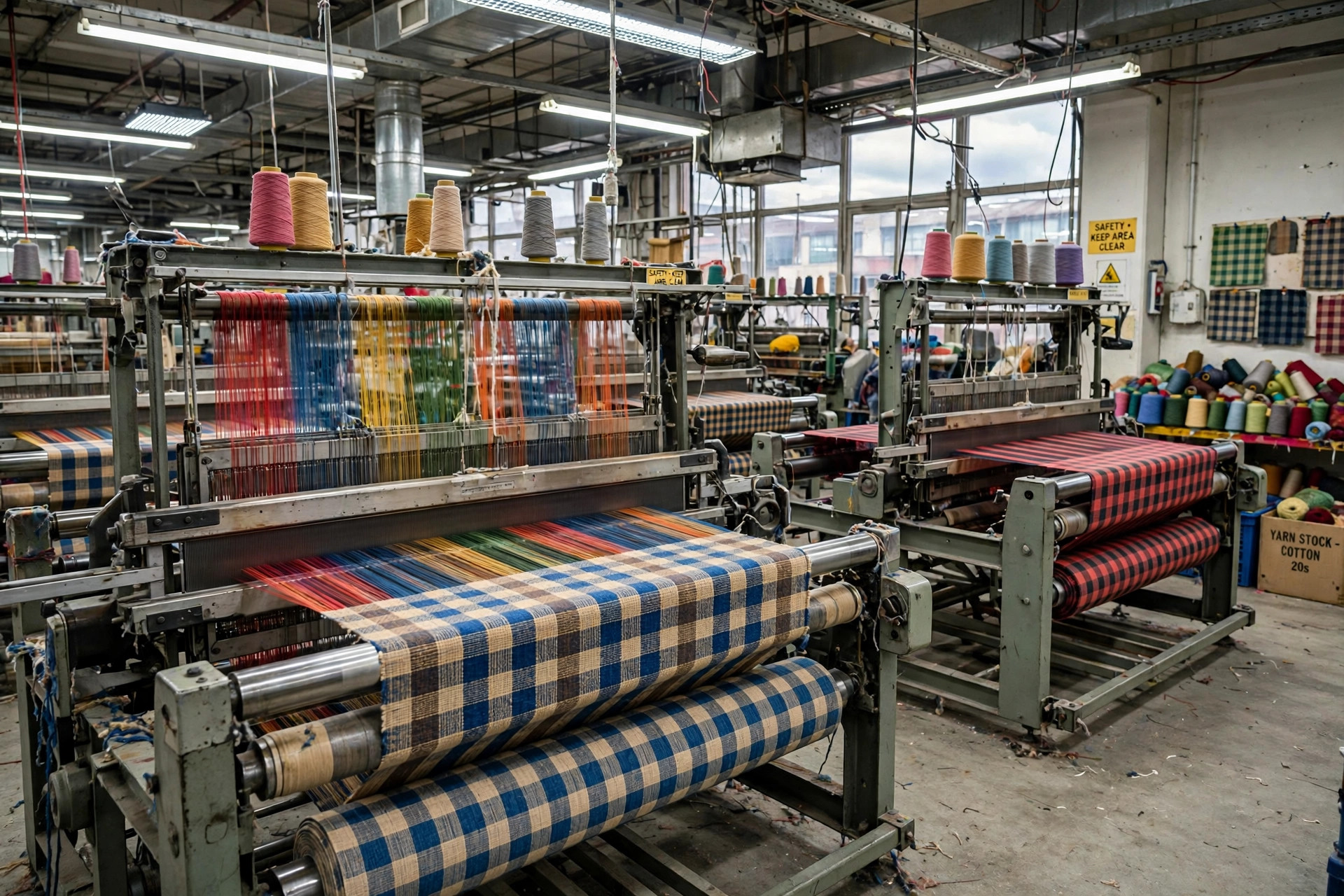
What a Yarn-Dyed Mill Actually Does
A yarn-dyed fabric mill starts production a stage earlier than an ordinary weaving mill. Before any cloth exists, the mill or its dyehouse partners colour the yarn, by package dyeing, hank dyeing or warp dyeing, in every shade the design requires. Those dyed yarns are then warped in the exact colour order of the pattern repeat, sized where needed to withstand weaving, and woven so that warp and weft colours cross to form stripes, checks, plaids, dobbies and jacquard effects that are part of the cloth structure itself.
Because colour is committed before weaving, mill discipline matters enormously. Shade lots must match across dyeings or the fabric will band, the warp pattern must be set without error across hundreds or thousands of ends, and loom settings must hold the repeat steady for the whole order. Good yarn-dyed mills therefore emphasise in-process inspection and quality checks on yarn and raw materials before weaving begins, and they test colourfastness on the dyed yarn rather than waiting to judge the finished fabric, when a fault can no longer be separated out.
Specifying Fabric to a Mill
A mill enquiry for yarn-dyed fabric should name the fibre and yarn count, the weave, the finished width and weight, and above all the colour pattern: a stripe or check repeat drawn or described colour by colour, with an approved shade standard for each colour. Shirting buyers commonly work in cotton and cotton blends in poplin, oxford, twill and seersucker constructions, while other buyers need yarn-dyed corduroy, linen-cotton mixtures, crepes and spandex-containing qualities, all of which appear in the ranges of mills listed in this guide.
Quantities and colourways deserve equal clarity. Yarn dyeing has minimums per colour, because a dye lot cannot sensibly be made for a handful of metres, so small patterns with many colours are the most expensive way to buy this cloth. Ask the mill about minimums per colourway, sample or strike-off yardage, lab dip approval, and whether the quality is a running stock programme or woven to order. Clear answers at this stage prevent the classic disappointment of a beautiful sample that cannot be reproduced economically at production volume.
Reading the Listings in This Guide
The listings below mix manufacturing mills with established exporters and trading companies that manufacture or source yarn-dyed fabric, reflecting how this trade actually works: large integrated groups export worldwide, while specialist regional mills serve buyers with particular constructions. Alongside the company listings, this section also points to marketplace manufacturer directories on Alibaba, IndiaMart, Global Sources and TradeIndia, which are carried as references for wider searching rather than as individual mill listings, since each one contains many sellers behind a single link.
Use the company notes to match a supplier to a construction before making contact. A mill strong in cotton grey, bleached and yarn-dyed wovens is a different prospect from an exporter whose yarn-dyed range runs to seersucker, dobby, poplin and linen blends. Where a listing mentions made-ups as well as fabric, the same supplier may be able to quote finished goods such as home textiles. As with any directory, confirm current production, minimums and shade ranges directly with the company, because mill ranges change as looms and markets move.
Quality Checks That Matter
Three checks separate a reliable yarn-dyed order from a risky one. First, shade continuity: ask how the mill controls variation between dye lots and whether the whole order will be woven from one dyeing of each colour. Second, pattern accuracy: check a production-width sample for repeat size, stripe or check symmetry, and missing or broken coloured ends, which show as fine lines along the warp. Third, fastness and finishing: confirm washing, rubbing and light fastness results for the darkest shade in the design, since it is usually the limiting colour.
Also confirm how the fabric will be finished and packed, whether it is supplied loom-state or washed and softened, how faults are flagged and allowed for in the delivered length, and what shrinkage to expect after garment washing. Yarn-dyed fabric rewards this care more than most cloth, because its entire value lies in a pattern that must arrive exactly as designed. Buyers who approve a sealed production sample and keep it for comparison against bulk delivery have a simple, effective reference if any dispute about colour or pattern arises later.
Yarn-Dyed Fabric Mills and Manufacturers
Company listings from the original directory, with marketplace manufacturer directories carried in the References instead. Notes summarise each company's yarn-dyed range as described in the original guide.
Jiangsu Sainty International Group Orient Trading Co.,Ltd
Trading company specialising in fabric and garments, with a yarn-dyed range covering seersucker, dobby, poplin, spandex fabric, crepes and oxford, alongside corduroy, denim, printed and linen-cotton fabrics.
KRG Textile Mills
Mill emphasising quality checks at every production stage, with sizing and warping on high-speed machines; its fabrications include cotton grey fabrics, polyester-cotton fabrics, bleached and printed fabrics, yarn-dyed fabrics and made-ups.
Mahadev Exports
Long-established trading centre for fabrics, specialising in manufacturing grey fabrics, yarn-dyed fabrics and processing dyed fabrics, and supplying a diverse range of clothing products as well.
Pururaj Fabrics
Supplier offering dyed fabric with patterned designs and a customised range made to individual client requirements, priced to market standards.
Sharad Textiles
Counted among the leading yarn-dyed woven fabric manufacturers and suppliers in its market, supplying yarn-dyed woven fabrics to the trade.
Common Questions
Why do yarn-dyed mills ask for a minimum per colour?
Each colour in a design is dyed as its own yarn lot, and dyeing has a practical minimum quantity. A pattern with many colours therefore carries several dye-lot minimums at once, which sets the smallest economical order.
What should a yarn-dyed fabric specification include?
Fibre and yarn count, weave, finished width and weight, the full colour pattern repeat with a shade standard for each colour, colourway quantity, and required fastness and shrinkage results.
Are marketplace directories the same as mill listings?
No. A marketplace directory link leads to many sellers and is useful for wide searching, while a company listing names one mill or exporter whose stated range can be checked directly before enquiry.
More to Explore
References & Further Reading
- Jiangsu Sainty International Group Orient Trading Co.,Ltd
- KRG Textile Mills
- Mahadev Exports
- Pururaj Fabrics
- Sharad Textiles
- Yarn Dyed Cotton Fabric Mills - Alibaba
- Yarn Dyed Fabric - TradeIndia
- Yarn Dyed Fabric Manufacturers - Alibaba
- Yarn Dyed Fabric Manufacturers - IndiaMart
- Yarn Dyed Fabrics - Global Sources
Looking for Fabric Mills and Suppliers?
Mills are the production end of this category; for stock sources see the wholesalers in this section, and browse the wider fabric mill directories on Apparel Search via the Fabric Search hub.