Elsa Peretti Jewelry
The main jewelry page — sculptural silver, designed to be worn every day.
The jewelry of Elsa Peretti changed what precious could mean: sculptural sterling silver jewelry in organic, fluid forms — necklaces, cuffs and pendants shaped to sit naturally against the body. This page is the jewelry front door to her record in this guide — the routes to jewelry news, photos and videos, and the links onward to the collections page, which files the designs as a body of work, the news page, and the profiles page, where the life behind the jewelry is told in full.
Elsa Peretti was born in Florence in 1940, the youngest daughter of Nando Peretti, the businessman who built Anonima Petroli Italiana (API) into one of the leading Italian oil companies. Educated in Rome and Switzerland, she lived in many countries during a restless youth; Barcelona, where she worked as a fashion model, and New York, where she arrived in 1968, are the two places that shaped her career. In New York she began modeling and designing jewelry for a handful of top designers, including Halston, Giorgio di Sant'Angelo and Tiffany & Co. The search routes in the references run Elsa Peretti jewelry news, photo and video searches.
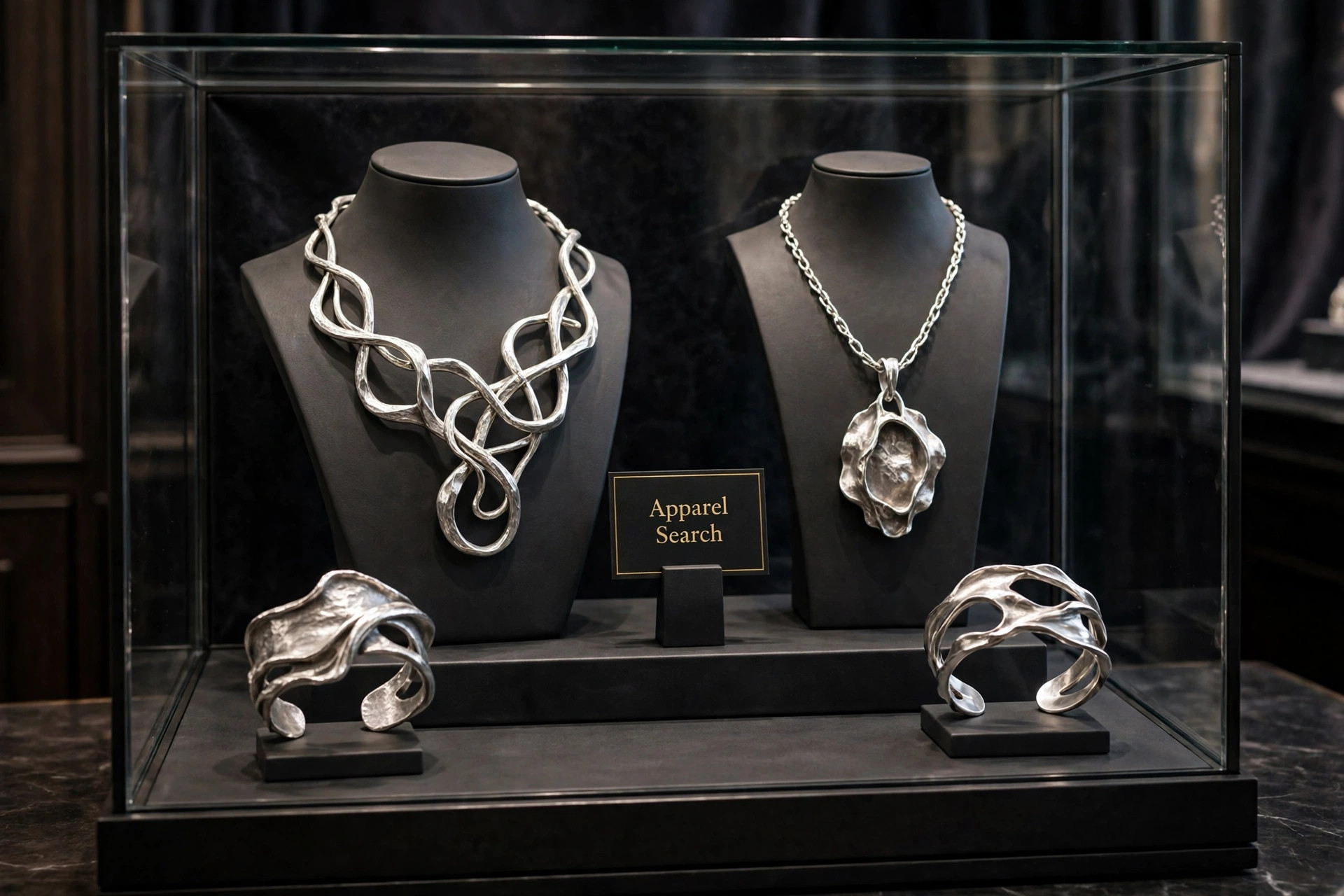
Illustrative image created for this guide — an artistic impression, not this designer's own garments.
Jewelry Meant to Be Worn
Most fine jewelry of her era was designed for the evening and the vault. Peretti designed for the day: silver — a metal then treated as minor — shaped into forms with the seriousness usually reserved for gold and stones, and finished so smoothly that a heavy cuff or a long pendant could be worn from morning to night. The method is the message: jewelry shaped by hand and eye — forms drawn from nature and from the body itself, finished smooth so a piece rests against the skin as if it had always belonged there. A Peretti piece does not sit on the body like a trophy; it settles onto it like clothing, which is why her fashion training matters to the jewelry record — she had worn jewelry professionally before she ever designed it.
The forms themselves come from close looking at natural things — stones smoothed by water, shells, beans, the curve of a bone — translated into silver with nothing added and nothing wasted. That economy is what makes the work recognizable at a glance and difficult to imitate in spirit: any workshop can copy a silhouette, but the restraint behind it, the decision of exactly where a form should stop, is the designer's own.
The Jewelry Record in This Guide
This page routes the jewelry record by medium — news for the current story, photos and videos for the visual record. The collections page files the designs themselves, seasonless in a way clothing never is: a jewelry design is not replaced each season but kept, reissued and worn for decades, so the filed record reads as an accumulation rather than a sequence of seasons. The profiles page supplies the dates and places the jewelry headlines assume.
Read together, the two main pages divide her record the way her career divided itself: the fashion page for the model and collaborator, this jewelry page for the designer whose name the pieces carry. Both lead to the same collections, news and profiles — one body of work, entered from either side.
Common Questions
What does this Elsa Peretti jewelry page gather?
It is the main jewelry page for her record in this guide: the routes to jewelry news, photos and videos, with links to the fashion main page, the collections page, the news page and the profiles page in her series.
What is Elsa Peretti jewelry known for?
The signature is sculptural sterling silver jewelry in organic, fluid forms — necklaces, cuffs and pendants shaped to sit naturally against the body — pieces designed to be worn every day rather than kept for occasions.
For whom did Elsa Peretti design jewelry?
In New York she designed jewelry for a handful of top designers, including Halston, Giorgio di Sant'Angelo and Tiffany & Co. — the collaborations the profiles page sets out in order.