Ozwald Boateng Profiles
The tailor who brought colour to Savile Row — and tailoring to British Airways.
Ozwald Boateng OBE is a British fashion designer and master tailor whose work changed what a Savile Row suit could look like. Born in London to Ghanaian parents, he kept the structure, discipline and craft of classic British tailoring and fused them with vivid colour, a slimmer silhouette and the influences of his Ghanaian heritage. The result brought a younger generation back to bespoke tailoring at a moment when Savile Row was struggling to attract one, and it carried his name from a Portobello Road studio to Paris Fashion Week, to the menswear creative directorship of Givenchy, and eventually to one of the largest tailoring commissions in Britain: the uniform of British Airways.
This profile follows that career in order: the London childhood and self-directed training that produced the tailor, the breakthrough years that reignited a British institution, the design signature that made his suits instantly recognisable, and the airline uniform that put his tailoring on cabin crew, pilots and airport teams around the world. The biography searches and his official website are gathered in the references below for readers who want to follow the wider coverage.
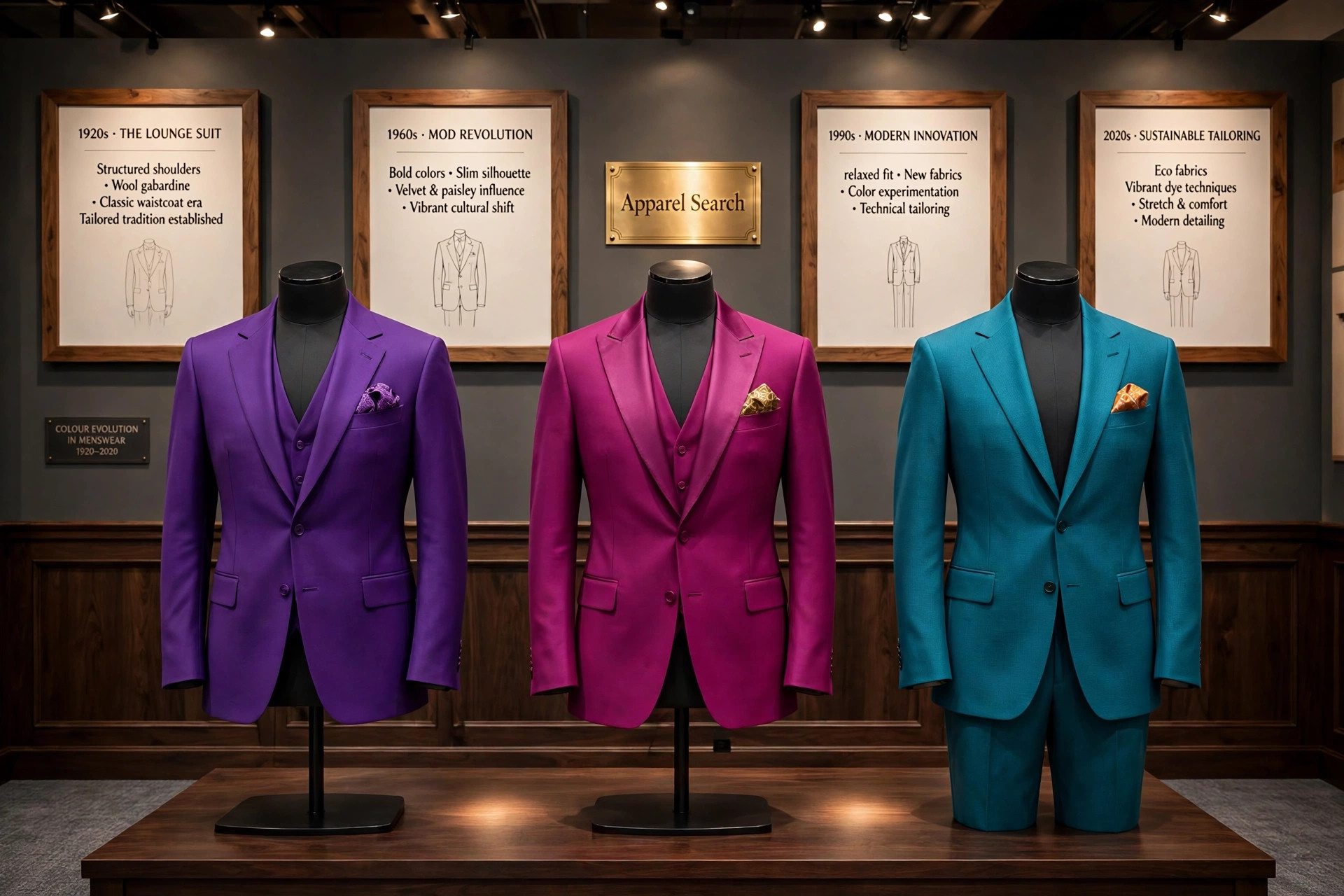
Illustrative image created for this guide — an artistic impression, not this designer's own garments.
Early Life & Training
Boateng was born in north London to Ghanaian parents, and the signs of his future trade were around him from childhood. His father, a teacher, always wore suits, and his mother made the first suit he remembers for him as a small child: a dark purple, double-breasted mohair suit. Purple would become one of the colours most associated with his own tailoring, and the family sewing machine became his first workroom tool. Working from his mother's machine, he created his first collection and sold it to the menswear store Sprint in Covent Garden.
His training was largely self-directed. He began a computing course, left it, and enrolled at Southgate College to study fashion, completing a year-long course that the London Museum describes as the formal part of an otherwise self-taught education. The decisive influence came from Tommy Nutter, the rebel Savile Row tailor whose flamboyant, colourful reinvention of British tailoring in an earlier era struck a chord with the young Boateng and first brought him into the world of Savile Row in the late 1980s. Nutter showed that fashion and the Row's suit-making craft could be combined; Boateng built his career on exactly that combination.
The Career
In his early twenties Boateng set up a design studio on Portobello Road in London, and by 1987 The Face magazine was profiling his approach under the name he gave it himself: 'Structured Classics'. Against the relaxed, loose fit then dominating menswear, he argued for putting structure back into men's suits in line with classic Savile Row tailoring. The breakthrough came in 1994, when he became the first tailor to stage a catwalk show at Paris Fashion Week, using a promotional video as the invitation, something that had never been done before. The critically acclaimed show put the British tailor on the world stage.
The Paris success enabled him to open his first retail store in 1995 on Vigo Street, at the southern end of Savile Row, at the age of 28, the youngest tailor to set up shop on the street. His fusion of traditional British tailoring with a modern design aesthetic and colour from his Ghanaian heritage is credited with re-establishing the street for a modern world and introducing Savile Row to a younger clientele; he was part of the new wave of British tailoring that revived the Row in that decade. He won Best Menswear Designer at the Trophées de la Mode in Paris in 1996 and Best Menswear Designer at the British Fashion Awards in 2000. In May 2002 he opened his first headquarters on Savile Row and marked the occasion, in the Queen's Golden Jubilee year, by closing the street to traffic and staging the first fashion show ever held on the Row itself.
In 2003 Bernard Arnault appointed him Creative Director for menswear at the French fashion house Givenchy, and his first Givenchy collection was presented in Paris in 2004. In 2005 the Victoria and Albert Museum marked his career with a Fashion in Motion exhibition, an honour given to only a handful of designers, with its curator crediting him with revolutionising Savile Row by fusing traditional tailoring skills and expert cutting with a very modern use of colour. In 2006 he was awarded an OBE by the Queen in her New Year Honours, as an Officer of the Order of the British Empire, for services to the clothing industry. In 2007 he opened his flagship store and headquarters at 30 Savile Row, designed with architect David Adjaye.
Design Signature
Boateng's signature begins with the cut. His suits are structured and sharply tailored, with a sleek, slim silhouette that refines the shape of the wearer rather than relaxing it, the 'Structured Classics' idea he named as a young designer. Onto that traditional Savile Row foundation he lays the element that made his windows stand out among the grey, black, white and navy of the Row: colour. Vivid cloth, bold linings and jewel tones run through his tailoring, an instinctive use of colour that his official history traces to his Ghanaian heritage, later expressed openly in Kente cloth and Adinkra symbols in his runway work.
The combination is the point. Traditional bespoke technique applied to boldly coloured fabric is how the London Museum summarises his impact, a synergy of Anglophilia and Ghanaian heritage. Colour in his work is never decoration pasted onto a conventional suit; it is cut with the same discipline as the cloth itself, which is why the same hand could move from bespoke suits for film stars to a national airline's working wardrobe without changing its principles.
The British Airways Uniform
British Airways commissioned Boateng in 2018 to design its new uniform, and he spent the years that followed developing the collection from inside the airline's working life, shadowing airport roles to understand how each uniform needed to perform and involving colleagues across the business in design workshops, prototype feedback and wearer trials. The collection was unveiled on 6 January 2023, the airline's first new uniform in nearly two decades, replacing the uniform designed by Julien Macdonald. His engineers and ground operations colleagues wore it first, from spring 2023, with cabin crew, pilots and check-in agents switching over in summer 2023.
It is a tailor's uniform, not a stylist's. The collection offers 96 garments, the widest choice the airline had offered its people: a tailored three-piece suit with slim or regular fit trousers for men, and for women the option of a dress, skirt or trouser suit, or a modern jumpsuit, an airline first, alongside a tunic and hijab option. Two patterns carry the brand through the tailoring: an airwave pattern, inspired by the movement of air over an aircraft wing, runs across jackets, T-shirts, buttons and ties, while the jacquard fabric of the tailored garments carries a variation of the airline's iconic Speedmarque. Outdoor garments were tested in deluge showers and in freezers at low temperatures so the wardrobe would perform in the climates the airline actually flies to. Read the full garment-by-garment account on the British Airways uniform guide linked below.
Beyond the Uniform
The uniform is one chapter in a wider body of work. Boateng created pieces for Marvel's Black Panther, dressed leading actors for awards seasons and premieres, and in 2019 presented his first full women's collection as part of an immersive show at the Apollo in Harlem. In February 2022 he returned to London Fashion Week at the Savoy Theatre with a celebration of Black British culture, showing bold tailored suits and flowing silks with Kente fabrics and Adinkra symbols. Alongside the fashion work he co-founded the Made in Africa Foundation, dedicated to bringing investment and development finance to African enterprises.
His legacy is the change he made to British tailoring itself. He arrived on Savile Row when its international profile had declined, argued that the suit was a cultural symbol worth reinvigorating rather than abandoning, and proved that a tailor trained on his mother's sewing machine could hold the street's traditions and a new generation's expectations in the same garment. The British Airways uniform extends that argument to its logical end: tailoring as something a whole workforce wears with pride, designed by a tailor who has always insisted that how people feel in their clothes changes how they do their work.
Airline Uniform Designers
Common Questions
Who is Ozwald Boateng?
Ozwald Boateng OBE is a British fashion designer and master tailor, born in London to Ghanaian parents, who brought vivid colour and a slimmer, modern silhouette to Savile Row tailoring and designed the British Airways uniform unveiled in 2023.
What is Ozwald Boateng's design signature?
His signature is the fusion of traditional British tailoring with bold colour drawn from his Ghanaian heritage: structured, sharply cut suits, vivid linings and fabrics, and a refined silhouette that put structure back into menswear.
When did Ozwald Boateng present at Paris Fashion Week?
In 1994, Ozwald Boateng became the first tailor to stage a catwalk show at Paris Fashion Week. The breakthrough led to his first shop, which opened on Vigo Street at the end of Savile Row in 1995, when he was the youngest tailor to set up shop on the street.
What did Ozwald Boateng design for British Airways?
He designed British Airways' new uniform collection, unveiled on 6 January 2023 after development that began in 2018. The collection replaced the Julien Macdonald uniform, offered 96 garments including an airline-first jumpsuit option, and carried an airwave pattern and a Speedmarque jacquard across the tailored pieces.